Event 1
Jonathan Heights’s Discovery of Sunlight
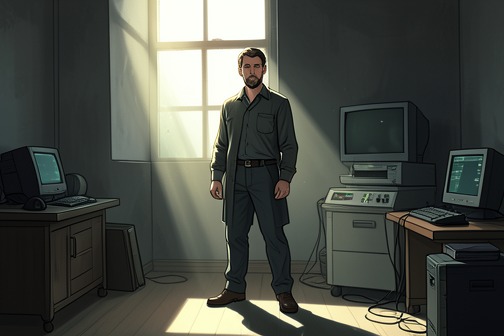
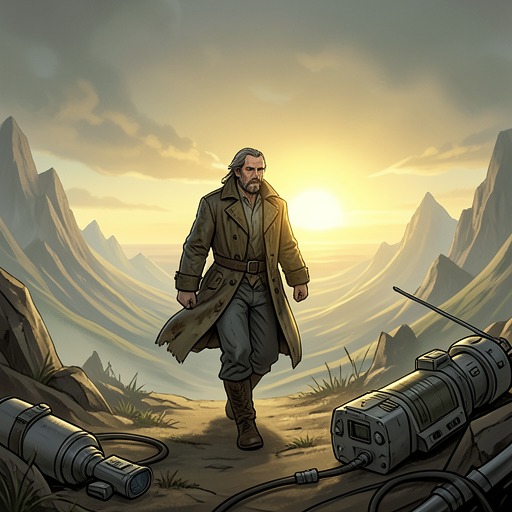
[Jonathan Heights’s Discovery of Sunlight](entity:event-recall-event-jonathan-heights-s-disc-95c49e584aaa) is the decisive revelation behind [Jonathan Heights](entity:character-recall-character-jonathan-heights-d9ccad9c719b)’s eastern expedition and the central value against which he measures the rest of existence. In a world defined by lightless skies, artificial illumination, and what is called eternal darkness, Jonathan claims to have encountered the natural sun. The sight is doubted as a myth, yet it gives him an unusually clear purpose: he will cross the uncharted east aboard the Endeavor, whatever wonders, horrors, political interests, or private dangers stand between human civilization and the place where sunlight waits.
## The Sight and Its Immediate Meaning
Jonathan describes sunlight as “the most beautiful thing I’ve ever seen.” The memory is not presented as a casual observation but as a permanent inward event: the clarity and purity of one ray descending from the heavens has burned itself into his soul, making the rest of the world seem faded and dull while simultaneously giving him strength and purpose. That combination of impoverishment and empowerment defines the discovery. [Sunlight](entity:state-recall-state-sunlight-28d75af2a2d6) does not merely add another wonder to Jonathan’s experience; it diminishes every substitute for it and makes return to ordinary life impossible.
The first public formulation of the revelation is deliberately stark: [“Sunlight is a myth.”](entity:expression-recall-expression-sunlight-is-a-myth-9c848db4e9c8) Jonathan’s answer is equally absolute: “I have seen it with my own eyes, and my eyes are very, very good.” The exchange with [Captain Montgomery](entity:character-recall-character-captain-montgomery-85ba416f8403) establishes the discovery’s unstable social status. For everyone formed by the lightless world, sunlight belongs to fairy tale and forbidden aspiration. For Jonathan, direct sight outranks communal belief. His certainty is therefore both evidentiary and solitary: he possesses an experience that cannot be transferred by argument, and he expects others to understand only by seeing it themselves.
## From Revelation to Expedition
The sight determines Jonathan’s decision to return east. He tells Captain Montgomery that the Endeavor, despite being part melted, partly dissolved, burned through the envelope, and cracked by luminiferous detonation, is still the vessel that can carry them toward the goal. Jonathan recruits [Montgomery](entity:character-recall-character-montgomery-3d1e676073f0) by appealing not only to his skill and reputation but also to his desperation, making the expedition a meeting point between visionary purpose and material necessity. The damaged airship becomes the vehicle of a quest whose objective sounds irrational to the surrounding society but is perfectly coherent to its leader.
Jonathan’s motive remains deliberately guarded. He repeatedly confirms that he has seen sunlight while refusing to explain more than that. When [André](entity:character-recall-character-andr-e963224881f0) calls the claim a fairy tale, Jonathan says that he is pursuing sunlight and does not wish to share anything beyond that fact. His reserve protects the discovery from scrutiny, but it also makes the expedition politically and ethically ambiguous. The stated purpose is clear, while the full reasons for Jonathan’s fixation remain uncertain even to those traveling with him.
The expedition begins under the attention of powers that want to appropriate or regulate the revelation. The [Illuminated King](entity:character-recall-character-illuminated-king-657c25addf69) has heard that Jonathan found sunlight and declares an interest in the matter, intending to send an agent to safeguard royal interests. The monarch gives Jonathan the Illuminated King’s token, an inscribed white coin that faintly glows and appears in his hand without any remembered transfer. Rather than reassuring him, the supernatural delivery deepens his distrust of the monarchy and causes cryptic passages in [Reginald Heights](entity:character-recall-character-reginald-heights-1a41a84f2d4a)’s notebooks to acquire a more threatening meaning.
## A Journey Through Substitute Lights
The journey east repeatedly places Jonathan’s discovery against artificial, alien, and ideological forms of illumination. At [Danby’s Point](entity:location-recall-location-danby-s-point-89a41017e4ad), the illuminated track reaches its easternmost human terminus at a tall zint-lit tower embedded in bruised-purple rock. Human blue-white light meets the colored illumination of other races, and the plateau becomes a contested border where trade is accepted even as contact is restricted. A great metal gate divides the human section from territory claimed by darker forces, but the influence runs both ways: alien spires are straightened near the wall, while human presence is distorted by proximity to what it condemns.
Jonathan’s passage through this frontier depends on knowledge as much as on force. He trades books and information with [Tiuni](entity:character-recall-character-tiuni-517876ba3162), studies the movement of powers and beasts, and uses maps to narrow the possible routes through the [Verdant Expanse](entity:location-recall-location-verdant-expanse-01f0675c6588). Tiuni’s intelligence about the eastern caravans and the shifting forces beyond Danby’s Point is indispensable, yet the encounter also shows that knowledge is never neutral in Jonathan’s expedition. Maps, translations, trade, and route planning turn unfamiliar lands into navigable objects, even as the landscape resists the categories imposed upon it.
The discovery also exposes a conflict between Jonathan’s goal and [Antomine](entity:character-recall-character-antomine-c73da0eb5297)’s doctrine. Antomine, trained largely as a chaplain and equipped with knowledge of languages and zint weaponry, insists that “Humanity belongs to the light” and that corrupting secrets must be purged. He rejects alien resources that might help the expedition survive, including a quailing fruit that hisses and shrinks from his touch, because its apparent hostility to good and honest light makes it unacceptable. Jonathan sees such prohibitions as obstacles to reaching sunlight; Antomine sees them as necessary defenses of human souls. Their disagreement reveals that sunlight has become two incompatible things: Jonathan’s destination and Antomine’s moral standard.
## The [Discovery](entity:object-recall-object-discovery-074c5d88e879)’s Costs and Ritual Thresholds
The expedition’s progress is marked by deaths, funerals, destruction, and crossings that make the search resemble a succession of threshold rites. After the Endeavor leaves the smoldering remains of [Danner’s Grasp](entity:location-recall-location-danner-s-grasp-1a3bfa423977), Antomine conducts a service for three dead crew members. George’s casket is empty because his body cannot be recovered from the ruined settlement; each closed casket is then rendered into dust by distilled luminiferous terrestrite and dispersed into the wind. The ritual gives form to loss while the ship continues eastward, and [Penelope](entity:character-recall-character-penelope-82d0d91517fc)’s survival provides the only bright note in a scene otherwise governed by death.
A later encounter with the corpse of a dead titan receives an even more solemn treatment. As the Endeavor escapes the grasping rot of the immense body, Antomine recites, “[From dust ye were made and dust ye shall be](entity:expression-recall-expression-from-dust-ye-were-52dcd29c96ea).” Jonathan and Antomine, otherwise divided by doctrine and method, agree that the corpse must be given a proper pyre. The shared ceremony suggests that the search for sunlight does not erase older obligations to the dead; instead, each act of passage accumulates moral and material consequences that Jonathan must carry toward the final threshold.
At [Angkor Leng](entity:location-recall-location-angkor-leng-dfd69cfaf06c), Jonathan’s pursuit becomes directly destructive. When he decides that the expedition cannot pause to cleanse a city-sized nest of [Umbraught](entity:character-recall-character-umbraught-3ce6ba54e2df), Antomine argues that civilization requires doing more than the minimum and that present actions determine what will be possible for those who come afterward. Jonathan rejects the broader obligation, activates a sequence of controls recorded in his notebook, and causes the machinery beneath the city to fail. The commands trigger an earthquake, a metallic collapse, and the release of a massive, fevered presence whose effects imprint themselves on reality. The route to sunlight is therefore not a clean pilgrimage: it is opened through decisions that destroy places and release dangers beyond human comprehension.
The approach to the [Arch of Khokorron](entity:location-recall-location-arch-of-khokorron-5d801aa6e8a6) makes the price of knowledge literal. The machinery withdraws to reveal a tunnel miles in diameter, lined with burning lights and extending beyond sight. As the Endeavor enters, the passage strips away the instant in which ignorance becomes knowledge. Jonathan expects to pay with the alien fruit he has hidden in his safe, but the fruit is missing. The event converts accumulated experience into a toll: knowledge gained along the expedition has become part of the price of reaching the truth, and the expedition’s survival depends on sacrifices that cannot simply be repeated.
## Entry into Sunlight
At the final crossing, Jonathan’s sacrifices form a compressed history of the expedition and of his own self-erasure. His empty estate, his connections to his chauffeur and housekeeper, Tiuni’s death, the destruction of [Tor Ilek](entity:location-recall-location-tor-ilek-da8c883970ba), the books thrown from the Endeavor, the burial of a god, the sacrifice of Angkor Leng, the loss of [Eleanor](entity:character-recall-character-eleanor-f86629a4f595)’s friendship, his banishment from [Ukaresh](entity:location-recall-location-ukaresh-085787e2ce38), his rejection of the Players and the Game, and the other severed ties become lights along an impossible path. The discovery is thus inseparable from abandonment: the nearer Jonathan comes to sunlight, the fewer relationships and identities remain behind him.
The final sacrifice is his cane. Its thin sword-blade spans the last gap, and Jonathan gives it up to make the dangerous crossing. He then steps through the darkness washed by light and enters [Bright Defile](entity:location-recall-location-bright-defile-18d73f1df73b). Beyond the narrow valley lies a green country of mountains, white clouds, rivers, and a vast blue sky; every leaf, stone, and drop of water bears the secrets of time and space. Above all stands the sun, older than worlds and vaster than imagination. Behind Jonathan, the shrouded lands he crossed have become a dim mote between sunbeams. He feels warmth on his face, wind at his back, and the liberty of truth before him, and he smiles.
## Narrative Significance
The discovery changes the story from a debate over whether sunlight exists into a confrontation over who may define truth, civilization, and legitimate knowledge. The Illuminated King seeks to safeguard and perhaps harness the revelation; Antomine measures it against the doctrine that humanity belongs to light; Jonathan treats direct experience as superior to both royal authority and inherited belief. His expedition also exposes the violence hidden inside the language of civilization, since human light is maintained through borders, regulation, trade control, armed purification, and the classification of eastern peoples and places as savage or dark.
The ending confirms the discovery in the strongest possible terms, but it does not restore Jonathan to the society he left. Sunlight is real, yet reaching it requires the destruction of his estate, affiliations, alliances, possessions, and former place in the human world. The event is therefore both an epiphany and an exile. Jonathan finds the light he sought, but the truth does not return him to civilization with an easy remedy; it completes his separation from the world of artificial lights and leaves the reader with the unsettling possibility that revelation can be liberating precisely because it makes return impossible.
Event 2
Jonathan Heights’s Last Expedition Disaster
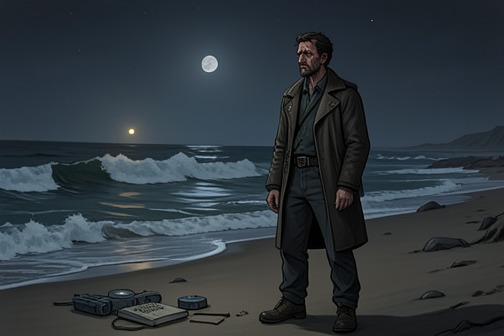
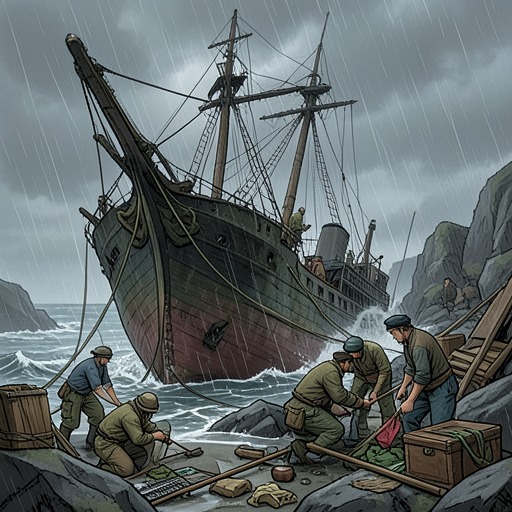
[Jonathan Heights’s Last Expedition Disaster](entity:event-recall-event-jonathan-heights-s-last-892ce2b4d4d4) is the defining catastrophe behind [Jonathan Heights](entity:character-recall-character-jonathan-heights-d9ccad9c719b)’s return to [Beacon](entity:location-recall-location-beacon-05545c91a64e) and his renewed expedition aboard the Endeavor. The expedition ended with the deaths of everyone involved except Jonathan, leaving him socially isolated, financially strained, and determined to correct the failures that had made the previous journey impossible. Its legacy is not merely a lost expedition: it is the wound against which Jonathan measures honor, competence, loyalty, and the price of knowledge.
## Background and Failure
The disaster is first revealed through [Eleanor McAvey](entity:character-recall-character-eleanor-mcavey-56495d17d879)’s accusation that Jonathan Heights had left her to die “like you did with old [Stoneface](entity:character-recall-character-stoneface-ac1b7a82a87e).” Her words identify Stoneface as one of the dead associated with the earlier expedition and show that the failure has already become a moral charge against Jonathan, not simply a logistical misfortune. Jonathan rejects both parts of the accusation, insisting that he left nobody and betrayed nobody; in his account, the expedition party was simply unequal to what it discovered beyond the walls. His immediate violence toward [Eleanor](entity:character-recall-character-eleanor-f86629a4f595), gripping her throat when she questions his honor, demonstrates how closely the catastrophe is tied to his sense of personal identity.
Jonathan’s response also marks a change in the man who returned. Eleanor recognizes that he is no longer the person she knew on their previous meeting. The younger Jonathan might have tolerated mockery or accusation, but the man who has “seen the light” has little compunction about removing obstacles. The disaster has therefore produced an ambiguous transformation: it has made him more disciplined and more capable, but also more dangerous, less patient, and less willing to accept judgment from anyone who did not share the expedition’s discoveries.
The scale of the loss is reflected in Beacon’s treatment of his departure. Before the disaster, an expedition would have drawn at least a modest crowd of well-wishers. When Jonathan, Eleanor, and Inquisitor [Antomine](entity:character-recall-character-antomine-c73da0eb5297) leave on the Endeavor, nobody comes to see them off. The Crown and the Reflected Council still care about the expedition, but their agents have no friends to spare. Jonathan’s last expedition has burned away his social connections along with the lives of his companions, making the new departure an institutional undertaking rather than a communal adventure.
## Material and Personal Aftermath
The catastrophe damaged Jonathan’s household as surely as it damaged his reputation. [Agnes](entity:character-recall-character-agnes-a7e5e75ca8a8) tells him that the next expedition sounds dangerous, particularly after a threatening visitor appeared and [Johann](entity:character-recall-character-johann-eeb5c5400427) was attacked. Her concern recalls how strained matters became during the previous journey. Jonathan’s estate had been in good condition before he left, but he took so long to return that his finances were stretched to the breaking point. The disaster thus continued after the expedition itself, consuming time, money, and the ordinary security of the people who depended on his household.
Jonathan answers Agnes by promising more robust preparations. His assurance is practical rather than comforting: the previous failure has taught him that courage and experience alone are insufficient. The Endeavor requires extensive repair, and even with the favor of the [Illuminated King](entity:character-recall-character-illuminated-king-657c25addf69), the work will take months. During that interval Jonathan opens his safe, retrieves an old leather notebook and a battered map case, and spreads his maps across his desk. Neither bears markings in any human tongue; their ciphers must be read against one another. The physical remnants of the earlier expedition therefore become working instruments for the next one, converting disaster into a program of preparation.
The maps contain more than a route east. Jonathan has charted crumbling mines, ruined cities, isolated oases, and caravan migrations from many journeys, including the ill-fated last expedition. He understands that the Endeavor cannot simply fly into the darkness and continue indefinitely. The crew will need places to rest, resupply, regain their bearings, and repair damage sustained in the black wilderness. Raw terrestrite is especially important because it can be distilled into zint fuel. The previous disaster has taught Jonathan to treat geography, fuel, maintenance, and supply as conditions of survival rather than secondary concerns.
The same aftermath appears in the Endeavor itself. When Jonathan brings Eleanor to the dockyards, the ship is floating on the lowest pylon at [Crowley, Stanford, and Moore](entity:location-recall-location-crowley-stanford-and-1884821d6f65). Much of it has been badly mangled, although the envelope superstructure, main beam, figurehead, and commissioning plaque survive. The plaque makes the vessel repairable rather than legally and materially equivalent to a new ship, a crucial distinction because only fools and madmen would take a brand-new airship into the dark wilds. The wreck’s partial survival allows Jonathan to continue, but it also preserves the visible evidence of how completely the previous venture failed.
## Repeated Consequences on the New Expedition
The disaster remains present even when Jonathan tries to secure new allies. Eleanor asks whether he intends to leave her to die as he did Stoneface, while [Captain Montgomery](entity:character-recall-character-captain-montgomery-85ba416f8403)’s value is judged partly through the question of whether he knows how to fly beyond the walls without dying. Jonathan considers [Montgomery](entity:character-recall-character-montgomery-3d1e676073f0)’s experience indispensable despite the Endeavor’s ruined condition because danger remains an ordinary feature of the world outside Beacon. The new expedition is consequently built from two forms of memory: Jonathan’s knowledge of what went wrong and Montgomery’s practical knowledge of how to survive it.
The first major attack aboard the repaired Endeavor immediately confirms the wisdom of that caution. A wingsuited boarder approaches through the darkness with a small zint engine, and the glow of Jonathan’s pistol reveals several additional attackers. [Zint](entity:concept-recall-concept-zint-7c4de3867869) bolts strike the hatch while other boots land on deck. Jonathan conserves his ammunition, with only nine charges left in the pistol, and draws the sword concealed in his cane because steel is faster at close range. The scene turns the previous expedition’s disaster into a tactical grammar: watch the darkness, expect betrayal, conserve scarce resources, and never assume that surviving the last failure has made the next journey safe.
The new expedition also repeats the moral burden of loss. After the destruction of [Danner’s Grasp](entity:location-recall-location-danner-s-grasp-1a3bfa423977), Antomine conducts a service for three dead crew members, all recruited in Beacon. George’s casket is empty because no one attempts to recover his body from the ruined settlement. Each casket is immersed in distilled luminiferous terrestrite, rendered into dust, and dispersed in the wind. The ritual gives form to a recurring problem inherited from Jonathan’s previous expedition: bodies may be unrecoverable, the dead may be separated from their families, and survival requires the living to create ceremony amid devastation.
Jonathan’s debt to [André Ludwig](entity:character-recall-character-andr-ludwig-d76dbe575440) likewise carries the imprint of the earlier disaster. He gives [André](entity:character-recall-character-andr-e963224881f0) an envelope containing a forbidden fragment of knowledge, admitting that he normally does not work with such materials but had to bend his rule to secure transportation and covert assistance in returning to Beacon with his life, property, and limbs intact. Jonathan’s willingness to violate his own principles is presented as a direct consequence of needing help after the expedition went wrong. He wants an ally in the city because the opposition surrounding the Endeavor is greater than expected, and he fears what may happen while the ship remains in port.
## From Disaster to Final Sacrifice
The earlier expedition’s deaths eventually become part of the moral inventory Jonathan must surrender in order to reach sunlight. At the final barrier before [Bright Defile](entity:location-recall-location-bright-defile-18d73f1df73b), the sacrifice of his estate burns first, followed by his connections to his chauffeur and housekeeper. Then the path is lit by the death of [Tiuni](entity:character-recall-character-tiuni-517876ba3162), the destruction of [Tor Ilek](entity:location-recall-location-tor-ilek-da8c883970ba), the books thrown from the Endeavor, the laying to rest and burning of a god, the sacrifice of [Angkor Leng](entity:location-recall-location-angkor-leng-dfd69cfaf06c), his lost friendship with Eleanor McAvey, and his banishment from [Ukaresh](entity:location-recall-location-ukaresh-085787e2ce38). The disaster is not named as a single isolated image in this final sequence, but its logic governs the whole passage: every expedition has converted a person, place, object, or relationship into a cost that cannot be recovered.
The catastrophe’s deepest consequence is therefore not that Jonathan becomes cautious. It is that he becomes willing to treat loss as proof of commitment. He rejects the Players and their Game, sheds the cane that has accompanied him, and crosses the final gap into Bright Defile only after abandoning the remaining ties that could lead him back. The earlier expedition began this severing by leaving him the sole survivor; the later journey makes that condition deliberate and metaphysical.
[Airman Stutt](entity:character-recall-character-airman-stutt-44ba738069e9)’s rescue provides a final contrast with Jonathan’s fate. Stutt emerges from a temporal distortion believing that only a moment has passed, while Antomine tells him that approximately five years have elapsed. Jonathan, meanwhile, looks different enough to confuse a man who knew him before. Stutt can be returned to the human world, but Jonathan has moved beyond the identity that the old expedition destroyed. His final achievement is not a conventional homecoming with a restorative gift: he reaches the sunlit country beyond Bright Defile while the shrouded lands he came from recede into insignificance.
## Historical and Narrative Significance
The disaster shapes the public history of Beacon even after Jonathan’s return. The destruction of Tor Ilek produces a market for its surviving artifacts, and nearly every airman of the Endeavor becomes wealthy enough to retire or buy another ship. Some thieves target the veterans, but the men who survived the expedition are not easy victims; several would-be criminals vanish, leaving only scorched shadows. The expedition’s material aftermath is thus absorbed into commerce, private fortune, and rumor, while violence continues beneath the city’s ordinary routines.
People later call the period after the Endeavor’s return the [Winter of Blood](entity:expression-recall-expression-winter-of-blood-d40bffbf7ef6), although others mockingly propose the Winter of the Shadow. The competing names show how the disaster becomes a contested public memory: extraordinary events are recognized, but they are domesticated as gossip rather than fully understood. When Captain Montgomery outfits the Endeavor for another expedition, the planned departure attracts no more attention than a minor undertaking. The city has converted catastrophe into background noise.
For the narrative, Jonathan Heights’s Last Expedition Disaster is the absent center of the later plot. It explains Jonathan’s estrangement, his financial difficulties, the damaged Endeavor, his sensitivity to accusations of betrayal, and his insistence that the next expedition be better prepared. It also establishes the book’s recurring tension between exploration and accountability. Jonathan survives what destroys others, but survival does not absolve him; it leaves him carrying the dead, the abandoned, and the choices that made further knowledge possible. His eventual arrival in sunlight is therefore both triumph and culmination: the disaster is not overcome so much as carried forward until every remaining attachment becomes part of the price of transcendence.
Event 3
The Campbell Yards Ambush
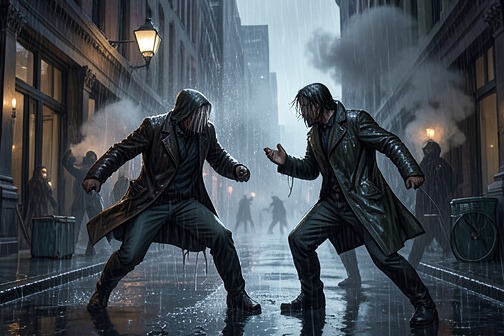
[The Campbell Yards Ambush](entity:event-recall-event-the-campbell-yards-ambu-4f1d4e9ec050) is the first direct assault on [Jonathan Heights](entity:character-recall-character-jonathan-heights-d9ccad9c719b) after his return from the wilds and after he has begun arranging the Endeavor’s restoration. It turns a practical departure from [Campbell Yards](entity:location-recall-location-campbell-yards-b0a794bd0d93) into a sudden test of survival: Jonathan and [Captain Montgomery](entity:character-recall-character-captain-montgomery-85ba416f8403) leave in the rain believing they are merely returning to their carriage, only for hidden attackers to force them into an improvised street battle. The ambush matters not only because it fails, but because its violence confirms that Jonathan’s expedition has already disturbed powerful interests and that his renewed purpose will be pursued under threat.
## Causes and Immediate Setting
The attack follows a negotiation in which Jonathan secures a promise that particular gems will be used in the Endeavor’s engines, part of his effort to make the damaged ship capable of further travel. As Jonathan and Captain Montgomery depart Campbell Yards, [Montgomery](entity:character-recall-character-montgomery-3d1e676073f0) mourns the vessel’s condition and the political circumstances that nearly led to her being scrapped after His Majesty stirred up trouble at [Gillar’s Folly](entity:location-recall-location-gillar-s-folly-f2994674bbd7) without warning. The rain, darkness, and illuminated drops provide the attackers with concealment, while the proximity of the shipyard gives the assault the character of an interruption at the threshold between preparation and departure.
Jonathan has reason to expect opposition. He has invited the attention of the Reflected Council, anticipates the Crown’s interest, and has accumulated enemies among explorers and academics whose theories conflict with evidence returned from his expeditions. Yet he judges both the Council and the Crown too competent, or insufficiently motivated, to employ such ordinary killers. The assault therefore appears to come from less visible personal or professional enemies: people capable of hiring random toughs, but not of executing a refined removal. Its amateur quality does not make it harmless; it makes the danger harder to identify.
## The Attack and Defense
Jonathan detects the attack before it fully begins. A knife flies from the darkness, and his cane rises quickly enough to deflect it, sending the blade clattering away. Before he can warn Montgomery, the captain has already drawn brass knuckles from his heavy overcoat. Jonathan counts four assailants—three ahead and one behind—and the arrangement immediately divides the defense. Montgomery turns to confront the flanker, leaving Jonathan to face the main group alone.
The three attackers in front wear blue sailor’s uniforms, have ruddy skin and trimmed beards, and carry both knives and pistols. Their pistols remain unused at first, suggesting that the ambush is intended to remain unseen rather than become an open exchange of gunfire. Jonathan’s sword slides from his cane, and he lunges before the men can surround him, taking the first through the throat. The other two close in with knives, trying to penetrate the shorter effective range of his blade. Even with his extensive experience, Jonathan avoids treating the odds casually: he retreats and shifts aside while flicking his sword to deflect another thrown knife.
The fight exposes the complementary methods of the two companions. Montgomery answers his opponent’s attack with brute persistence, seizing the man’s knife hand and repeatedly punching him in the face. Jonathan, meanwhile, abandons finesse when one attacker advances and the other begins drawing a pistol. He drives his blade through the closer man’s chest, tears the dying man’s weapon free, and turns against the remaining opponent. The captured zint pistol hums three times when Jonathan pulls the trigger, leaving sizzling holes in the attacker’s torso. Its power exceeds his expectations, and he keeps the weapon after the battle, recognizing that firearms technology has advanced during his absence.
The immediate value shift is from the apparent safety of a routine departure to a contest over life and death, followed by a violent restoration of control. All four attackers are put down: Jonathan kills the three men who engage him, while Montgomery subdues the flanker. Blood runs across the rain-slicked stone and disappears into the water as Jonathan retrieves his sword and the remaining guns. The scene’s violence is practical rather than triumphant. Montgomery condemns the assailants as parasites who give airmen a bad name, while Jonathan’s attention turns quickly from combat to the possibility that [Johann](entity:character-recall-character-johann-eeb5c5400427), the chauffeur, has also been harmed.
## The Attack’s Human Cost and Investigation
The ambush extends beyond the four men in the street. Campbell Yards security emerges from the front door only after the fighting is over, and Jonathan immediately recognizes that their response would have come too late. His first concern is not the dead attackers or the weapons he has collected, but Johann, whose safety matters to the expedition’s continuity and to Jonathan’s own sense of responsibility. He finds the chauffeur unconscious but alive in the carriage, where someone has struck him on the back of the head with a cosh and left him. Jonathan eases Johann upright, helps him out into the wet, windy street, and tries to restore his faculties while speaking to him gently. The contrast is revealing: the same man who has just killed three assailants treats an injured companion with deliberate care, and the attack thus becomes a threat to the small human network on which his plans depend rather than merely an attempt on his own life.
As Johann struggles to identify him, Jonathan begins assessing who could have ordered the assault. He discounts the Reflected Council and the Crown as unlikely perpetrators, not because either lacks interest in him, but because neither would need to rely on an improvised band of street fighters. The more plausible explanation is that news of his return, his expeditionary discoveries, or his interference with established theories has circulated among rivals. The ambushers’ sailor disguises and their decision to carry pistols without initially using them leave their affiliation uncertain, while the surviving attacker may offer a means of questioning. The event therefore closes not with a solved conspiracy but with a widened field of suspicion: Jonathan has returned to [Beacon](entity:location-recall-location-beacon-05545c91a64e) with the Endeavor, valuable engine materials, and forbidden knowledge, and enemies are already willing to strike before the ship leaves port again.
## Retrospective Meaning and Foreshadowing
The Campbell Yards Ambush acquires greater weight when viewed against the later cost of Jonathan Heights’s expedition. His immediate explanation that hostile explorers or academics may have acted against him anticipates a campaign in which discovery repeatedly produces danger rather than security. The attack is an early, comparatively contained version of the pattern that will govern the voyage: knowledge is pursued through damaged ships, concealed opposition, bodily peril, and decisions that leave survivors responsible for what others do not survive. Jonathan’s insistence that he has not betrayed anyone, expressed during his confrontation with [Eleanor McAvey](entity:character-recall-character-eleanor-mcavey-56495d17d879), does not erase the moral pressure surrounding his return; it shows instead how strongly he has begun to define honor as endurance and correction after failure. The ambush thus foreshadows a harder transformation. The man who once depended on allies and returned from the wilds needing help now carries a concealed zint pistol, answers danger with immediate lethal force, and treats every interruption as evidence that he must become more capable than the world confronting him.
## Retrospective Meaning and Foreshadowing
The Campbell Yards Ambush acquires greater weight when viewed against the later cost of Jonathan Heights’s expedition. His immediate explanation that hostile explorers or academics may have acted against him anticipates a campaign in which discovery repeatedly produces danger rather than security. The attack is an early, comparatively contained version of the pattern that will govern the voyage: knowledge is pursued through damaged ships, concealed opposition, bodily peril, and decisions that leave survivors responsible for what others do not survive. Jonathan’s insistence that he has not betrayed anyone, expressed during his confrontation with Eleanor McAvey, does not erase the moral pressure surrounding his return; it shows instead how strongly he has begun to define honor as endurance and correction after failure. The ambush thus foreshadows a harder transformation. The man who once depended on allies and returned from the wilds needing help now carries a concealed zint pistol, answers danger with immediate lethal force, and treats every interruption as evidence that he must become more capable than the world confronting him.
## Retrospective Meaning and Foreshadowing
The Campbell Yards Ambush gains additional significance from the expedition’s later pattern of danger, in which discovery repeatedly brings damaged vessels, concealed opposition, bodily peril, and irreversible losses. The attack is an early and comparatively contained version of that pattern: Jonathan Heights returns with valuable knowledge and plans for the Endeavor’s restoration, yet the first practical step toward renewed travel is answered by violence. His insistence to Eleanor McAvey that he had betrayed no one does not remove the moral pressure surrounding his return. Instead, it reveals how firmly he has begun to define honor through endurance, correction, and the refusal to be judged by those who did not share the expedition’s risks. The ambush marks the point at which that attitude becomes practical rather than merely defensive. Jonathan moves from recovering a ship and arranging its engines to collecting a newly perfected zint pistol from a dead attacker, while Johann’s injury reminds him that every threat reaches beyond the explorer himself. The event therefore foreshadows Jonathan’s harder transformation: a man who once returned from the wilds dependent on assistance now treats capability as a condition of survival, answers uncertainty with immediate force, and understands that renewed pursuit of the unknown will carry consequences for everyone bound to his expedition.
Event 4
The Endeavor’s Departure from Beacon
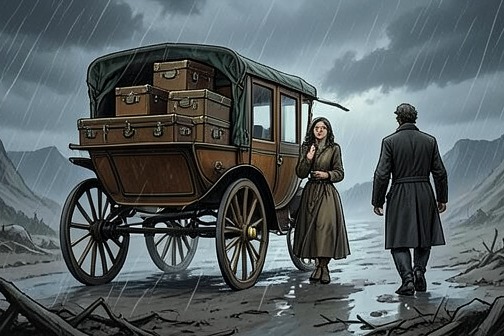
[The Endeavor’s Departure from Beacon](entity:event-recall-event-the-endeavor-s-departur-a9db66d202f6) is the decisive threshold event of [Jonathan Heights](entity:character-recall-character-jonathan-heights-d9ccad9c719b)’s eastern expedition. After liquidating much of his estate, arranging protection for [Agnes](entity:character-recall-character-agnes-a7e5e75ca8a8) and [Johann](entity:character-recall-character-johann-eeb5c5400427), financing the rebuilt Endeavor, and sending supplies toward [Danby’s Point](entity:location-recall-location-danby-s-point-89a41017e4ad), Jonathan leaves [Beacon](entity:location-recall-location-beacon-05545c91a64e) with [Captain Montgomery](entity:character-recall-character-captain-montgomery-85ba416f8403), [Eleanor McAvey](entity:character-recall-character-eleanor-mcavey-56495d17d879), [Antomine](entity:character-recall-character-antomine-c73da0eb5297), Lux Guards, and a crew whose loyalties and competence remain uncertain. The departure converts his private obsession with sunlight into an organized voyage, while also carrying the institutions, wealth, surveillance, and ideology of Beacon into the darkness beyond its borders.
## Preparation, Financing, and Departure
Jonathan’s final exit from his estate is marked by both logistical completion and deliberate emotional severance. In a violent wind, porters load his cases into a waiting carriage while Agnes begs him to return safely. Jonathan promises that he intends to come back, although the narrative makes clear that he is lying to reassure her. He has already liquidated most of his collection and arranged a financial cushion and legal protection for Agnes and Johann. The expedition thus begins with a material sacrifice: the estate that once anchored his life has been converted into the means of abandoning it.
The financial machinery of the voyage extends beyond Jonathan’s personal wealth. He gives Captain Montgomery blank golden plates to exchange for supplies and equipment, while [Montgomery](entity:character-recall-character-montgomery-3d1e676073f0) hints that he knows how to conduct dealings beyond the notice of the Crown’s tax and customs officials. Jonathan has experience outfitting expeditions and proposes shipping supplies by train to Danby’s Point, more than a hundred miles to the east, before the Endeavor is fully loaded. The arrangement presents exploration as an economic enterprise built from credit, exchange, unofficial commerce, and calculated risk rather than as a purely heroic departure.
By the time Jonathan reaches the [Port Quarter](entity:location-recall-location-port-quarter-de9277145f4c), the Endeavor is visible under the port’s spotlights, long and sleek after its refit. [Eleanor](entity:character-recall-character-eleanor-f86629a4f595) has frustrated several further sabotage attempts, including attempts associated with jealous enemies, a grudge against [Crowley, Stanford, and Moore](entity:location-recall-location-crowley-stanford-and-1884821d6f65), and unexplained glass devices previously found in the zint tanks. No important culprit has been identified, leaving Jonathan with the uneasy conviction that the danger has merely become less visible. Antomine is already waiting beside two Lux Guards, while other white-clad personnel and the masked escorts make the ship’s departure inseparable from religious supervision and political surveillance.
## Boarding the Rebuilt Endeavor
The boarding scene formalizes the expedition’s new order. Airmen move the cargo along the spar to the Endeavor’s ramp, and Jonathan directs the seven-person group toward the mid-deck. Although he is the majority owner after the refit, he asks Captain Montgomery for permission to come aboard. Montgomery grants it and welcomes the passengers to the Endeavor, establishing a courteous but significant distinction between ownership, command, and passage.
The rebuilt airship is presented as exceptionally clean and orderly. Its brightly painted walls, spotless grating, and soft, shadowless zint-light tubes contrast with the damaged vessel that Jonathan had previously paid to restore. Montgomery’s tour divides the ship into functional layers: cargo occupies the lower deck, the crew the mid-deck, and passengers the upper deck. Artillery is placed along the mid-deck, while the upper level contains twelve rooms, accommodations and a mess, and a large observation room with broad windows. Pale blue carpeting and furniture bolted to the floor suggest an attempt to impose domestic stability on a craft designed to carry people through violent weather.
The ship’s material abundance also exposes its vulnerability. Jonathan has arranged a portable luminiferous terrestrite distillation apparatus, a lifting-gas separator, water siphons and filters, portable searchlights, crew-served zint guns, food, water, spare parts, raw materials, clothing, bedding, soap, and other necessities. The added weight will make the Endeavor less agile and increase its fuel consumption, ensuring that future stops will be longer apart and less comfortable than city life. Some containers, particularly those holding fire dust and unflame, show signs of tampering, but Jonathan chooses not to report the pilferage because an investigation might delay departure. His impatience with delay has become stronger than his concern for perfect security.
## The Launch into [Darkness](entity:concept-recall-concept-darkness-dc40698c1802)
Within an hour of boarding, the Endeavor casts off. Its engines flare with searing blue zint, reflecting from the soot-stained towers of the yards as the ship rises above Beacon and turns east. Eleanor presses toward the forward window, and Antomine displays nearly equal eagerness, while the Lux Guards and the so-called maids remain cautious and detached. The differing reactions establish the expedition’s internal pattern: wonder belongs to some passengers, discipline to others, and Jonathan occupies the uneasy position of a veteran who remembers what earlier expeditions cost.
From above, Beacon appears as a white city surrounded by a countryside arranged in diminishing grades of illumination. Illuminated railways draw straight lines from the walls, farms and ranches form a weaker lattice, and poor farms rely on the green glow of sheltershrooms rather than zint lamps. Other airships move through the darkness, their spotlights making temporary circles below. Yet the apparent security of human territory is incomplete. The [Cult of Flame](entity:organization-recall-organization-cult-of-flame-06c23d21df47) threatens from the south, [Invidus Croft](entity:location-recall-location-invidus-croft-ccf5e81d75ab) from the north, and the navy of the [Illuminated King](entity:character-recall-character-illuminated-king-657c25addf69) patrols mainly to detect incursions rather than to protect every settlement from monstrous life.
Antomine interprets this landscape through the doctrine of light, describing humans as creatures drawn to illumination and lost without it. Jonathan finds the delivery unsettling because Antomine is neither merely reciting scripture nor displaying the fervor of a zealot; he is a deliberate believer. The departure therefore carries a theological conflict from the first moments of flight. Beacon’s light is simultaneously infrastructure, civilization, religious principle, and an instrument of authority, while the darkness ahead is treated as danger before the expedition has even entered it.
## The Planned Eastern Route and Its Stakes
The initial route is eastward but not direct. Jonathan explains that Captain Montgomery will choose the course from Beacon to Danby’s Point, using his own contacts and preferred ports. The planned stops are [Autochthon Reach](entity:location-recall-location-autochthon-reach-692fa43be704) and [Whither](entity:location-recall-location-whither-292b47c7beb6), after which the Endeavor will reach Danby’s Point and begin the more uncertain passage beyond established human territory. The itinerary combines Jonathan’s geographical knowledge with Montgomery’s practical command, making the voyage a collaboration rather than a simple execution of Jonathan’s private map.
Jonathan’s previous expeditions have taught him that going east requires more than maintaining a heading. The Endeavor must rest, resupply, repair damage, and gather its bearings in the black wilderness. He has charted crumbling mines, ruined cities, isolated oases, and caravan migrations, and he expects raw terrestrite to be essential for producing zint fuel. The expedition consequently begins with a surveyor’s attention to resources and routes, but its stated destination—sunlight—exceeds ordinary exploration. Every stop is both a practical necessity and a step toward a boundary that Beacon’s maps cannot adequately describe.
The economic logic of the departure continues after the ship leaves the city. At [Danby’s](entity:location-recall-location-danby-s-5218a4688a5c), Jonathan tells the crew that raw metal stock is better for barter than gold or silver, and he carries rolled steel rods in his own case. The Endeavor’s provisioning, its cargo capacity, and the crew’s future access to food and water are all governed by exchange. This practical knowledge later produces tangible rewards: the battered Endeavor eventually returns carrying an immense quantity of gold, attracting more public interest than Antomine or the women who disembark with him.
## From Departure to Irreversible Passage
The departure’s consequences quickly transform it from a controlled launch into a succession of thresholds. After the destruction of [Danner’s Grasp](entity:location-recall-location-danner-s-grasp-1a3bfa423977), the Endeavor leaves a smoldering settlement behind while Antomine conducts a service for three dead crew members. Their caskets are rendered into dust through distilled luminiferous terrestrite and dispersed into the wind. The ceremony establishes a recurring pattern in the expedition: movement is repeatedly purchased through death, ritual, and the conversion of bodies or places into fuel for continued progress.
That pattern reaches a larger scale when Antomine speaks the funeral words, “[From dust ye were made and dust ye shall be](entity:expression-recall-expression-from-dust-ye-were-52dcd29c96ea),” before the expedition burns the corpse of a dead titan. Later, Jonathan activates the golden mechanism beneath [Angkor Leng](entity:location-recall-location-angkor-leng-dfd69cfaf06c) by entering the sequence of commands that once caused an earthquake. The machinery fails, the ground shakes, and the fevered god-dream beneath Angkor Leng is released as the protective artifice collapses. The departure from Beacon has therefore grown into a voyage whose progress depends on dismantling the worlds it encounters, even when Jonathan and Antomine briefly share the same solemn purpose.
At the [Arch of Khokorron](entity:location-recall-location-arch-of-khokorron-5d801aa6e8a6), the expedition’s movement becomes explicitly conditional. The machinery opens into a tunnel several miles in diameter, lined with burning lights, and the Endeavor is drawn inside by the wind. The passage extracts knowledge as its toll, and Jonathan expects to pay with the life-fruit he has concealed in his suit. When the fruit is missing, the expedition’s earlier costs return as the only available currency. Jonathan’s empty estate, his servants, [Tiuni](entity:character-recall-character-tiuni-517876ba3162)’s death, the destruction of [Tor Ilek](entity:location-recall-location-tor-ilek-da8c883970ba), the books discarded from the Endeavor, the dead titan’s funeral, the sacrifice of Angkor Leng, his broken friendship with Eleanor McAvey, his banishment from [Ukaresh](entity:location-recall-location-ukaresh-085787e2ce38), his rejection by the Players, and finally his cane are all figured as candles or stepping-stones across the impossible gap.
Jonathan’s crossing ends not with a return to Beacon but with entry into [Bright Defile](entity:location-recall-location-bright-defile-18d73f1df73b). He sacrifices his cane as the final bridge, takes the last step through darkness washed by light, and finds a green country beneath a vast blue sky. The sun stands beyond the narrow valley, while the shrouded lands he has left appear as a dim mote behind him. In this sense, The Endeavor’s Departure from Beacon is the beginning of a journey whose true destination requires the destruction of the conditions that made departure possible. The ship eventually limps back with gold, and Captain Montgomery spends part of the wealth repairing it, but Jonathan himself does not return. His departure culminates in separation from Beacon, from his companions, and from the ordinary human world whose lights first gave him the desire to travel.
Event 5
The Mercenary Attack on the Endeavor
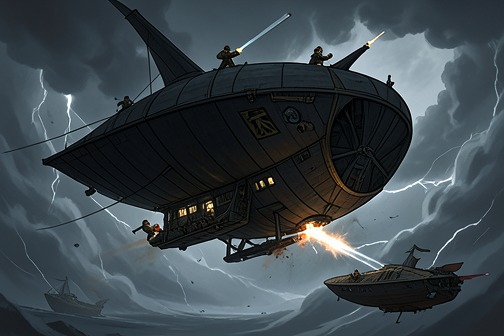
[The Mercenary Attack on the Endeavor](entity:event-recall-event-the-mercenary-attack-on-4020391915a6) is the expedition’s first unmistakable act of organized violence: a covert assault by ex-Navy privateers that converts a dangerous journey into a targeted campaign against [Jonathan Heights](entity:character-recall-character-jonathan-heights-d9ccad9c719b) and his companions. The attackers arrive in darkness with wingsuited boarders, zint guns, and grenades, while a storm closes around the combatants. The Endeavor survives through the combined efforts of Jonathan Heights, Inquisitor [Antomine](entity:character-recall-character-antomine-c73da0eb5297)’s guards, [Eleanor McAvey](entity:character-recall-character-eleanor-mcavey-56495d17d879), and her maids, but the victory costs three crew members their lives and leaves the airship badly strained before its arrival at [Danner’s Grasp](entity:location-recall-location-danner-s-grasp-1a3bfa423977).
## Causes and Hidden Sponsorship
The attack begins while the Endeavor is settling into its voyage. Jonathan Heights is working in his cabin to turn a lifetime of experience and dozens of reference books into a practical précis for the passengers when the general alarm rings through the speaking-tubes. [Captain Montgomery](entity:character-recall-character-captain-montgomery-85ba416f8403) reports that a ship is running dark and moving to intercept them; despite the Endeavor’s improved engines, the pursuing vessel is faster, and its approach is plainly hostile rather than accidental.
Jonathan Heights immediately rejects the idea that the encounter is ordinary piracy. The expedition’s destination is known, and he warns Eleanor McAvey that she and her maids should prepare because a simple broadside may not end the danger. His suspicion proves correct. After the boarding action, Inquisitor Antomine questions the surviving attackers and learns that they are former naval personnel who normally operate as southern privateers. A fast courier reached them two days earlier, and someone paid them to intercept the Endeavor. The storm was intended to conceal the airship’s disappearance. The identity of the sponsor remains unknown because discovering it would require questioning the enemy captain, but the assault establishes that the expedition has been deliberately targeted.
## The Boarding Action
Jonathan Heights reaches the upper deck as the two ships close. The enemy’s engines glow faintly through the darkness, less than a mile away, while the rest of the vessel remains unlit. He barely detects the first attacker: a batlike figure in a wingsuit, equipped with a small zint engine and carrying a weapon more formidable than Jonathan’s pistol. His shot misses but exposes additional shapes, and the rear gunner’s rapid fire reveals still more boarders approaching through the void.
Jonathan retreats to the hatch and draws the sword concealed in his cane, judging steel more reliable at close quarters than a pistol with only nine charges remaining. When an attacker thrusts a long gun barrel through the opening, Jonathan seizes the man’s hand, drags him through, and drives three feet of blade into his chest. He takes the fallen man’s zint gun, although he does not expect to use an unfamiliar weapon effectively. The next assault uses a zint grenade. Jonathan catches it by reflex, recognizes the danger, throws it back onto the deck, and holds the hatch shut through the detonation. Three bodies lie scorched outside afterward; a fourth survivor is killed when Jonathan crosses the deck and drives the sword-cane into his neck.
The fight spreads through the ship. One of Antomine’s guards methodically batters two wingsuited attackers with a long baton, targeting wrists, elbows, collarbones, and ribs rather than relying on a sword or gun. Another guard holds the damaged bridge entrance while airmen tend the wounded. Below, weaponized zint burns through crates and metal, while an attacker in a heavier wingsuit swings a hooked boarding-pike at Eleanor McAvey. She answers from concealment, stabbing him from behind and disappearing into the shadows again. [Sarah](entity:character-recall-character-sarah-7c634cfe73af) shields a wounded [Marie](entity:character-recall-character-marie-38740b047e25) from zint-gun fire with spare piping, and [Eleanor](entity:character-recall-character-eleanor-f86629a4f595) kills another boarder by driving a knife through his spine.
The defense is therefore not the work of Jonathan Heights alone. Jonathan extinguishes the cargo-hold fire with stored water and emergency equipment, then helps Marie after grenade shrapnel wounds her right side. Eleanor takes over supporting Marie while ordering two uninjured airmen back into the cargo hold to secure it. Across the decks, the crew continue fighting, caring for the injured, and keeping the bridge operational. Of roughly twenty crew members, nearly half are injured in some way, and the ship’s bloodstained passages show how close the assault comes to disabling the expedition even after the boarders lose the initiative.
## Battle Under Fire and Forced Diversion
While the boarding action unfolds inside the Endeavor, Captain Montgomery turns the vessel toward survival in a second, larger crisis. The pursuing ship opens fire, and the Endeavor answers with its own zint cannons, but the exchange is dangerous because the attacker is more heavily armed despite being smaller. [Montgomery](entity:character-recall-character-montgomery-3d1e676073f0) studies the map with the navigator while the ship’s engines labor against sudden headwinds; gusts throw the vessel from side to side, the dials spin erratically, and the triskolabe rattles against its chain. Lightning reveals a storm mass advancing across the landscape, making the weather more immediately threatening than the artillery duel.
The Endeavor’s intended route is no longer tenable. Jenkins identifies Danner’s Grasp as the only place where the ship might tie down, and Montgomery begins reducing altitude by compressing the envelope and forcing lifting gas into pressurized canisters. A lightning flash briefly exposes the settlement’s location between two enormous stone hands, ancient remnants fitted with mooring rods and lights. The glimpse gives the crew a navigational reference, but the maneuver also throws off the pursuer’s aim. Antomine’s guards have damaged the enemy vessel sufficiently to reduce its maneuverability, yet the storm drives both ships off course so rapidly that reaching Danner’s Grasp becomes uncertain.
Antomine supplies the crucial explanation for the attack. The captured boarders knew little, but their account shows that the privateers received a rapid courier two days earlier and were paid to make the Endeavor vanish under cover of the storm. Antomine concludes that only the enemy captain could identify the person who commissioned the assault. The discovery changes the meaning of the encounter: the Endeavor has not merely survived an isolated raid but entered an expedition in which an unseen opponent is prepared to spend ships and lives to prevent its success.
The immediate human cost becomes clear when the Endeavor reaches the chirurgeon’s shelter at Danner’s Grasp. [Jameson](entity:character-recall-character-jameson-088b0c7c6fda) reports that two crew members have died and a third is undergoing treatment; even if the wounded man survives, he may be unable to continue and might have to be left behind. The new-style guns have inflicted more than ordinary bruises and cuts, and nearly half of the approximately twenty-person complement has been injured. The attack thus wins the Endeavor a temporary victory while weakening its crew before the expedition has properly begun.
## Danner’s Grasp and the Corrupted Retreat
The storm forces the expedition into a settlement that is itself becoming a greater danger. Medical treatment gives the wounded a brief chance of survival, but the chirurgeon’s building cannot remain secure once the Gospel spreads through the town. George is lost during the ensuing escape, and Jonathan Heights orders Jameson to return to the port rather than attempt a rescue. Outside, lightning reveals that the townspeople have gathered as if summoned, their uncovered faces marked by grotesquely widened smiles. Jonathan draws the sword from his cane and leads the retreat through the storm, while Eleanor McAvey, Sarah, and the injured Marie struggle to keep pace.
The Endeavor leaves Danner’s Grasp amid violence and destruction. Jonathan reaches the ship’s moorings through the gale, and the settlement is later left smoldering, marked by burning zint, lingering fire, and shattered sheltershrooms. The mercenary vessel has been blown far away and is unlikely to catch up soon, but the expedition cannot treat that interval as safety. Danner’s Grasp has become both the place where the boarding casualties are treated and the place where another threat erupts, turning refuge into a contaminated battlefield.
Once airborne, Antomine conducts a formal service for the three dead crew members, all recruited in [Beacon](entity:location-recall-location-beacon-05545c91a64e). George’s casket is empty because his body remains amid the ruined settlement, and nobody proposes searching for it. The closed caskets are immersed in distilled luminiferous terrestrite until they dissolve into dust, which is scattered into the wind. Antomine then performs the final rites for eight dead mercenary boarders in cheap myceliplank boxes; the two surviving attackers attend under the watch of his guards, too badly injured to pose a credible threat. These paired ceremonies establish a grim symmetry between defenders and attackers without erasing the difference between the expedition’s losses and the men hired to destroy it.
The attack leaves the Endeavor operational but exposes the expedition’s structural vulnerability. Montgomery must rebuild his complement after losing three men so early, and experienced airmen are difficult to recruit once fear and hostile influence have spread through the ports. The ship also faces the practical burden of repairing damage, treating wounds, and continuing toward [Danby’s Point](entity:location-recall-location-danby-s-point-89a41017e4ad) under the knowledge that its route has been compromised. The mercenary assault is therefore a threshold event: the voyage survives its first organized strike, but its crew, security, and confidence are permanently altered by the realization that the dangers ahead include adversaries who can locate, ambush, and pursue the Endeavor with deliberate coordination.
## Danner’s Grasp and the Corrupted Retreat
The storm forces the expedition into a settlement that is itself becoming a greater danger. Medical treatment gives the wounded a brief chance of survival, but the chirurgeon’s building cannot remain secure once the Gospel spreads through the town. George is lost during the ensuing escape, and Jonathan Heights orders Jameson to return to the port rather than attempt a rescue. Outside, lightning reveals that the townspeople have gathered as if summoned, their uncovered faces marked by grotesquely widened smiles. Jonathan draws the sword from his cane and leads the retreat through the storm, while Eleanor McAvey, Sarah, and the injured Marie struggle to keep pace.
The Endeavor leaves Danner’s Grasp amid violence and destruction. Jonathan reaches the ship’s moorings through the gale, and the settlement is later left smoldering, marked by burning zint, lingering fire, and shattered sheltershrooms. The mercenary vessel has been blown far away and is unlikely to catch up soon, but the expedition cannot treat that interval as safety. Danner’s Grasp has become both the place where the boarding casualties are treated and the place where another threat erupts, turning refuge into a contaminated battlefield.
Once airborne, Antomine conducts a formal service for the three dead crew members, all recruited in Beacon. George’s casket is empty because his body remains amid the ruined settlement, and nobody proposes searching for it. The closed caskets are immersed in distilled luminiferous terrestrite until they dissolve into dust, which is scattered into the wind. Antomine then performs the final rites for eight dead mercenary boarders in cheap myceliplank boxes; the two surviving attackers attend under the watch of his guards, too badly injured to pose a credible threat. These paired ceremonies establish a grim symmetry between defenders and attackers without erasing the difference between the expedition’s losses and the men hired to destroy it.
The attack leaves the Endeavor operational but exposes the expedition’s structural vulnerability. Captain Montgomery must rebuild his complement after losing three men so early, while experienced airmen are difficult to recruit once fear and hostile influence have spread through the ports. The ship also bears the practical burden of treating wounds and repairing damage while continuing toward Danby’s Point under the knowledge that its route has been compromised. The mercenary assault is therefore a threshold event: the voyage survives its first organized strike, but its crew, security, and confidence are permanently altered by the realization that an unseen enemy can locate, ambush, and pursue the Endeavor with deliberate coordination.
Event 6
The Third Gospel Outbreak at Danner’s Grasp
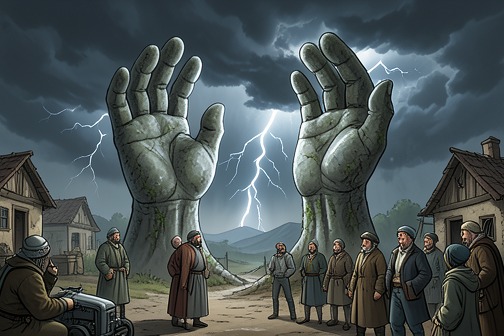
[The Third Gospel Outbreak at Danner’s Grasp](entity:event-recall-event-the-third-gospel-outbre-150b76831843), also known as the Destruction of [Danner’s Grasp](entity:location-recall-location-danner-s-grasp-1a3bfa423977) and the Smiling Man Incident, is a decisive crisis during the Endeavor’s eastward expedition. What begins as a storm-forced landing at a remote settlement becomes an encounter with the Third Gospel of the Smiling Man, a corruption [Jonathan Heights](entity:character-recall-character-jonathan-heights-d9ccad9c719b) regards as capable of spreading through people, buildings, and even remembered words. The outbreak exposes the expedition’s central moral division: whether forbidden knowledge must be contained at any cost, or whether destroying an infected community is itself an intolerable atrocity.
## Storm-Bound Arrival
The crisis begins when the Endeavor, pursued by a mercenary ship, is driven toward Danner’s Grasp by violent weather. A lightning flash reveals the settlement below: farmland and rugged vegetation surround two enormous, six-fingered stone hands rising from the ground, the surviving fragments of an ancient monument. Human settlers have fastened mooring rods to the fingers and placed lights in the empty palms, building their town beneath the exposed remains. The lightning disappears almost immediately, but the brief illumination gives [Captain Montgomery](entity:character-recall-character-captain-montgomery-85ba416f8403) enough guidance to turn the Endeavor southward toward the settlement while the storm throws the pursuing ship off course.
The Endeavor reaches the monument in a precarious condition, anchored to three stone fingers while another line is tied to a small building on one palm. With [Montgomery](entity:character-recall-character-montgomery-3d1e676073f0) occupied and the ship unstable in the gale, the party goes ashore at its own risk. Jonathan carries [Marie](entity:character-recall-character-marie-38740b047e25) down by force while [Eleanor McAvey](entity:character-recall-character-eleanor-mcavey-56495d17d879) and [Sarah](entity:character-recall-character-sarah-7c634cfe73af) follow the handholds behind him. A three-fingered gaffer directs them along a rain-slick wooden walkway that spirals down the monument’s wrist. The settlement’s structures have not been driven into the stone; instead, ropes and chains hold the creaking walkways in place against the wind, making the town’s connection to the ancient monument visibly provisional.
The streets are unnaturally empty. Jonathan expects inhabitants of such a remote settlement to endure the weather and continue their business, yet no one appears among the pitted cobbles, and neither candles nor sheltershrooms reveal ordinary movement. The group follows the gaffer’s directions to a chirurgeon’s building marked by a red heliograph light, where several Endeavor crew members wait in the anteroom. The apparent medical refuge becomes the threshold of the outbreak.
## Recognition of the Gospel
Jonathan discovers that the town’s doctor has locked the interior door, and a low, murmured cadence comes from beyond it. He breaks the latch and enters the operating theatre, where the doctor and George, a wounded crewman, turn toward him with smiles. The doctor’s grin stretches almost to the back of his neck, exposing more teeth than a human mouth should contain. George’s smile is nearly as broad; his injured body is covered with stitches, while his teeth have begun to stretch and divide into doubled versions of themselves. The physical deformation makes the infection visible as a transformation of the human face and body rather than merely a change in belief.
[Eleanor](entity:character-recall-character-eleanor-f86629a4f595) asks whether the phenomenon is the Second Gospel, but Jonathan identifies it as the Third Gospel of the Smiling Man. He knows the First Gospel, encountered in [Beacon](entity:location-recall-location-beacon-05545c91a64e), to be comparatively harmless, while the Second and Third are not meant for the human mind. The distinction changes the party’s objective immediately: the doctor and George are no longer patients or stragglers to be rescued, but evidence that the settlement has crossed into a form of contamination that Jonathan believes cannot be safely confronted by ordinary violence or negotiation.
The Gospel itself exerts a dangerous attraction. Jonathan hears the doctor reciting words with a nauseating, seductive quality, yet the remembered reality of sunlight helps him resist listening. Rather than fight the two infected men inside the building, he withdraws, refusing to escalate the encounter before he understands its extent. Outside, the storm conceals the sound of the recitation, and Jonathan orders the others to flee toward the Endeavor. When [Jameson](entity:character-recall-character-jameson-088b0c7c6fda) asks about George, Jonathan answers that George is gone and orders everyone to reach the ship.
Lightning then reveals the true scale of the outbreak. Figures have emerged throughout the streets as if summoned by an invisible command. Without their cloaks and hoods, the townspeople’s faces show the same agonizingly wide smiles. Jonathan tells the others to block their ears and runs ahead with the sword drawn from his cane, knocking aside clubs and belaying pins and using the blade when necessary. The townspeople are too numerous to count, but the party reaches the monument because the Endeavor is close and the storm prevents the infected crowd from overtaking them. The gaffer’s hut has been smashed, leaving behind a hissing, glowing residue of zint that indicates [Antomine](entity:character-recall-character-antomine-c73da0eb5297)’s guards have already begun using force to secure the retreat.
## The Inquisition’s Decision
Back aboard the Endeavor, Antomine immediately identifies the settlement as a Smiling Man cult, though Jonathan recognizes that the outbreak exceeds the ordinary meaning of a cult. The townspeople remain visible through the rain as figures gathered on the stone palm, still chanting while zint spotlights pass over them. Their words are indistinct, but the sound vibrates through the ship, preserving the Gospel’s power even after the expedition has escaped the streets. Antomine therefore asks Captain Montgomery to commandeer the ship’s cannon, declaring that the town has been infected with forbidden secrets and that artillery can resolve the danger. His request turns the outbreak from a flight for survival into a dispute over the fate of everyone left below.
Eleanor McAvey objects at once, insisting that hundreds of people are present and that they cannot all be assumed to be Gospelites. Montgomery likewise refuses to make the Endeavor an instrument of mass slaughter. Antomine answers by invoking the authority of the Inquisition and asking whether their resistance amounts to treason. The moment strips away his earlier boyish manner and reveals the dangerous Crown agent beneath it: the outbreak is no longer merely a religious emergency, but a test of obedience to the state’s doctrine that forbidden knowledge must be purged.
Jonathan intervenes reluctantly. He does not defend the Inquisition’s excesses, yet he argues that the Third Gospel creates a threat unlike the First or Second. In his judgment, ordinary soldiers with guns and swords might contain the lesser Gospels, whereas the Third Gospel leaves no one safely untouched; even buildings must be destroyed because they may retain echoes of the contamination. His argument recalls the scale of an earlier encounter in which a village was erased so completely that a deep lake occupied its former site. By presenting destruction as containment rather than vengeance, Jonathan gives Antomine the practical justification needed to proceed, while revealing how his pursuit of sunlight has made him capable of endorsing the same brutal logic he distrusts.
Antomine finally limits the operation to his two guards and tells Montgomery that the Inquisition will bear the burden alone. Montgomery hesitates before yielding, and Jonathan’s small nod helps settle the decision; the captain orders his crew to continue cleaning and repairing the Endeavor while Antomine’s agents act outside. Eleanor then accuses Jonathan of taking Antomine’s side. He answers that he wishes otherwise, but the Third Gospel is an unspeakable menace and the storm has left them unable to depart safely. His response does not reconcile the disagreement. It establishes the outbreak’s enduring moral injury: survival requires the expedition to abandon the ordinary distinction between rescuing the infected and destroying them.
## Destruction and Aftermath
The decision is followed by the destruction of Danner’s Grasp. By the time the Endeavor leaves, the settlement is no longer a place to which the expedition can return but a smoldering ruin of zint, lingering fire, and shattered sheltershrooms whose green light survives among the debris. The storm has passed, allowing the airship to resume its course, while the mercenary ship has been blown far away and is unlikely to pursue them soon. The outbreak therefore ends through a double release: weather frees the Endeavor from immediate pursuit, and fire is used to sever the settlement from the spreading Gospel. The town’s removal is treated as a necessary quarantine, but the imagery makes clear that containment has required the obliteration of a human community.
The aftermath extends beyond the burning settlement into the survivors’ treatment of death. Antomine conducts a service for the three crew members killed during the encounter, while George’s casket remains empty because no one attempts to recover his body from the ruined town. Each sealed casket is immersed in distilled luminiferous terrestrite and reduced to dust before the remains are scattered into the wind. The ceremony gives the expedition a formal passage out of the disaster, but it cannot restore the missing crewman or resolve the question of whether the town’s inhabitants were victims, converts, or both. Even the ritual’s language of proper burial is therefore shadowed by the outbreak’s contamination logic: the dead are honored only after being rendered incapable of remaining as physical traces.
Event 7
The Theft of Jonathan’s Maps
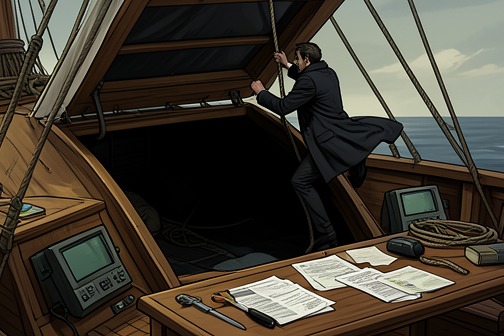
[The Theft of Jonathan’s Maps](entity:event-recall-event-the-theft-of-jonathan-s-67679ac119e1) is a targeted burglary aboard the Endeavor at [Autochthon Reach](entity:location-recall-location-autochthon-reach-692fa43be704), and its importance lies in what the thieves leave behind as much as in what they take. [Jonathan Heights](entity:character-recall-character-jonathan-heights-d9ccad9c719b) loses the maps that chart his eastern ambitions, but the method of the intrusion reveals that someone has identified his cabin, understood the value of his papers, and possessed enough skill and access to search the ship without immediate detection. The incident turns the Endeavor from a temporary refuge into a compromised expeditionary space and gives Jonathan a concrete adversary to pursue.
## Circumstances and Vulnerability
The theft occurs while the Endeavor is unusually exposed. The ship is quiet, with half the crew absent: [Antomine](entity:character-recall-character-antomine-c73da0eb5297) is occupied with prisoners and messages to [Beacon](entity:location-recall-location-beacon-05545c91a64e), while [Eleanor McAvey](entity:character-recall-character-eleanor-mcavey-56495d17d879) has disappeared into the city, apparently acquiring ammunition and perhaps attending to Reflected Council business. Jonathan Heights returns to the vessel already unsettled by an earlier encounter with [André Ludwig](entity:character-recall-character-andr-ludwig-d76dbe575440), and the silence of the ship magnifies his suspicion. The removed top hatch provides a practical route from above, while the reduced watch leaves fewer people able to observe an intruder.
Jonathan’s assumption that the Endeavor, or at least his own cabin, would remain untouched within port proves dangerously complacent. The alarm elsewhere in the expedition has accustomed the crew to overt threats, but this attack is quiet, selective, and intimate. It does not announce itself through a confrontation like the dark ship that once attempted to intercept the Endeavor; it appears first as disorder in a private room, making access and betrayal more important than firepower.
## The Break-in and [Discovery](entity:object-recall-object-discovery-074c5d88e879)
The intruders force open crates, splintering myceliplank with hurried crowbar work and spilling clothing, tools, and artifacts across the floor. They open Jonathan’s desk drawers and cut into his mattress, searching through places where valuable records might have been concealed. The destruction is not random: Jonathan recognizes in the mess the same hand he has been seeking, connecting the burglary to the broader pressure already gathering around his expedition.
He bars the cabin door with his cane before approaching the safe. Breaking the safe or carrying away its massive iron body would have been difficult without attracting notice, but cracking it would have been possible. When Jonathan rotates the familiar combination and opens it, the papers and petty cash remain. The conspicuous absence is his maps.
The maps are not his only records. Jonathan uses a fragment of broken mirror to inspect the safe’s reflection and activates the hidden compartment concealed behind it. His original notes and [Reginald Heights](entity:character-recall-character-reginald-heights-1a41a84f2d4a)’s notebooks are still intact. This distinction changes the nature of the loss: the thieves have taken the expedition’s working navigational material, not the irreplaceable archive from which it was derived. Jonathan can reconstruct the maps, but doing so would consume time he refuses to surrender while an opponent is actively moving against him.
The maps are also written in cipher. Their removal therefore creates a delay rather than an immediate transfer of knowledge. Anyone who copied them would still need to interpret them, and the thieves would have difficulty reproducing the entire collection under the conditions of the hurried search. Jonathan consequently treats the loss as recoverable, though not trivial. The maps represent accumulated labor and the practical means of reaching sunlight; their disappearance threatens the expedition’s schedule even while preserving a tactical advantage for their owner.
## Investigation and Suspected Perpetrators
Jonathan informs André Ludwig in writing, although he gives equal odds that [André](entity:character-recall-character-andr-e963224881f0) himself arranged the theft. The letter demonstrates Jonathan’s investigative method: he distributes information while withholding trust, treating every contact as a possible source of assistance and a possible channel of danger. He then waits at the gangplank for Eleanor McAvey, deciding that Antomine’s particular talents are unlikely to help with a burglary investigation.
[Eleanor](entity:character-recall-character-eleanor-f86629a4f595) returns with only one maid, [Sarah](entity:character-recall-character-sarah-7c634cfe73af), because [Marie](entity:character-recall-character-marie-38740b047e25) is presumably convalescing elsewhere. Jonathan tells her that the maps are gone and that recovering them would be faster than reconstructing them, especially if the recovery identifies the person who has set himself or herself against the expedition. He leaves unstated the further consequence he imagines: once located, the enemy could be removed. Eleanor responds by ordering Sarah to secure their quarters and verify that nobody has entered them.
Eleanor examines Jonathan’s cabin and opens his safe with an ease that suggests either knowledge of the combination or a more esoteric talent. She concludes that the burglars were a group rather than a lone trespasser. The safecracker was considerably more skilled than the accompanying muscle, which gives her confidence that the pair or group can be found if the right questions are asked in the right places. Sarah reports that Eleanor’s rooms are untouched. The contrast is decisive: the intruders went directly to Jonathan’s cabin, indicating foreknowledge rather than a general search for valuables.
Jonathan and Eleanor infer that at least one crew member disclosed the location or significance of the cabin. The likely informants are among the sailors who abandoned the Endeavor after its recent difficulties. This suspicion broadens the theft from an external intrusion into an internal security failure. The missing maps expose not only hostility beyond the ship but also the danger created by demoralization, desertion, and the circulation of expeditionary information among former crew.
## The Trail to the Society of Explorers
Eleanor refuses to bring Jonathan into the Reflected Council business that she intends to pursue, and he accepts the separation because he has another lead. He visits the courier ship [Lady Green](entity:object-recall-object-lady-green-a8facb3da72d) and tells its captain that a thief stole navigational maps from his ship. Jonathan believes the stolen material may have been intended to guide the Endeavor toward the courier’s most recent passenger, a man from Beacon. The captain identifies that passenger as Harrington, who represented the Society of Explorers and had instructed the courier to send messages to the [Faithful Respite](entity:location-recall-location-faithful-respite-7bdeb78e4e0c) in the [Merchant Quarter](entity:location-recall-location-merchant-quarter-ab8767151eec).
The captain’s reluctance and Jonathan’s controlled menace make the exchange feel less like a formal inquiry than a warning held in reserve. Jonathan does not accuse the courier crew of participation; he promises that trouble will go to those who deserve it and leaves after receiving the address. The information points toward Harrington and the Society of Explorers, whose rivalry with Jonathan provides a plausible motive. Jonathan considers the Society capable of stealing his maps, especially because its presence in Beacon had previously been constrained by both the Crown and the Reflected Council.
Yet the motive remains uncertain. Hiring a mercenary ship to harass an exploration vessel would require an extravagant expenditure, and the Society’s limited coffers make such a decision difficult to explain. Jealousy could motivate such waste, but Jonathan distinguishes emotional hostility from the practical ability to fund an operation. Harrington’s name is unfamiliar to him, but Jonathan hopes the man can be used to persuade the Society that further interference will be costly.
## Consequences for the Expedition
The theft forces Jonathan to revise his understanding of security aboard the Endeavor. He repairs the visible disorder, questions the airman on watch, and recognizes that the missing hatch allowed approaches from above without even the warning noise that a normal entry might have produced. The watchman saw nothing, but the failure is not treated as proof of supernatural concealment; Jonathan identifies a dozen possible routes and accepts that his own assumption of safety was the immediate weakness.
He chooses not to delay the voyage with a formal investigation into minor cargo tampering discovered elsewhere. Later, cases containing fire dust and unflame show signs of having been opened, with some small pilfering, but most supplies remain intact. Jonathan suppresses the matter because the Endeavor has already endured too many delays and he will not allow another inquiry to obstruct its departure toward sunlight. The map theft therefore occupies a special category: unlike scattered theft from cargo, it is precise, strategic, and directly connected to the expedition’s route.
The event also clarifies the value of Jonathan’s cartographic work. The expedition carries an enormous range of equipment, including a portable luminiferous terrestrite distillation apparatus, a lifting-gas separator, water siphons and filters, searchlights, crew-served zint guns, food, water, spare parts, clothing, and bedding. Those supplies can be replaced through trains, ports, and trade; the maps embody a more personal accumulation of knowledge and cannot be exchanged for ordinary provisions. Their theft threatens the expedition’s future while proving that Jonathan’s enemies understand which possessions matter most.
The maps ultimately remain a danger to their thieves as well as to their owner. Because they are encoded and derived from protected notes, possession does not immediately grant mastery of the route. Jonathan can reconstruct them, but the time required would be substantial, and the stolen originals give an adversary the possibility of following or redirecting the Endeavor. The burglary thus establishes a contest over knowledge in which navigation, secrecy, crew loyalty, and political rivalry become inseparable.
Event 8
Autochthon Reach Rising
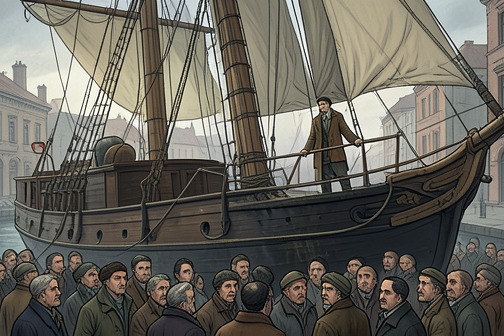
[Autochthon Reach Rising](entity:event-recall-event-autochthon-reach-rising-75d2a04743cf) is the looming uprising that drives the Endeavor out of [Autochthon Reach](entity:location-recall-location-autochthon-reach-692fa43be704) and turns departure into an act of risk management rather than simple travel. The event is never shown as a fully described battle; its importance lies in the warning signs, the hurried evacuation, the moral dispute over whether to help, and the consequences of leaving a potentially besieged settlement to its own defenses.
## Causes and Uncertain Intelligence
[Jonathan Heights](entity:character-recall-character-jonathan-heights-d9ccad9c719b) learns of the crisis when an envelope bearing [André](entity:character-recall-character-andr-e963224881f0)’s seal reaches him early in the morning. The message does not establish whether the danger is coincidence or a deliberate operation, but it reports that the Baron will commandeer all ships to deal with a Rising from the Reach. Jonathan treats the uncertainty itself as dangerous. Whether someone has read the signs in advance or the crisis has been engineered to immobilize ships and men, the result is the same: delay would interfere with the expedition’s larger purpose and expose the Endeavor to compulsory service under conditions Jonathan cannot control.
Jonathan therefore tells [Captain Montgomery](entity:character-recall-character-captain-montgomery-85ba416f8403) that they must leave immediately and insists that the decision is certain enough to act upon. His judgment is not based on complete knowledge of the Rising, but on the relationship between probability, controllability, and consequence. He can neither verify the threat nor predict its scale, yet he knows that waiting will allow outside authorities to seize the ship and that the Endeavor is not prepared to become an instrument of suppression or relief. The event’s first decisive value shift is consequently from ordinary logistical inconvenience to imminent loss of freedom and strategic initiative.
## The Endeavor’s Evacuation
[Montgomery](entity:character-recall-character-montgomery-3d1e676073f0) objects that departure seems cowardly, without specifying whether he condemns fleeing the crisis or the authorities’ practice of commandeering ships to confront local danger. Even so, he accepts Jonathan’s certainty and begins the exhausting work of preparing the Endeavor. Jonathan promises that they will make do at [Danby’s Point](entity:location-recall-location-danby-s-point-89a41017e4ad), while Montgomery warns that the plan is unsafe unless enough crew and supplies can be found there. The expedition must therefore trade a known port and available resources for an uncertain eastern destination.
Several painfully long hours pass before the ship is ready. The whistle sounds through the speaking-tubes, the mooring lines drop, and the Endeavor pulls away from Autochthon Reach while most passengers gather in the observation room to watch the city recede. [Marie](entity:character-recall-character-marie-38740b047e25) appears among them in new maid’s garments, with numerous bandages still visible beneath them; her presence marks how hurriedly the departure has been assembled and how little recovery time the passengers have had. Jonathan recognizes that Montgomery has met the deadline only barely, but the ship leaves before the authorities can take control of it.
Only minutes after the Endeavor’s departure, bells sound faintly behind the ship and the lighthouse’s yellow gas-fire turns a smeared crimson. The altered signal gives the Rising a visible public consequence without revealing its exact nature. [Antomine](entity:character-recall-character-antomine-c73da0eb5297) watches the city with his hands clasped behind his back and argues that they should help. Jonathan refuses, explaining that this is precisely why they left early: even if the emergency is genuine, the Endeavor is too lightly armed to make a meaningful difference. His refusal is not indifference to danger but a rejection of an action whose likely cost is high and whose effect would be negligible.
## Competing Judgments of Responsibility
Antomine responds as an Inquisitor rather than as a ship’s strategist. Whether the emergency is genuine or fabricated, he believes that someone should ask who had foreknowledge and how that knowledge was obtained. His attention shifts from immediate rescue to responsibility, conspiracy, and institutional accountability. Jonathan does not argue with him, but he also does not allow that inquiry to redirect the expedition. The two men thus assign different priorities to the same crisis: Antomine seeks the hidden cause and the guilty party, while Jonathan protects the ship’s mission and the lives already committed to it.
The Endeavor leaves the possibly besieged city behind, and Jonathan deliberately puts the Rising out of his mind. He assumes that it will matter only when the ship returns, a return so distant and uncertain that it cannot govern the present decision. His confidence that Danby’s Point will provide what they need makes the evacuation appear controlled, but the scene also exposes the limits of that confidence. Autochthon Reach is left at the moment its lighthouse changes color, and the narrative withholds confirmation of what follows, making departure itself the event’s final irreversible act.
## Consequences for the Expedition
The Rising changes the expedition’s route, timetable, and relationship to human authority. Instead of remaining at Autochthon Reach while ships are gathered for the emergency, the Endeavor proceeds toward Danby’s Point, the easternmost point of human civilization. Jonathan spends the days of travel teaching his companions rules intended to prevent disaster through ignorance, because unfamiliar hazards will not spare passengers who lack the knowledge to recognize them. The crisis therefore strengthens his role as an instructor and emergency leader even as it demonstrates that preparation cannot eliminate uncertainty.
At Danby’s Point, the expedition reaches a frontier where human civilization ends at a tall, zint-illuminated tower built into bruised-purple rock. Human light occupies one side of the plateau, while the lights of other races meet it at the trading point. The Inquisition is simultaneously strongest and weakest there: strong enough to regulate contact, yet weak enough to depend on the trade and proximity it seeks to contain. The Rising at Autochthon Reach foreshadows this larger frontier condition, in which political authority, military capacity, commerce, and local danger are inseparable.
The consequences also become structural rather than immediate. Later dangers repeatedly expose the same problem that Jonathan faces at the Reach: the expedition must make decisions before it understands what is approaching. When the crew disturbs an unknown creature or phenomenon, Jonathan relies on long experience to conclude that it cannot be fought and leads a retreat through furnace heat, while even the beasts flee the ruins. At [Terminus](entity:location-recall-location-terminus-9fe35f8062b8), the absence of visible threat frustrates him because the town’s enforced peace and friendliness deny the dangers he expects to uncover. In the [Crimson Caldera](entity:location-recall-location-crimson-caldera-f34c82d45880), Antomine orders full engine power to buy time for [Airman Stutt](entity:character-recall-character-airman-stutt-44ba738069e9), despite the risk of exhausting the Endeavor’s zint reserves. During the storm near the [Grave of Wood](entity:location-recall-location-grave-of-wood-2991ab0ec704), Captain Montgomery again has to judge whether the ship can outrun a phenomenon unlike ordinary western storms. These later episodes repeat the Rising’s central pattern: incomplete evidence must be converted into action before the consequences become fully visible.
## Narrative Significance
Autochthon Reach Rising functions as an early demonstration of Jonathan’s governing principle that ignorance is not neutral when a decision has a narrow window. He does not claim to know what the Rising is, who engineered it, or whether the emergency is genuine. Instead, he acts because the cost of waiting is legible: the Endeavor may be commandeered, its mission delayed, and its limited armament committed to a crisis it cannot solve. His choice produces no heroic victory and no confirmed rescue; its success is measured by retaining command of the expedition.
The event also establishes a recurring contrast between visible danger and hidden danger. The first warning arrives privately in André’s sealed envelope, while the public confirmation appears only after departure through bells and a lighthouse burning crimson. Antomine wants to investigate the gap between foreknowledge and official response, but Jonathan accepts that some unanswered questions must remain unanswered when survival and strategic freedom are at stake. The Rising consequently defines the expedition’s moral atmosphere: responsibility does not always mean intervening, and withdrawal can be the most deliberate response to a threat that cannot be reliably measured or controlled.
Event 9
Jonathan’s Chart Theft Confrontation
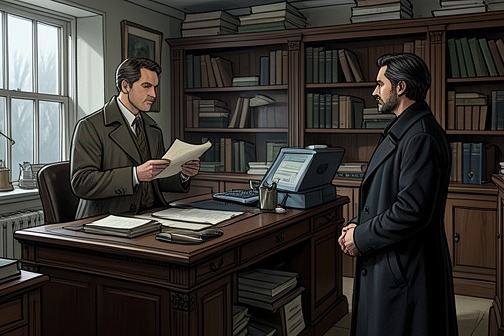
[Jonathan’s Chart Theft Confrontation](entity:event-recall-event-jonathan-s-chart-theft-a58f0d747fcb) is a decisive recovery and confrontation in which [Jonathan Heights](entity:character-recall-character-jonathan-heights-d9ccad9c719b) retrieves his encoded maps from Harrington, an agent connected to the Society of Explorers, and threatens the organization with destruction if it continues obstructing his expedition. The event converts the maps from vulnerable possessions into instruments of defiance and confirms that Jonathan’s pursuit of sunlight will proceed against both the dangers of the eastern world and the authorities that claim to regulate exploration.
## The Stolen Maps and the Pursuit of [Sunlight](entity:state-recall-state-sunlight-28d75af2a2d6)
The confrontation takes place in a merchant boardinghouse in [Autochthon Reach](entity:location-recall-location-autochthon-reach-692fa43be704), whose floors are organized around studies and offices for people whose lives depend on the exchange of coin. Jonathan Heights and [Eleanor McAvey](entity:character-recall-character-eleanor-mcavey-56495d17d879) reach the third-floor study after moving through a locked-looking basement and climbing a stone stairway. The setting is important because it places the theft within an ordinary commercial environment, while the maps themselves carry consequences far beyond ordinary commerce: although encoded, their symbols retain enough significance to inspire dread, and the heavy paper curls into cylinders as Harrington grips it.
Jonathan identifies the man in the room as Mister Harrington, a bespectacled, pencil-necked figure who resembles the people who previously harassed him in [Beacon](entity:location-recall-location-beacon-05545c91a64e). Jonathan sees him as one of the descendants and associates of genuine explorers who presume to understand the truth without personally confronting the world beyond the settled cities. Harrington’s presence therefore represents more than a single thief. He stands for an establishment that possesses or claims authority over exploratory knowledge while attempting to prevent Jonathan from extending that knowledge eastward.
The immediate stakes are practical as well as ideological. Jonathan has been preparing the Endeavor for a long expedition, arranging financing, equipment, supplies, and transport. Earlier, he had offered [Captain Montgomery](entity:character-recall-character-captain-montgomery-85ba416f8403) blank golden plates as a means of outfitting the ship and had planned to send supplies by train to [Danby’s Point](entity:location-recall-location-danby-s-point-89a41017e4ad) before the Endeavor’s final loading. The maps are consequently part of a larger logistical system: without them, the expedition’s route and purpose are compromised; with them, Jonathan can continue toward the unknown edge of the map.
## Recovery in the Boardinghouse Study
When Jonathan bursts into the study, Harrington spills ink across the table and then seizes the maps. Jonathan demands an explanation for the possession of what belongs to him, while Harrington attempts to retain control through the documents’ apparent legitimacy and importance. The exchange quickly becomes physical and supernatural rather than remaining a dispute over property.
Eleanor McAvey recovers the maps with startling ease. After asking Jonathan to confirm that they are his, she takes the rolled papers from Harrington and offers them back to Jonathan, who receives them gravely. Harrington is left staring at his empty hands, unable to understand how she removed the documents. The recovery reverses the immediate power arrangement: the thief has the papers, then suddenly has nothing, while Jonathan once again possesses the knowledge required for the expedition.
[Eleanor](entity:character-recall-character-eleanor-f86629a4f595) then draws a long dagger and appears ready to deal with Harrington directly. Jonathan stops her with his cane. His intervention does not indicate mercy toward Harrington; instead, it shows that Jonathan wants the confrontation to yield information and a message as well as punishment. He asks who Harrington represents and why, then identifies the Society of Explorers as the likely authority behind the theft. The maps are thus recovered before the institutional motive is fully exposed, allowing Jonathan to turn the scene from a private act of violence into a political warning.
## The Threat to the Society of Explorers
Harrington confirms that Jonathan knows who he is and complains that Jonathan ignored the Society’s warnings. Jonathan answers with a declaration that nobody will stop him from finding sunlight. The statement condenses his expedition’s central objective into an absolute commitment: sunlight is not a curiosity or a negotiable destination, but the goal against which every rival claim must be measured.
Jonathan then orders Harrington to carry a message back to Beacon. He dismisses the Society of Explorers as frightened, petty, and irrelevant, condemning its members for recoiling from the darkness and asserting that he understands how little humanity matters to the forces beyond the known world. He threatens to destroy any Society agent who crosses his path, regardless of rank or role, and states that he will not tolerate anyone blocking his route to sunlight.
The threat has an immediate bodily effect. As Jonathan advances, Harrington is forced almost into the fire; his clothes begin to smolder, his eyes become glassy with panic, and he cannot look away or blink because of the force of Jonathan’s displeasure. Jonathan stops only when he reaches the table, then turns away in disgust. The scene shifts the value of power from Harrington’s possession of the maps to Jonathan’s mastery of the room. Harrington entered as the apparent guardian of forbidden knowledge; he leaves as a terrified courier compelled to transmit Jonathan’s ultimatum.
## Securing the Charts and Continuing the Expedition
Jonathan and Eleanor leave the boardinghouse without further resistance, passing the local toughs who lack the wit to fear the person departing. Eleanor remarks that Jonathan can be frightening when angry, while Jonathan gives the concise justification that Harrington should not have stolen from him. Their exchange establishes a contrast between Eleanor’s amused recognition of Jonathan’s menace and Jonathan’s own practical interpretation of the event: to him, the violence is a consequence of trespass against an essential possession.
Back aboard the Endeavor, Jonathan places the maps in a more discreet location in his cabin. He recognizes that the ship’s safe is not absolute protection and that anyone sufficiently determined can defeat an obvious lock. The maps will eventually be brought out and used, but once the expedition is underway there will be no dock or port where a thief or saboteur can easily enter. Their security therefore depends partly on movement: the charts become safer when the Endeavor leaves the settled spaces in which institutions and agents can reach them.
Captain Montgomery offers the ship’s safe or his own quarters, but Jonathan declines. He explains that this is not because he distrusts [Montgomery](entity:character-recall-character-montgomery-3d1e676073f0); the responsibility is simply not yet one he is ready to transfer. Jonathan trusts his own ability to repel both ordinary intruders and opponents with more esoteric talents than Montgomery’s crew. He also gives [Antomine](entity:character-recall-character-antomine-c73da0eb5297) an edited account of the incident when the inquisitor returns, allowing Antomine to decide how to handle any official complaints without surrendering the full circumstances of the confrontation.
The recovery directly supports the expedition’s preparation. Jonathan inspects the cargo to ensure that it has not been tampered with, finding equipment ranging from a portable luminiferous terrestrite distillation apparatus and lifting-gas separator to water filters, searchlights, crew-served zint guns, food, clothing, bedding, and spare parts. Some containers, especially those holding fire dust and unflame, show signs of opening and minor pilfering, but Jonathan chooses not to trigger an investigation that might delay departure. Recovering the maps is therefore part of a wider struggle against obstruction: he treats every delay, theft, and administrative complication as another force attempting to keep him from the east.
## Consequences and Narrative Significance
The confrontation marks a value shift from threatened expedition to renewed agency. Before Eleanor recovers the charts, Harrington possesses the documents and the Society’s warnings appear capable of constraining Jonathan’s movement. After the recovery, Harrington is reduced to a messenger, the Society is openly named as an enemy, and Jonathan retains both the maps and control of the expedition’s next stage. The scene’s conflict is not resolved by reconciliation or legal judgment; it is resolved through possession, intimidation, and the promise of future retaliation.
The maps also reveal the material politics of exploration. They are encrypted, physically unstable, and dangerous even in symbolic form, yet they are treated as tradable or stealable objects within a boardinghouse economy. Jonathan’s expedition depends on converting knowledge into logistics: golden plates help finance the refit, raw metal later serves as barter among the [Caravaneers](entity:creature-recall-creature-caravaneers-cdffe1ff9745), and cargo must be assembled before the Endeavor can travel beyond familiar ports. The Society’s attempt to control the charts is therefore an attempt to control access to the route, the resources discovered along it, and the authority to define what counts as legitimate exploration.
Jonathan’s later conduct shows that retrieving the charts does not make the journey safe. When the crew disturbs an unknown creature or phenomenon, he immediately judges it beyond their ability to fight and leads the retreat through furnace heat and the chaos of awakened beasts. In [Terminus](entity:location-recall-location-terminus-9fe35f8062b8), by contrast, the enforced peace and friendliness frustrate him because he cannot uncover the threatening secret he expects to find. At the [Crimson Caldera](entity:location-recall-location-crimson-caldera-f34c82d45880), he accepts that [Airman Stutt](entity:character-recall-character-airman-stutt-44ba738069e9)’s affliction may require the Endeavor to run its engines at full power, risking the depletion of the ship’s zint reserves. Before [Bright Defile](entity:location-recall-location-bright-defile-18d73f1df73b), even the destination itself remains something Captain Montgomery says he will believe only when he sees it. These later dangers give the chart theft its proper scale: recovering the maps restores direction, but direction is not mastery.
The expedition ultimately returns with the Endeavor battered and carrying an immense quantity of gold, drawing more public interest than the lone inquisitor or the three women who disembark. That aftermath retrospectively confirms the importance of what the Society tried to suppress. The maps enabled a voyage that produced wealth, knowledge, and consequences far beyond a dispute in a third-floor study, while Jonathan’s threat established the personal and institutional conflict that shadows his progress toward sunlight.
Event 10
Tiuni’s Betrayal and Death
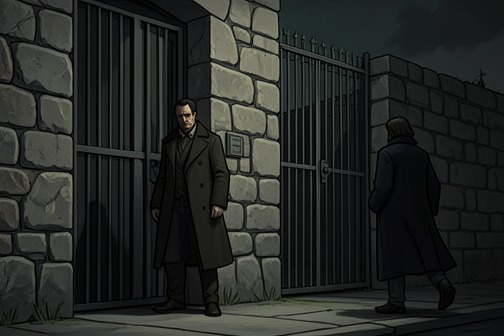
[Tiuni’s Betrayal and Death](entity:event-recall-event-tiuni-s-betrayal-and-de-0b4013db55b3) marks the moment when [Jonathan Heights](entity:character-recall-character-jonathan-heights-d9ccad9c719b)’s trusted eastern intelligence network collapses into suspicion and murder. At [Danby’s Point](entity:location-recall-location-danby-s-point-89a41017e4ad), [Tiuni](entity:character-recall-character-tiuni-517876ba3162) provides information about shifting powers and routes beyond human civilization, but her deliberate concealment of what lies in the far east convinces Jonathan that knowledge has become a threat. Her death protects the expedition from a possible warning or countermeasure, yet it also exposes the expedition’s willingness to destroy the very beings it depends upon when they obstruct its passage toward sunlight.
## Danby’s Point and the Intelligence Exchange
Danby’s Point is the easternmost terminus of the illuminated human track, built against a tall tower and a bruised-purple rock face where human zint light meets the illumination and architecture of other peoples. It is simultaneously a trading frontier and a controlled border: the Inquisition is strongest there because human authority is concentrated, and weakest there because contact with nonhuman powers cannot be eliminated. A great metal gate divides the human section of the plateau from darker territories, but influence crosses in both directions. Near the wall, alien spires have been pulled toward straighter lines, while human forms and customs have also been altered by proximity to the nonhuman inhabitants.
Tiuni belongs to this unstable border world. She is one of the [Fractured](entity:creature-recall-creature-fractured-5d3ef48e4511), whose bodies shift from one movement or angle to the next: features alter, limbs seem to skip through space, and a face may become a mask of flesh. Jonathan has nevertheless relied on her for years, and she had also served as a source of information for his father. Her position therefore combines personal familiarity, practical value, and structural danger. Jonathan does not treat the relationship as one of equality; he knows that Tiuni is not human and ultimately not on his side, even while admitting that her intelligence has been invaluable.
Before their confrontation, Tiuni gives Jonathan a detailed account of political and military movement in the eastern wilderness. She identifies the rise of a third house among the Thrantin and marks changes in the routes of caravans and the positions of forces and beasts. Her information concerns the [Verdant Expanse](entity:location-recall-location-verdant-expanse-01f0675c6588), a region that grows and shifts like a tide, as well as ruins of ancient powers resembling the twisted structures of Danby’s Point. Jonathan records the details on his map, using them to narrow the expedition’s possible routes. This is a familiar ritual: Tiuni is his final stop before ventures beyond human lands, whether the destination is directly east or not.
## The Betrayal and the Hidden Warning
The scene turns when [Antomine](entity:character-recall-character-antomine-c73da0eb5297) abruptly declares that Tiuni has lied. Jonathan’s writing stops before he can add her latest notation, and the alleged falsehood closes some of the routes that had seemed most promising, including possibilities affected by the [Wandering Slough](entity:location-recall-location-wandering-slough-b243fb76823b). Tiuni denies the accusation, but her changing face cycles through expressions of disapproval while Antomine advances. The Inquisitor’s white pupils flare with a light resembling zint, overpowering the room’s indigo lamps and forcing Tiuni’s shifting body into a single distorted form.
Antomine’s intervention changes the balance of the exchange. Tiuni is no longer merely an informant whose reliability must be assessed; she is physically constrained by a representative of the human religious and political order. Jonathan does not challenge Antomine’s display or openly defend Tiuni. Instead, he accepts the claim that Tiuni has deceived him, despite acknowledging that he has known Antomine for a shorter time and has no independent reason to trust him. The scene thus makes the expedition’s hierarchy plain: Jonathan may command its practical direction, but Antomine can convert uncertainty into an accusation with the authority of illumination and the Inquisition behind him.
Under pressure, Tiuni reveals the reason for her deception. She says that a man returned from the farthest east, something that should not happen, and that it would be better if it did not happen again. The secrets there, she insists, should not be disturbed. Her warning reframes the lie. It was not simply an attempt to misdirect Jonathan about roads or dangers; it was an effort to prevent the expedition from reopening a forbidden eastern passage. Tiuni’s knowledge of sunlight is likewise not neutral. When Jonathan demands to know what she knows about it, she dismisses sunlight as a myth and warns instead of the ancient things he might bring back.
The warning strikes at the expedition’s central purpose. Jonathan is traveling east because he claims to have seen sunlight, a claim treated by much of humanity as a laughable myth, and the airship Endeavor carries agents of the crown and underworld toward a destination whose truth remains uncertain. Tiuni’s response implies that the danger is not merely whether sunlight exists, but what an expedition may release or return with after reaching the far east. She therefore opposes Jonathan’s goal not by arguing about its reality, but by insisting that its consequences would be worse than ignorance.
## The Decision and the Killing
Once Tiuni’s warning is spoken, Jonathan ends the negotiation. He rolls up the map, places it in his satchel, and abandons the remaining payment because currency from Danby’s Point has no value beyond the frontier. The practical exchange is over, but the political danger remains. [Eleanor](entity:character-recall-character-eleanor-f86629a4f595) asks what should be done with Tiuni, and Jonathan considers the fractured informant not as a person entitled to leave but as a possible source of influence among her own kind.
Jonathan orders Eleanor to remove her because he would rather Tiuni not turn the Fractured against the expedition. The wording makes the killing an act of preventive control. No attack by Tiuni is shown; the immediate basis for the decision is her lie, her warning, and the possibility that she could mobilize nonhuman opposition. Knowledge, allegiance, and survival are therefore fused into one judgment. Because Tiuni’s information is useful, she is tolerated; because her deeper loyalties are uncertain, she becomes expendable.
Eleanor acts before Tiuni can say anything further. She drives a dagger through the back of Tiuni’s neck. Quicksilver blood pours from the alien body as Tiuni falls to the floor, a final physical reminder that her strangeness does not make her bloodless or unreal. Antomine and his guards do not flinch, and Antomine dims his illumination without apparent concern for the death of a nonhuman. [Sarah](entity:character-recall-character-sarah-7c634cfe73af) is the only one who asks whether the Fractured will be angered when they learn what happened.
Jonathan answers that dealings between humans and nonhumans always carry that risk. He believes the expedition will not return to Danby’s Point and that Tiuni’s people will not dare enter the human section even if they discover the identities of those responsible. His confidence is paired with immediate flight: the group must not linger, and they retire to the Endeavor. The killing is thus followed not by public reckoning but by departure, leaving retaliation as a possibility that Jonathan acknowledges without allowing it to interrupt the mission.
## Consequences and Narrative Significance
The event destroys a relationship that had extended across expeditions and generations. Tiuni had been Jonathan’s final source of eastern intelligence, and her knowledge had helped him navigate regions where ordinary human maps and assumptions failed. By killing her, he gains freedom from a potentially hostile informant but loses access to the network that made his eastern ventures possible. The decision also confirms that his commitment to finding sunlight has become more important than preserving a long-standing alliance or investigating the warning on its own terms.
Tiuni’s death is a value reversal: an exchange that begins by producing usable knowledge ends with the informant dead and the expedition in flight. The expedition’s declared opposition to darkness and ignorance is thereby darkened by its method. Jonathan seeks illumination, but he responds to an inconvenient truth through coercion and removal; Antomine’s supposedly civilizing light freezes Tiuni into a manageable shape; Eleanor’s dagger converts uncertainty into irreversible silence. The scene does not establish that Tiuni was right about the ancient things, but it makes her warning inseparable from the danger of Jonathan’s quest.
The episode also sharpens the book’s frontier politics. Human civilization depends on contact with peoples it calls dark, savage, or nonhuman, yet that contact is tolerated only while it remains useful and contained. At Danby’s Point, trade, maps, language, and violence occupy the same boundary. Tiuni can sell information about caravans and eastern forces, but she cannot withhold knowledge about a forbidden return without becoming a target. Her assassination exposes the colonial logic beneath the expedition’s language of exploration: the east is treated as a source of routes, resources, and secrets, while its inhabitants are denied the authority to decide which secrets should remain undisturbed.
The later atmosphere of the returned Endeavor’s era, eventually labeled the [Winter of Blood](entity:expression-recall-expression-winter-of-blood-d40bffbf7ef6) by people who thought themselves clever, gives the killing a broader resonance. Tiuni’s death is one of several incidents in which exploration, wealth, forbidden artifacts, and violence unsettle [Beacon](entity:location-recall-location-beacon-05545c91a64e), even though public gossip does not fully grasp the scale of what has occurred. The expedition’s continued movement and Jonathan’s refusal to linger prevent the event from becoming a formal crisis at Danby’s Point, but they do not make it inconsequential. Tiuni’s betrayal reveals that the far east is guarded by knowledge as much as by geography; her death reveals the cost the expedition is prepared to pay to cross that guard.
Event 11
Tor Ilek Expedition
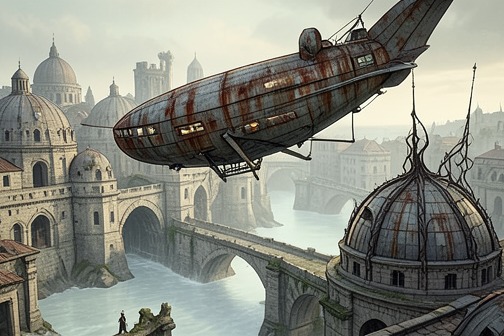
The [Tor Ilek Expedition](entity:event-recall-event-tor-ilek-expedition-a2ff99ca612e) is [Jonathan Heights](entity:character-recall-character-jonathan-heights-d9ccad9c719b)’s deliberate return to the ruined city of [Tor Ilek](entity:location-recall-location-tor-ilek-da8c883970ba), an undertaking that converts archaeological knowledge into immediate danger and material profit. After a week of following the [Khorus River](entity:location-recall-location-khorus-river-ee80c1bda628), the Endeavor reaches the ancient city, whose crumbling domes and arches leech color from the river until its water emerges pale and ghostly. Jonathan does not approach Tor Ilek as an unknown ruin: he has visited it before, knows that ordinary explorers have stripped its easily accessible treasures, and has come for a particular chamber and the device hidden within it. The expedition therefore begins as a calculated recovery mission, but its logic of control steadily gives way to the city’s alien mechanisms and hostile life.
## Arrival at the Ruined City
The Endeavor approaches Tor Ilek under zint lights, with the river passing beneath rotted bridges and around tumbled arches. Rust marks the dark stone where the metal skeletons of demolished towers and spires curl upward from the ruins. Jonathan recognizes a knurled dome whose broken iron buttresses resemble twisted teeth and directs [Captain Montgomery](entity:character-recall-character-captain-montgomery-85ba416f8403) to tether the airship to southern spikes, identifying a route into the structure. [Montgomery](entity:character-recall-character-montgomery-3d1e676073f0) brings the ship around against wind and inertia while the envelope compresses and the vessel descends toward a hook-like remnant protruding from the dome.
The landing is treated as a military operation rather than a sightseeing stop. Airmen first secure the ship with chains and then install descent lines, while Jonathan notices movement at the edge of the spotlights and orders the forward zint-cannons to fire. The artillery scatters the uncertain forms lurking near the metal spine without damaging the ancient stone, which appears capable of outlasting even [Beacon](entity:location-recall-location-beacon-05545c91a64e)’s civilization. Jonathan estimates that seven or eight men armed with swords and guns will be needed for the excursion and insists that someone remain at the cannon so that nothing can sever the six-inch steel chains. His stated timetable is several hours, and his objective is narrowly defined: there are no people to negotiate with, only things, and the party must reach one particular chamber before returning to the Endeavor.
## Passage Through Tor Ilek
The expedition descends by stairs built for bodies unlike human ones. The steps are unusually long and slanted, worn by parallel grooves that suggest ages of strange traffic. A concealed door opens through a weathered section of stone that slides outward and sideways on hidden mechanisms. Jonathan had left the door open during his previous visit, so its closure becomes an immediate uncertainty: either another mechanism has acted, or someone has closed it. The party proceeds downward through a stairwell where apertures briefly reveal deserted halls and rooms, finding no easily recoverable treasure because earlier explorers have already searched the accessible areas.
The ruins nevertheless remain inhabited. A zint rifle kills a long-limbed, long-jawed creature half the size of a man, whose scream sounds disturbingly human and whose corpse leaves a metallic smell of rust in the stairwell. [Antomine](entity:character-recall-character-antomine-c73da0eb5297) explains that innumerable creatures dwell in the dark, particularly in places like Tor Ilek, and connects their presence to the walls surrounding human cities. Beneath the ancient stone and metal, the Khorus River gathers in vast caverns that generate hostile forms of life, turning the ruined city into both an archaeological site and an ecological hazard.
At the base of the stairs, Jonathan’s lantern reveals a section of floor that is somehow extra. The party can trace a perfect circle within the area illuminated by their ordinary lights, yet something more has been compressed inside that apparently complete boundary. The phenomenon exemplifies Tor Ilek’s impossible geometry: the city does not merely contain unusual spaces but makes ordinary measurements unreliable. Jonathan identifies it as one of the mechanisms that still works and warns the party not to touch anything moving, comparing the machinery to ordinary industrial equipment only to emphasize that even familiar kinds of danger are sufficient here.
The route ends at a large door covered with metal circles and symbolic inscriptions. The circles move according to an arcane calculus, and several symbols are hidden within the extra degrees used by the builders. Normally, opening the lock would require days or weeks of guesswork and the interpretation of partially translated symbols. Jonathan instead calls on [Eleanor McAvey](entity:character-recall-character-eleanor-mcavey-56495d17d879). She walks toward the door and fades from sight, then opens it from the far side, revealing that her knowledge includes a way through defenses that are inaccessible to the rest of the party. Jonathan does not ask her to explain the method; the expedition advances because her unexplained ability supplies the key his archaeological expertise cannot provide.
## The Hidden Chamber and the Navigator
Beyond the door, the party crosses a defile and reaches an intact monolith amid collapsed stone. Jonathan identifies it as a defensible position and activates its extra degrees, causing a passage to unfold in a direction that no ordinary architecture could contain. Antomine’s guards take station at the entrance while the rest of the party searches the adjoining rooms. Jonathan warns that creatures may be nesting there, although the area was empty on his previous visit, and permits the airmen to take portable fragments of the past. The expedition thus combines a specific technological objective with opportunistic looting, as the crew gathers statues of grotesque nonhuman figures, rings, spirals, dark gems, and tarnished gold.
At the far end of the hall, Jonathan finds a pedestal bearing a mechanism of interlocking rings. Some of its symbols correspond to those on Jonathan’s maps. He places his lantern beside it and uses lengths of wire to copy the arrangement, wrapping the wire around the mechanism and fitting each completed circle into a sliding armature. The resulting device resembles a compass, but its function depends on geometries that defy human comprehension. Jonathan does not claim to understand the original builders’ secrets, or even to know whether the method came from his father, [Reginald Heights](entity:character-recall-character-reginald-heights-1a41a84f2d4a), or from older explorers whose work his father merely transmitted. His achievement is therefore an act of reconstruction rather than invention: he reproduces a lost instrument from fragments of inherited knowledge.
The work is physically demanding. The required angles and distances resist his hands, and on his previous visit he could complete the construction only through prolonged rests and brute effort. This time, the sunlight within him drives both his fingers and his mind, giving the recovery mission a supernatural resource that changes Jonathan’s relation to the past. Around him, the crew searches rooms, and [Eleanor](entity:character-recall-character-eleanor-f86629a4f595) is summoned to breach doors that refuse to open. Antomine watches Jonathan rather than taking interest in the recovered trinkets, while every potentially dangerous object is brought before him for inspection.
The relics form a small fortune on the right market, and the loot is packed into cloth sacks until a sizeable pile accumulates. Jonathan suspects that most of it is not truly dangerous, but respects the possibility that a malevolent artifact could disable or destroy the Endeavor before it reaches its destination. The expedition’s value is therefore double-edged: the ruins offer wealth, yet every object removed from them may carry a threat. When Jonathan completes the ring-and-armature device, the surrounding architecture seems to stretch and relax simultaneously. New doorways appear in corners that previously contained none, prompting the airmen to return for still more objects and deepening the crew’s cupidity at precisely the moment the ruin begins to reveal that its mechanisms are active.
The altered space is followed by a warning from the environment itself. A long, low sound vibrates through the decrepit stone, making the metal treasure clink, while a hot breeze overwhelms the constant sigh of the river. An airman returns at speed, dragging a companion who babbles incoherently. The party looks to Jonathan for guidance, and his response is a single imperative: flee. The expedition’s central reversal occurs here. The party enters Tor Ilek believing that careful preparation, armed guards, zint illumination, and Jonathan’s prior experience can contain the risk; it leaves when the city’s deeper machinery and whatever it has awakened make further exploration impossible.
## Wider Expeditionary Context
The Tor Ilek Expedition belongs to a larger eastward venture whose success depends on Jonathan Heights’s accumulated knowledge of hostile geography, forgotten infrastructure, and nonhuman environments. Before reaching the ruins, the Endeavor follows the Khorus River south and east, while Jonathan relies on charts made during earlier expeditions, including the disastrous voyage of the [Discovery](entity:object-recall-object-discovery-074c5d88e879). The route is not a simple progression into empty wilderness: the expedition must pass through regions where raw luminiferous terrestrite may be needed for zint fuel, where settlements and supply points are uncertain, and where the boundaries of human civilization are enforced by technology and violence. At [Autochthon Reach](entity:location-recall-location-autochthon-reach-692fa43be704), Jonathan has already seen how human districts are separated from darker forces by a great zint-lit gate, while the surrounding buildings and their inhabitants reveal that influence runs in both directions. These experiences make Tor Ilek part of a continuous frontier system rather than an isolated ruin: every advance eastward requires navigation through material, biological, and ontological hazards that Beacon’s infrastructure can only partially restrain.
The journey also establishes the expedition’s dependence on waterways as both routes and threats. Jonathan directs Captain Montgomery to follow the Khorus River, and later the river becomes the defining presence beneath Tor Ilek, losing its color as the city draws something vital from it. Elsewhere, the [Autochthon Sea](entity:location-recall-location-autochthon-sea-55915b44e58c) carries tales of phosphorescent forms stretching across the horizon, while the route toward [Angkor Leng](entity:location-recall-location-angkor-leng-dfd69cfaf06c) requires the Endeavor to follow a strange compass through landscapes whose roads and ruins only resolve into a city when the ship reaches the correct angles. The expedition therefore treats water and geography as active forces that shape movement, conceal destinations, and expose the limits of ordinary maps. Tor Ilek’s river, drained to a ghostly pallor beneath the city, is the most concentrated expression of that pattern: the ruin does not merely stand beside a route of travel but alters the route’s substance.
The expedition’s encounters beyond Tor Ilek reinforce the unstable relationship between human exploration and nonhuman life. Above Beacon, migrating [Glacilium](entity:creature-recall-creature-glacilium-fb0796ff3e3c) bring snow and [Glaciwing](entity:creature-recall-creature-glaciwing-26a76f0069b0) attacks, prompting soldiers to mount unfamiliar zint weapons on the city’s towers. In the [Verdant Expanse](entity:location-recall-location-verdant-expanse-01f0675c6588), a caravaneer approaches the Endeavor as an intelligent traveler rather than a monster, speaking with Jonathan in whistles and clicks; moments later, the human party witnesses the caravaneers tear into the carcass of a hunted beast in a violent feeding frenzy. These scenes complicate the expedition’s claim to mastery. Jonathan can speak across species, recognize useful weapons, and plan hunting or salvage operations, but the living world repeatedly exceeds the categories through which his party tries to organize it. Tor Ilek’s creatures belong to the same continuum: they are not supernatural decorations around an archaeological puzzle, but inhabitants of an environment whose history and mechanisms remain inseparable from its ecology.
The ruins’ recovered wealth also binds the expedition to the economic life of Beacon. The Tor Ilek relics become valuable because the city is known to the Exploration Society and its architecture has long fascinated collectors of forbidden knowledge. After the Endeavor returns, the destruction of Tor Ilek makes even minor objects from the city sought-after commodities, and nearly every airman becomes wealthy enough to consider leaving the profession. Their fortunes attract thieves and opportunists, but the veteran airmen prove difficult targets, and some would-be attackers disappear, leaving only scorched shadows. The expedition thus produces consequences far beyond Jonathan’s private recovery of the navigator: it redistributes wealth, changes the crew’s future, and turns the ruins into a cultural and commercial absence whose fragments grow more valuable after the city itself is gone.
Those consequences contribute to Beacon’s unsettled period after the Endeavor’s return. Observers give the season competing names, including the [Winter of Blood](entity:expression-recall-expression-winter-of-blood-d40bffbf7ef6) and the mocking Winter of the Shadow, because the expedition’s aftermath coincides with an unusual concentration of violence and strange incidents. Yet the city does not treat the next fitting-out of the Endeavor as an extraordinary undertaking. When Captain Montgomery prepares the airship for another voyage, the departure is regarded as little more than a minor expedition, despite the wealth, danger, and destruction associated with the previous one. This contrast gives the Tor Ilek Expedition a larger historical irony: an event that permanently alters a ruin, enriches its survivors, and feeds public rumors is absorbed by Beacon’s culture of recurring exploration almost as soon as it ends.
## Wider Expeditionary Context
The Tor Ilek Expedition belongs to a larger eastward venture whose success depends on Jonathan Heights’s accumulated knowledge of hostile geography, forgotten infrastructure, and nonhuman environments. Before reaching the ruins, the Endeavor follows the Khorus River south and east, while Jonathan relies on charts made during earlier expeditions, including the disastrous voyage of the Discovery. The route is not a simple progression into empty wilderness: the expedition must pass through regions where raw luminiferous terrestrite may be needed for zint fuel, where settlements and supply points are uncertain, and where the boundaries of human civilization are enforced by technology and violence. At Autochthon Reach, Jonathan has already seen how human districts are separated from darker forces by a great zint-lit gate, while the surrounding buildings and their inhabitants reveal that influence runs in both directions. These experiences make Tor Ilek part of a continuous frontier system rather than an isolated ruin: every advance eastward requires navigation through material, biological, and ontological hazards that Beacon’s infrastructure can only partially restrain.
The journey also establishes the expedition’s dependence on waterways as both routes and threats. Jonathan directs Captain Montgomery to follow the Khorus River, and later the river becomes the defining presence beneath Tor Ilek, losing its color as the city draws something vital from it. Elsewhere, the Autochthon Sea carries tales of phosphorescent forms stretching across the horizon, while the route toward Angkor Leng requires the Endeavor to follow a strange compass through landscapes whose roads and ruins only resolve into a city when the ship reaches the correct angles. The expedition therefore treats water and geography as active forces that shape movement, conceal destinations, and expose the limits of ordinary maps. Tor Ilek’s river, drained to a ghostly pallor beneath the city, is the most concentrated expression of that pattern: the ruin does not merely stand beside a route of travel but alters the route’s substance.
The expedition’s encounters beyond Tor Ilek reinforce the unstable relationship between human exploration and nonhuman life. Above Beacon, migrating Glacilium bring snow and Glaciwing attacks, prompting soldiers to mount unfamiliar zint weapons on the city’s towers. In the Verdant Expanse, a caravaneer approaches the Endeavor as an intelligent traveler rather than a monster, speaking with Jonathan in whistles and clicks; moments later, the human party witnesses the caravaneers tear into the carcass of a hunted beast in a violent feeding frenzy. These scenes complicate the expedition’s claim to mastery. Jonathan can speak across species, recognize useful weapons, and plan hunting or salvage operations, but the living world repeatedly exceeds the categories through which his party tries to organize it. Tor Ilek’s creatures belong to the same continuum: they are not supernatural decorations around an archaeological puzzle, but inhabitants of an environment whose history and mechanisms remain inseparable from its ecology.
The ruins’ recovered wealth also binds the expedition to the economic life of Beacon. The Tor Ilek relics become valuable because the city is known to the Exploration Society and its architecture has long fascinated collectors of forbidden knowledge. After the Endeavor returns, the destruction of Tor Ilek makes even minor objects from the city sought-after commodities, and nearly every airman becomes wealthy enough to consider leaving the profession. Their fortunes attract thieves and opportunists, but the veteran airmen prove difficult targets, and some would-be attackers disappear, leaving only scorched shadows. The expedition thus produces consequences far beyond Jonathan’s private recovery of the navigator: it redistributes wealth, changes the crew’s future, and turns the ruins into a cultural and commercial absence whose fragments grow more valuable after the city itself is gone.
Those consequences contribute to Beacon’s unsettled period after the Endeavor’s return. Observers give the season competing names, including the Winter of Blood and the mocking Winter of the Shadow, because the expedition’s aftermath coincides with an unusual concentration of violence and strange incidents. Yet the city does not treat the next fitting-out of the Endeavor as an extraordinary undertaking. When Captain Montgomery prepares the airship for another voyage, the departure is regarded as little more than a minor expedition, despite the wealth, danger, and destruction associated with the previous one. This contrast gives the Tor Ilek Expedition a larger historical irony: an event that permanently alters a ruin, enriches its survivors, and feeds public rumors is absorbed by Beacon’s culture of recurring exploration almost as soon as it ends.
Event 12
Awakening and Destruction of Tor Ilek
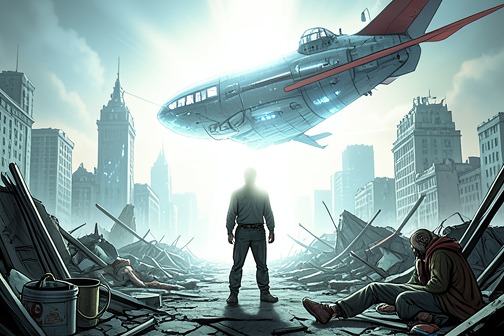
[Awakening and Destruction of Tor Ilek](entity:event-recall-event-awakening-and-destructi-9f4fd407d075) is the decisive catastrophe of the expedition’s passage through the ancient ruins. What begins as an act of salvage becomes an escape from a force no one can identify or fight: an apocalyptic radiance rises beneath the city, meets the [Unflame](entity:state-recall-state-unflame-841fb624b656) carried aboard the Endeavor, and consumes [Tor Ilek](entity:location-recall-location-tor-ilek-da8c883970ba) in a fusion of malignant cold, hungry light, and geological ruin. The event preserves [Jonathan Heights](entity:character-recall-character-jonathan-heights-d9ccad9c719b) and his companions, but destroys the site, traumatizes one of the airmen, and deepens the expedition’s governing paradox: knowledge is necessary for survival, yet every discovery may awaken something that civilization cannot contain.
## Causes and Background
The expedition reaches Tor Ilek as part of Jonathan Heights’s eastward search for [Sunlight](entity:state-recall-state-sunlight-28d75af2a2d6). He is traveling through a world of lightless skies under the authority of the [Illuminated King](entity:character-recall-character-illuminated-king-657c25addf69) and the Reflected Council, moving beyond the eastern boundary of human civilization in pursuit of a truth most people dismiss as a myth. The journey has already placed him and his companions among environments where human maps, categories, and safeguards are unreliable. At [Danby’s Point](entity:location-recall-location-danby-s-point-89a41017e4ad), the eastern terminus of the illuminated human track, human construction presses against the architecture and inhabitants of darker forces; beyond that frontier, Jonathan relies on accumulated experience, copied maps, and information purchased from [Tiuni](entity:character-recall-character-tiuni-517876ba3162).
Tor Ilek therefore represents more than an isolated ruin. It belongs to the ancient and unrecorded world that Jonathan has chosen to enter, a world whose relics can be traded, mapped, and partially understood without becoming safe. Before the catastrophe, the crew explores the decrepit city and gathers treasure from its halls. Jonathan constructs a mechanism of rings and armatures copied from impossible geometry, and its operation alters the ruin’s apparent structure: doorways appear where none had existed, corners open into new passages, and the crew’s opportunity for plunder expands at precisely the moment the site becomes less intelligible.
The immediate cause is the crew’s disturbance of something below or within the ruins. A fleeing airman returns babbling, a deep low sound vibrates through the stone, a hot breeze overwhelms the constant sound of the river, and the gathered metal treasure begins to clink. Jonathan does not know whether the danger is a creature, a phenomenon, or something produced by the expedition’s interference. His conclusion is nevertheless immediate and practical: the expedition must flee. The crew’s greed has converted a salvage operation into an awakening, while the event leaves the nature of what was awakened deliberately unresolved.
## The Escape from the Ruins
Jonathan leads the retreat through corridors as furnace heat rises behind the party. The hot air intensifies from a breeze to a gale, driving the expedition forward while beasts and vermin throughout the unlit reaches of Tor Ilek erupt from their lairs. The creatures are not attacking the expedition; they are fleeing in the same direction. Their flight supplies the clearest available measure of the threat, since even the hostile inhabitants of the ruin appear to recognize that remaining behind means destruction.
The expedition catches glimpses of stretched, spider-limbed animals and hulking bodies moving through colors both bright and dim. After the party exits the monolith, something massive plunges into the distant river, its shape only partially visible and its scale comparable to some of the surrounding buildings. Behind them, the roar grows into an unending, apocalyptic sound. Jonathan looks back and sees a glow of bright, hungry color that he cannot name. It behaves less like a passive eruption than a pursuing intelligence, capable of overtaking the fleeing group but choosing instead to nip at its heels.
The escape becomes a physical contest against closing doors, heat, and exhaustion. Jonathan races ahead to reopen doors that have sealed behind the group, including a ring-locked door whose circular handle requires several moments of effort. [Eleanor McAvey](entity:character-recall-character-eleanor-mcavey-56495d17d879), [Antomine](entity:character-recall-character-antomine-c73da0eb5297), the guards, the companions, and the airmen follow through the opening. Two injured or incapacitated crewmen must be hauled bodily by the others, and the expedition’s movement remains threatened by the possibility that the airmen may have to choose between saving their companions and carrying away the treasure.
At the final stairwell, the heat becomes difficult to breathe, and the boots of the fleeing crew begin to smoke. The Endeavor waits above, but the crew stationed at the descent line has begun to withdraw it because the strange radiation is spreading through cracks and rents in the ruins. Jonathan reaches the line with Eleanor McAvey and Antomine behind him, followed by the companions, guards, maids, and injured airmen. Once aboard, Jonathan does not simply abandon the ruin. He retrieves an amphora of Unflame from the cargo and throws it down onto the dome as the last crewman is pulled to safety.
## The Collision of Unflame and Light
The amphora breaks on the dome, releasing a dark liquid that erupts into black, atramentous flame. Its malignant cold suppresses the heat rising toward the Endeavor and makes the metal descent equipment brittle enough for the cables and tether lines to be cut and released. The device is not presented as a conventional weapon with a controlled target or predictable result. It is a second impossibility introduced into an already unstable site, used by Jonathan because he has no better means of preventing the pursuing force from reaching the ship.
The black fire and the horrific radiance meet and merge. The image is intimate as well as violent: the two forces touch and embrace, and the light appears to drink the darkness. This brief quiescence gives the Endeavor its chance. [Montgomery](entity:character-recall-character-montgomery-3d1e676073f0), watching from the bridge, orders the engines to full power and commands an emergency ascent while the deck lurches beneath the survivors.
The apparent reprieve becomes a larger catastrophe. The Unflame and the hungry light fuse into something more terrible than either source, then leap outward through the ancient streets and halls. The illumination exposes Tor Ilek more completely than the expedition has ever seen it, revealing the crumbled grandeur and impossible architecture of the forgotten civilization even as the combined force destroys them. The city is made visible by the very doom that consumes it, so that discovery and obliteration occur in the same instant.
The destruction reaches the river. Unnamable colors leach into steam, the water appears to boil, and the sound of ruin overwhelms the Endeavor’s engines before gradually fading as the airship pulls away. Tor Ilek founders beneath the spreading forces; falling debris enters the river, which churns over the remains and turns them into a watery necropolis of rotted stone and drowned, tombstone-like fragments. The expedition does not merely leave a dangerous ruin behind. It witnesses the conversion of an ancient city into its own graveyard.
## Consequences for the Expedition
The survivors emerge physically alive but not unchanged. Eleanor McAvey demands an explanation, while the injured airman who had been attacked or disturbed during the expedition stares into space and speaks only in a language described as unfit for human speech. Reflections of the terrible light remain in his pupils, making his body a lingering record of an experience no one else can interpret. The catastrophe therefore continues after the immediate escape: Tor Ilek has been destroyed, but its effect has entered the survivors and their account of the journey.
Jonathan admits that he does not know what happened. His explanation is not a revelation of hidden lore but a statement of the limits of human knowledge: the darkness contains things without names and phenomena no expedition has previously encountered, and every expedition returns with new records accompanied by more questions than answers. His response protects the group from false certainty, but it also confirms that the event cannot be reduced to an ordinary monster attack or mechanical accident.
The catastrophe establishes a recurring pattern in Jonathan’s expedition. The crew’s maps, tools, trade goods, and mechanisms make contact with the unknown possible, yet those same instruments invite danger. At Danby’s Point, trade and human governance extend into a frontier where the Inquisition is simultaneously strongest and weakest; at Tor Ilek, the expedition’s act of measurement and acquisition opens spaces that were previously hidden. The more successfully the explorers penetrate the ruin, the less stable the distinction becomes between object and threat, artifact and agency, exploration and desecration.
The event also sharpens the conflict between Jonathan’s objective and the wider claims of civilization. Later, at [Angkor Leng](entity:location-recall-location-angkor-leng-dfd69cfaf06c), Antomine argues that a threat cannot be ignored merely because addressing it is inconvenient, while Jonathan insists that the expedition is not a navy and lacks the time and resources to cleanse an entire city. Tor Ilek gives that disagreement an earlier, more terrible context. The party has already learned that entering, investigating, and attempting to control an unfamiliar site can produce devastation on a scale no small expedition can manage. Jonathan’s refusal to promise mastery is therefore grounded in experience, even though his continued pursuit of Sunlight repeatedly carries him toward precisely such uncontrollable thresholds.
## Narrative and Thematic Significance
Tor Ilek is a threshold event in Jonathan Heights’s hero’s journey, but it reverses the reassuring form of an ordeal. The expedition crosses into an ancient space expecting knowledge and treasure; it leaves with survival but without explanation, and the apparent reward of discovery is inseparable from destruction. The city’s architecture becomes legible only while it is being erased. In that reversal, the event gives narrative form to the book’s suspicion that human knowledge does not simply illuminate the darkness; it can also provoke the darkness into answering.
The sequence is structured around a severe value shift. The crew begins by treating the ruin as a source of wealth and information. When the awakening occurs, treasure becomes a burden, exploration becomes flight, and the value of survival temporarily competes with the value of preserving fellow crewmen or salvaged objects. Jonathan’s command to flee is stark because it cuts through that hierarchy. His later use of Unflame changes the terms again: the expedition survives, but only by setting one incomprehensible force against another and accepting the destruction of the place it entered.
The event also occupies an unstable space between the sacred and the profane. Tor Ilek is treated neither as a simple archaeological site nor as a fully explained temple. Its impossible geometry, buried power, and final illumination give it an almost ritual character, while the expedition’s looting and technical intervention belong to commerce and practical exploration. The later funerary ceremony for a dead titan, in which Antomine recites, “[From dust ye were made and dust ye shall be](entity:expression-recall-expression-from-dust-ye-were-52dcd29c96ea),” shows the expedition attempting to impose ritual order on alien death. Tor Ilek offers no comparable closure. Its destruction is witnessed, recorded, and interpreted only as an unanswered danger.
That uncertainty is central to the event’s lasting force. Jonathan is sustained by his faith in Sunlight, yet even that conviction cannot explain the glow that pursues the expedition or the force that consumes the city. He can only preserve the fact of survival and the warning that the ruins’ treasure carries risks beyond human imagination. Tor Ilek consequently becomes one of the sacrifices later remembered on Jonathan’s path toward [Bright Defile](entity:location-recall-location-bright-defile-18d73f1df73b): alongside Tiuni’s death, the burning of a dead god, the sacrifice of Angkor Leng, and the loss of his former relationships, the destruction of the city marks the cost of crossing from the known world toward Sunlight. Its final significance is not that the expedition solved an ancient mystery, but that it survived long enough to carry the mystery onward.
Event 13
Verdant Expanse Caravan Encounter
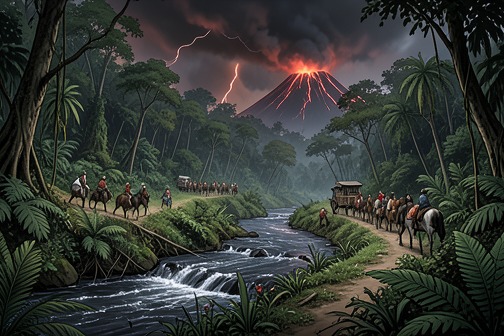
The [Verdant Expanse Caravan Encounter](entity:event-recall-event-verdant-expanse-caravan-560ac9ff45d7) is a decisive resupply and threshold event in the Endeavor’s eastward expedition. Facing volcanic storms, flooded jungle, hostile wildlife, and no reliable natural harbor, [Jonathan Heights](entity:character-recall-character-jonathan-heights-d9ccad9c719b) locates a moving caravaneer community and secures shelter through language, trade, and disciplined negotiation. The meeting keeps the expedition alive, but it also unsettles the boundary between human civilization and the nonhuman societies that the crown and the Inquisition attempt to contain.
## Causes and Setting
The encounter arises from the [Verdant Expanse](entity:location-recall-location-verdant-expanse-01f0675c6588)’s refusal to function as ordinary territory. Volcanoes continually throw ash and lava across monumental vegetation that regrows almost immediately, while rivers from both north and south generate violent weather. A clearing may be temporary or occupied by something dangerous, and the Endeavor cannot safely fly straight through the region’s unstable climate. Jonathan therefore treats the caravaneers as the best available form of safe harbor: their moving communities know the forest, can defend themselves against its inhabitants, and travel along routes that an outsider could not reliably find.
The search depends on accumulated expeditionary knowledge. Jonathan and the navigator use imperfect charts and intelligence previously obtained from [Tiuni](entity:character-recall-character-tiuni-517876ba3162) to estimate where a caravan should be, then look for a trail rather than a conventional anchorage. The trail is visible because the canopy has been cleared enough to reveal a dark river and unusually large fruits and flowers. This method places Jonathan’s mapmaking beside the caravaneers’ own mobility and ecological knowledge: his charts narrow possibilities, but their route is what makes survival practicable.
The meeting also follows the expedition’s passage through increasingly unstable borders. At [Danby’s Point](entity:location-recall-location-danby-s-point-89a41017e4ad), human construction and the architecture of darker forces press against one another across a great metal gate, and the human side of the plateau is already being altered by contact with nonhuman peoples. The Endeavor’s journey thus moves from a fortified frontier of trade and restraint into a wilderness where the supposed outsiders possess the practical knowledge on which human travelers depend.
## Approach and First Contact
As the Endeavor follows the caravan trail, [Montgomery](entity:character-recall-character-montgomery-3d1e676073f0) lowers the ship toward the canopy while sailors use zint cannons against the wildlife. Huge insects pass through the spotlights, and a green-scaled creature with a head nearly the size of the Endeavor’s envelope rises from the trees. Sustained cannon fire drives it away without clearly inflicting much damage, making the ship’s vulnerability unmistakable even before contact with the caravan begins.
Jonathan recognizes the caravan ahead as a line of ghostly white forms and orders Montgomery to extinguish the forward spotlights. He knows from earlier experience that the caravaneers dislike intense zint light, so courtesy becomes part of the ship’s defensive strategy. Jonathan then joins Montgomery on the lower platform, whistles to announce himself, and waits for the community to respond rather than forcing an approach.
The first caravaneer to reach the ship is a radically nonhuman figure. It is twice the size of a human apart from its tail, with a long neck, a reptilian head, razor claws, pearlescent scales, and a vast tail that floats thirty or forty feet behind it. The tail’s glowing stripes resolve the approaching whiteness into a living, bioluminescent body. Its movements are sharp and separated by absolute stillness, a physical rhythm that contrasts with the human expectation of continuous motion.
Jonathan addresses the visitor in the caravaneers’ language of whistles and clicks, learned in his youth. His command of the language is merely acceptable, but sufficient to establish recognition and reciprocity. He asks for shelter and supplies, offering human stories and weapons in return. The request is practical rather than sentimental: the Endeavor needs a safe place to moor and must obtain food and water before the expedition can continue.
## Bargain and Temporary Hospitality
The caravaneer accepts the proposal under a precise condition. Storms are approaching, and the Endeavor may share the caravan’s clearing provided that the human party guards it as its own. Hospitality is therefore framed as a reciprocal obligation, not a gift. Jonathan translates the exchange for Montgomery, then continues negotiating the practical details of mooring, weapons, and resupply. Montgomery’s presence ensures that the Endeavor is positioned so it can benefit from the camp while also contributing to its defense.
The caravan is not a single simple vehicle but a moving settlement. Enormous reptiles, each comparable in size to the Endeavor, clear the route by biting through leaves, trunks, vines, and flowers and by flattening the ground beneath their feet. Most of the caravan consists of house-sized sleds drawn behind these vanguard beasts, accompanied by smaller vehicles tended by the long-tailed caravaneers. Their mobility is simultaneously transportation, labor, infrastructure, and protection against the living environment.
Jonathan warns the expedition that the arrangement has absolute limits. No crew member or passenger may touch anything without invitation; theft or injury will bring death, and the human party will not retaliate or intervene. Mere offense would also force the Endeavor to leave and attempt to gather supplies without native support, an undertaking Jonathan has already established as perilous. The warning is directed at everyone, but his cold gaze lingers on [Eleanor McAvey](entity:character-recall-character-eleanor-mcavey-56495d17d879), whose judgment he considers potentially hazardous even though he does not regard her as foolish.
The ship is tethered with a thick braided vine attached to one of the pack-beasts’ harnesses. A gondola then approaches along the tether, propelled by means the humans do not understand, and a rope bridge connects it to the Endeavor. Jonathan leads the party into the basket, whose walls are lit by grey-green globes, and the conveyance lowers them into the caravan’s camp. The descent marks a literal movement from the airship’s controlled human platform into a nonhuman social space governed by rules Jonathan can explain but does not control.
## Exchange, Hunting, and the Limits of Translation
Trade is organized around scarcity and usefulness. Jonathan tells the expedition that raw metal stock is the best barter because steel is more valuable to the caravaneers than gold or silver. He carries a case of rolled steel rods himself, while the Endeavor has been loaded with extensive equipment: a portable luminiferous terrestrite distillation apparatus, a lifting gas separator, water siphons and filters, portable searchlights, crew-served zint guns, spare parts, food, water, clothing, and other necessities. The encounter converts part of that carefully assembled expeditionary infrastructure into access to local resources.
The caravan offers immediate shelter while the storm passes, but the greater opportunity is future cooperation. Jonathan explains that the humans may trade during the delay and later accompany hunting parties for supplies. Montgomery notes that the expedition will soon need water and fresh food, even if its stored provisions can last for a few more weeks. The caravaneers therefore provide more than a marketplace: they offer access to an ecological labor system capable of obtaining food in a landscape where the human travelers cannot safely hunt alone.
Communication remains an unequal but workable process. [Antomine](entity:character-recall-character-antomine-c73da0eb5297) objects that the caravaneers do not speak the human tongue, while Montgomery answers that gestures are enough for a simple exchange. Jonathan’s linguistic knowledge goes further than pantomime, but he still insists on learning the rules peculiar to each caravan. He understands that the reptiles may appear calm and then erupt into coordinated violence without visible provocation. Their society is not rendered safe by translation; it is made legible enough for the humans to avoid violating it.
The relationship between protection and predation becomes stark when a creature attacked by the Endeavor’s guns is brought into camp. The rain stops suddenly, and the remaining humans return toward the gondola as the caravaneers haul in the carcass of an enormous, long-faced, shaggy-maned beast, nearly the size of their pack animals and capable of supplying thousands of pounds of meat. Antomine begins to suggest purchasing some of it, but the entire caravan descends upon the still-warm body, tearing into it in a savage struggle over the entrails. His revulsion and immediate withdrawal of the proposal expose the difference between human commercial assumptions and the caravan’s collective feeding practices.
## Consequences and Narrative Significance
The encounter’s immediate consequence is survival. The Endeavor obtains a protected place to wait out dangerous weather, access to water and fresh food, and the possibility of joining hunting parties. Its crew is also given a disciplined framework for interacting with a society whose customs are dangerous to violate. The ship’s expeditionary capacity is not enough by itself; its continued movement east depends on negotiated dependence.
The event also complicates the expedition’s claims to civilization. The world presents humanity as a vigil of light under the authority of the [Illuminated King](entity:character-recall-character-illuminated-king-657c25addf69), while the eastern peoples are treated as savage, dark, or outside official recognition. Yet the caravaneers possess the specialized knowledge that permits travel through the Verdant Expanse, and they organize transport, defense, resource gathering, and hospitality with formidable efficiency. Human civilization arrives with charts, zint weapons, paperwork, and trade goods; the caravan answers with ecological mastery and a social order whose rules are no less exact.
Jonathan’s role is correspondingly double. He is the expedition’s indispensable mediator, using an old language, personal experience, maps, and logistical judgment to secure passage. At the same time, he remains committed to the expedition’s larger extractive purpose: he identifies routes, seeks resources, offers weaponry, and treats local knowledge as something to be acquired for the journey toward sunlight. His later refusal to divert the Endeavor into cleansing [Angkor Leng](entity:location-recall-location-angkor-leng-dfd69cfaf06c) of [Umbraught](entity:character-recall-character-umbraught-3ce6ba54e2df) shows the same prioritization. He rejects Antomine’s demand to pursue an Inquisition objective because the ship lacks the time and resources, placing the eastward mission above the broader defense of civilization.
The meeting therefore becomes a model for the book’s repeated crossings of human and nonhuman worlds. Earlier, the passage of [Glacilium](entity:creature-recall-creature-glacilium-fb0796ff3e3c) over [Beacon](entity:location-recall-location-beacon-05545c91a64e) reveals how human cities live beneath the migration of mountain-sized beings and the threats carried with them. At Danby’s Point, a gate attempts to separate human construction from darker forces, even as influence crosses in both directions. In the Verdant Expanse, no gate can preserve that separation. The Endeavor must lower its lights, speak another language, accept another people’s rules, trade steel for necessities, and rely on creatures whose scale and customs make human categories unstable.
Its broader aftermath belongs to the expedition’s return and to the changing reputation of the Endeavor. The unusual incidents surrounding the voyage contribute to the period later labeled the [Winter of Blood](entity:expression-recall-expression-winter-of-blood-d40bffbf7ef6), though the name is treated as exaggerated and the public reduces extraordinary events to gossip. The expedition’s wealth also enters a larger economy: many airmen become rich from the journey and some leave the profession, while artifacts from the destroyed [Tor Ilek](entity:location-recall-location-tor-ilek-da8c883970ba) become valuable to collectors. Against that retrospective transformation, the caravan encounter stands as one of the quieter but essential exchanges that made the later wealth possible. It is not merely an exotic stop; it is the moment when an isolated human airship survives by recognizing that the wilderness already has roads, economies, laws, and hosts.
Event 14
The Silent Minaret Incident
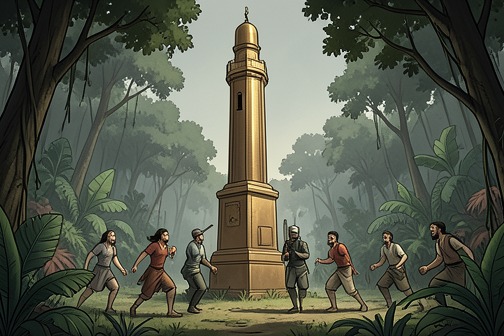
[The Silent Minaret Incident](entity:event-recall-event-the-silent-minaret-inci-68a391107e95) is one of the Endeavor expedition’s clearest encounters with an ancient power that does not merely attack the travelers but alters the conditions of perception, communication, and movement. In the [Verdant Expanse](entity:location-recall-location-verdant-expanse-01f0675c6588), [Jonathan Heights](entity:character-recall-character-jonathan-heights-d9ccad9c719b), [Antomine](entity:character-recall-character-antomine-c73da0eb5297), [Captain Montgomery](entity:character-recall-character-captain-montgomery-85ba416f8403), the airmen, and their caravaneer guides discover a pristine bronze minaret in a clearing that should not exist. Its silent bell removes speech and then sound itself, turning a routine return journey into a struggle against an invisible, hungry force. The party escapes alive, but one airman permanently loses the ability to make any audible sound, and the caravaneers interpret the encounter as a consequence of aspirations forbidden in their territory.
## [Discovery](entity:object-recall-object-discovery-074c5d88e879) in the Verdant Expanse
The incident occurs while the expedition is returning toward the caravaneer camp after hunting in the Verdant Expanse. The jungle is already difficult to navigate: paths regrow almost immediately, landmarks appear unfamiliar on the return journey, and the surrounding titans of vegetation can shift through the forest. The group remains oriented through the caravaneer outriders and Captain Montgomery’s sense of direction, but the landscape makes clear that ordinary assumptions about distance and continuity are unreliable.
A caravaneer’s warning precedes the transformation. The canopy recedes in a prolonged, unnatural moment, and gray illumination rises from the ground like mist. From the clearing emerges a burnished bronze minaret, half-buried yet astonishingly untouched by vegetation, heat, or age. A shallow spiral climbs its surface toward arches at the summit, where a cracked clay bell hangs above them. Around the structure lies a perfect ring of black, untrodden soil, without plants or stones. Jonathan Heights recognizes the absence of decoration as its own kind of style, but the tower corresponds to none of his knowledge of the civilizations buried in the Verdant Expanse; its unexplained perfection and isolated ground make it immediately threatening.
## The Silence Takes Hold
Jonathan Heights turns toward Antomine and Captain Montgomery to speak, but although his mouth moves and air leaves his lungs, no words emerge. Antomine suffers the same failure. With every attempted utterance, the menace surrounding the minaret intensifies, while the clay bell begins to rock as if tolling without producing a sound. The expedition’s inability to communicate becomes part of the danger: the airmen can only gesture, and their failed attempts at speech seem to feed the tower’s pressure.
The jungle then vanishes into the luminous gray mist behind them. Jonathan Heights regards the disappearance as a simple trick rather than an irresistible revelation, and he signals Antomine to link the party together. Their response is practical and collective: arms are clasped, hands grip the sled, and the group begins hauling itself away from the clearing. The encounter therefore turns a band of explorers into a single physical chain, with survival depending on coordinated movement after language has ceased to function.
The force grows heavier with each step. The sled’s bottom bites into the earth, some airmen struggle to remain upright, and Captain Montgomery helps pull the weaker men forward. Sound disappears in stages: first the scrape of the sled and the sigh of the wind, then breath and heartbeat. Antomine’s white-pupiled eyes glow as he resists the influence and forces a small bubble of sound into existence, but the surrounding silence responds as though it were hungry. It clutches at clothing and ropes, grips the sled, and draws objects toward the minaret; even the expedition’s single flaming fruit rolls from the supplies, its fire flickering and dying as it moves inward.
## Escape and the Cost of Survival
The danger becomes personal when an airman collapses to his knees. James or John, whose faceless armor remains expressionless, lifts him and keeps him moving. Jonathan Heights fixes his attention on the jungle’s edge, recognizing that it is closer than the distorted space suggests, and takes hold of the sled. The silence pulls backward with avaricious force, but his will is described as steel and his soul as sunlight. That inner allegiance enables him to treat the minaret’s radiance and mist as lesser distortions rather than authorities capable of determining his fate.
The party finally crosses the boundary of the mist. With one convulsive effort, Jonathan Heights hauls everyone beyond the clearing, and the entire structure evaporates. The minaret, its ring of soil, and the gray radiance disappear as though they had been made from vapor, leaving only the vibrant vegetation of the surrounding jungle. Captain Montgomery counts the people, confirming that the group has not lost a life, while Jonathan Heights discovers that a lizard has slipped along with them.
Survival is nevertheless incomplete. The airman who collapsed has suffered a permanent loss of sound. No word, shout, or clap of the hands produces anything audible from him. Antomine takes the distraught man aside during the slow return, attending to the consequence while the rest of the party proceeds cautiously among other possible antiquities. The incident’s value shift is therefore stark: the travelers enter an unfamiliar clearing as a functioning expedition, lose speech and nearly their physical freedom, and emerge alive but with communication permanently damaged for one member.
## Taboo, Suspicion, and the Return
Jonathan Heights demands an explanation from the caravaneer, asking why the party was not warned and whether it had failed as a group of guests. The guide replies that the hazard was not foreseen and suggests that someone among them may be following a taboo path capable of attracting the workings of the ancients. Such aspirations, the caravaneer concludes, are forbidden, and the group will have to leave. Jonathan Heights refuses to abandon the expedition before obtaining what it needs. His answer preserves the expedition’s immediate objective but also confirms the tension between his purposes and the local order.
The caravaneer’s explanation does not satisfy him. Jonathan Heights considers that either he or Antomine may have provoked the minaret simply by being present. He still does not know the [Illuminated King](entity:character-recall-character-illuminated-king-657c25addf69)’s true interest in sunlight or why the Society of Explorers opposed it so strongly. He therefore entertains several possibilities: a forgotten device may have resonated with the memory he carries, or Antomine’s fragment of the Illuminated King’s secret may have been objectionable to the ancient mechanism. The minaret is never reduced to a solved artifact; its meaning remains tied to the larger mystery of sunlight, forbidden knowledge, and the competing claims of exploration and containment.
The return journey carries the encounter’s fear forward. Twice Jonathan Heights stops the group because he senses an unnamed evil beyond the circle of zint-light, although nothing attacks them. Leaf and branch shadows form suggestive claws, jaws, and other threats, and the party burns the most disturbing obstacles with oily flame. They reach the encampment after an hour, alive but with frayed nerves. There they find a new confrontation already developing: the gondola has been torn from the vine leading to the Endeavor, airmen stand nearby with guns, [Eleanor McAvey](entity:character-recall-character-eleanor-mcavey-56495d17d879) and her maids face several motionless caravaneers, and the expedition must move directly from an encounter with an ancient silence into a human standoff.
## Narrative Significance
The Silent Minaret Incident makes language itself an unstable resource. The travelers cannot negotiate, warn one another, or call for help; gestures replace speech, and then even the physical evidence of breath and heartbeat is removed. The loss of one airman’s voice extends that formal disruption beyond the scene, turning the minaret’s attack into a lasting alteration of a person rather than a danger that ends when the tower vanishes.
The encounter also establishes the Verdant Expanse as a space where hospitality and prohibition coexist. The caravaneers guide the expedition, yet their knowledge does not protect it from every ancient hazard, and their explanation places moral limits on the visitors’ aspirations. Jonathan Heights treats those limits as obstacles to be resisted. His refusal to leave before securing the expedition’s needs shows that the minaret is not an isolated horror but a concentrated expression of the expedition’s broader logic: the farther it moves toward sunlight and forbidden knowledge, the more often the world answers with rules that cannot be translated into ordinary human terms.
The event’s later significance is sharpened by the expedition’s continuing use of ritualized passage and sacrifice. Elsewhere, Antomine conducts funerary rites for the dead, Jonathan Heights triggers buried machinery beneath [Angkor Leng](entity:location-recall-location-angkor-leng-dfd69cfaf06c), and the Endeavor passes through the [Arch of Khokorron](entity:location-recall-location-arch-of-khokorron-5d801aa6e8a6) by paying a knowledge toll. The minaret differs from those episodes because it offers no intelligible exchange and accepts no deliberate payment; it simply takes speech, sound, and the party’s sense of stable space. Its disappearance does not resolve the danger. Instead, it leaves behind a voiceless survivor, an unresolved taboo, and the suspicion that Jonathan Heights and Antomine carry secrets capable of awakening powers that the surrounding cultures can neither predict nor control.
Event 15
The Caravaneer Flesh Bargain
[The Caravaneer Flesh Bargain](entity:event-recall-event-the-caravaneer-flesh-ba-9fa048b2e6ba) is the decisive settlement reached after the Endeavor’s supply expedition collapses into a confrontation with the caravaneers. Martin has stolen a pale-blue amber statuette, violating the camp’s guesting agreements, while the human party has separately been led into a dangerous ruin without warning. [Jonathan Heights](entity:character-recall-character-jonathan-heights-d9ccad9c719b) turns these two breaches into opposed debts, but the bargain does not preserve Martin’s bodily integrity: it preserves his life at the price of his hand. The scene makes survival a matter of accounting, translation, and unequal power rather than mercy.
## Setting and Immediate Crisis
The bargain begins when the returning humans find the gondola ripped from the vine leading to the Endeavor. Airmen stand around it with guns, [Eleanor McAvey](entity:character-recall-character-eleanor-mcavey-56495d17d879) and her maids are tense and ready, and the caravaneers face them in silence, their tails drifting slowly. The physical arrangement shows how quickly a commercial visit has become a hostage standoff. The immense pack-beasts surrounding the camp make open violence impractical, while the lack of a shared language makes Jonathan’s intervention essential.
Jonathan Heights moves toward the gondola despite the danger and appeals to the camp in clicks and whistles, asking what has caused the disagreement. [Eleanor](entity:character-recall-character-eleanor-f86629a4f595) explains that the caravaneers want to take Martin. The accusation is then stated in terms more serious than ordinary theft: the human has stolen, violated the guesting agreements, and forfeited the rights attached to his flesh. In the caravaneers’ system, hospitality is not merely courtesy. It creates reciprocal obligations, and its violation authorizes a bodily claim.
## The Theft and the Counterclaim
[Antomine](entity:character-recall-character-antomine-c73da0eb5297) investigates and returns almost immediately with the object Martin tried to remove. He describes the airman as possessing a profoundly deficient intellect and explains that Martin believed he could spirit away the statuette unnoticed. The object is made of pale blue amber, translucent and shimmering in the ghost-light cast by the caravaneers’ tails. Its specific material presence matters: Martin’s offense is not an abstract breach but an attempt to convert a local possession into portable value.
Jonathan recognizes Martin as probably one of the crew hired at [Danby’s Point](entity:location-recall-location-danby-s-point-89a41017e4ad), though he doubts [Captain Montgomery](entity:character-recall-character-captain-montgomery-85ba416f8403) would knowingly have accepted someone so reckless. Antomine insists that Martin’s poor judgment does not make him unworthy of empathy. Jonathan, however, refuses to risk anything valuable on an appeal for clemency. The party had been warned about the consequences of theft, even if airmen tended to interpret ownership loosely when visiting foreign ports. He returns the statuette to the accusing caravaneer rather than treating it as evidence to be retained or as an object that could be leveraged for private advantage.
Jonathan’s real strategy is to oppose one failure with another. He acknowledges the caravaneers’ penalty for theft but argues that their guides led the expedition directly into an entrapping ruin and failed to warn the humans. The party escaped only through its own efforts. He deliberately omits the fact that a caravaneer had also been rescued during that episode, understanding that the guides would count abandonment as a failure, not as a credit. His argument therefore follows the caravaneers’ own logic: obligations are measured as debts, and one breach may be held against another.
## Negotiation and Bodily Payment
The caravaneer rejects Jonathan’s attempt to balance the scales by declaring that one of the humans carries forbidden desires. That condition makes the party’s presence itself dangerous in the caravaneers’ view, but Jonathan answers that it does not absolve the guides of their duties as hosts and guards. He claims that the humans are owed the default payment of flesh for services not rendered in good faith, then offers to trade the two debts so that the caravaneers’ claim can be held in abeyance until later.
The exchange produces only a partial victory. The caravaneer agrees that the debts may be traded but insists that the scales remain unbalanced and that a pound of flesh is still required. Jonathan accepts the condition and orders Antomine to bring Martin out. His formulation is grimly precise: Martin will live, but he will not be happy. Antomine’s guards drag the airman from the gondola, and Jonathan tells him to consider himself lucky because survival is what the bargain has purchased.
The punishment is carried out almost instantly. Martin begins to protest, but a flash of scale and jaws leaves him staring at the stump of his wrist where his hand had been. Jonathan wraps a cord around the arm and tightens it as a tourniquet before pushing the shocked airman back toward Antomine. The gesture combines practical rescue with emotional refusal. Jonathan does not abandon Martin to die, yet neither does he disguise mutilation as compassion. He has secured the minimum possible outcome and treats the cost as settled business.
## Consequences for the Expedition
After the amputation, Jonathan orders the party to retrieve its sleds and leave. The expedition’s priority is departure, not moral reconciliation. The caravaneer camp remains a place where the humans can obtain supplies only by accepting rules they find abhorrent, while the humans’ own conduct has already shown that they are willing to extract value from foreign spaces. The bargain consequently exposes a mutual economy of exploitation: the caravaneers defend their property and customs through flesh, while the expedition seeks trade, salvage, and passage through increasingly dangerous territory.
The event also clarifies Jonathan’s command style. He is prepared to translate, argue, and accept an unfavorable settlement when the alternative is fighting the entire camp, but his calculation never becomes egalitarian. Martin’s hand is the expendable asset; Jonathan’s own safety, the expedition’s equipment, and its ability to continue eastward remain protected. His intervention saves a crewman from death while making the crewman’s body the currency of the expedition’s continued movement.
That logic recurs in the expedition’s wider economy. Jonathan later organizes supplies for the Endeavor through Danby’s Point, where equipment can be shipped by train, and supervises the loading of a portable luminiferous terrestrite distillation apparatus, a lifting-gas separator, water siphons and filters, searchlights, zint guns, food, water, spare parts, clothing, bedding, and toiletries. He is likewise willing to carry a massive section of a golden apparatus when doing so will improve the crew’s attitude. In the caravaneer bargain, as in these logistical decisions, bodies and materials are managed according to their usefulness to the journey.
## Narrative Significance
The bargain marks a value shift from the expectation of ordinary trade to the reality of sacrificial exchange. The expedition arrives seeking fresh food and barter opportunities, with Jonathan advising the crew that raw metal stock is more valuable than gold or silver. It leaves with a wounded airman and a sharply demonstrated knowledge that the eastern economy prices human flesh alongside metal, antiquities, and supplies.
The incident also foreshadows later transformations in Jonathan’s relation to violence and sacrifice. Earlier, when Eleanor questioned whether he had left companions to die, he physically choked her and insisted that the expedition had simply been unequal to what it found. Later, the death of [Tiuni](entity:character-recall-character-tiuni-517876ba3162), the destruction of [Tor Ilek](entity:location-recall-location-tor-ilek-da8c883970ba), the sacrifice of [Angkor Leng](entity:location-recall-location-angkor-leng-dfd69cfaf06c), and the loss of his friendship with Eleanor become among the sacrifices he passes through on the way to [Bright Defile](entity:location-recall-location-bright-defile-18d73f1df73b). Martin’s hand is smaller in scale, but it belongs to the same moral trajectory: Jonathan repeatedly converts attachment, injury, and loss into steps toward sunlight.
Unlike the later rites conducted by Antomine, this sacrifice receives no ceremonial framing. Antomine can render the dead into dust with distilled luminiferous terrestrite and speak proper words over the three dead crewmen, but Martin’s mutilation is handled through a cord, a tourniquet, and an order to move on. The contrast separates institutional mourning from expeditionary pragmatism. The Caravaneer Flesh Bargain therefore stands as one of the clearest scenes in which Jonathan’s pursuit of sunlight demands not only courage or knowledge, but the willingness to let another person’s body pay the price.
Event 16
Terminus Stay and Departure
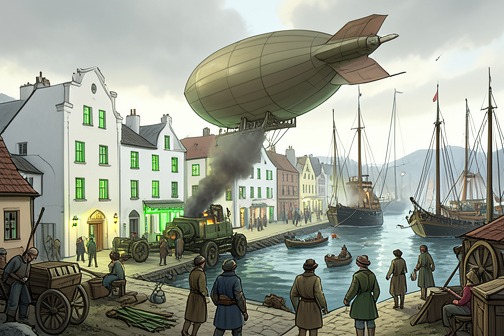
[Terminus Stay and Departure](entity:event-recall-event-terminus-stay-and-depar-addbd804e091) marks the point at which the Endeavor’s expedition confronts a new kind of danger: not a visible monster or hostile city, but a settlement so clean, welcoming, and orderly that its very harmlessness becomes suspicious. Found in the wilderness around a terrestrite vein, [Terminus](entity:location-recall-location-terminus-9fe35f8062b8) offers repair, supplies, books, food, and apparent safety. Yet its hospitality gradually separates the expedition from itself, as crew members abandon the ship and [Jonathan Heights](entity:character-recall-character-jonathan-heights-d9ccad9c719b) concludes that the town’s true weapon is temptation.
## [Discovery](entity:object-recall-object-discovery-074c5d88e879) of an Impossible Settlement
The encounter begins when the Endeavor approaches what should have been an isolated terrestrite vein and instead finds rumbling machinery, a bright town, tall white walls, sturdy mooring towers, and busy streets. Human infrastructure appears to have been established far beyond the ordinary reach of [Beacon](entity:location-recall-location-beacon-05545c91a64e), producing what Jonathan recognizes as an impossible flame of civilization in the wilderness. The mooring towers display inviting green lights, human figures move about the port, and the settlement is plainly preparing to receive the arriving airship.
Jonathan accepts that Terminus is physically real, but he refuses to regard it as genuine in any moral or political sense. A clean, well-supplied town could not have appeared in only a few years without a trace of the undertaking in Beacon, especially when every pound of metal and stone would have had to be transported by airship. [Antomine](entity:character-recall-character-antomine-c73da0eb5297) reaches a similar conclusion from the perspective of the Inquisition, questioning where the inhabitants and their supplies came from. Their shared suspicion establishes the central tension of the stay: Terminus is not an illusion, but its existence seems to violate the expected order of the world.
## The Port and Its Hospitality
Jonathan and Antomine descend to the mooring towers in flight suits, with zint engines keeping them aloft. The people they pass appear clean, healthy, cheerful, and entirely ordinary; they wave to the visitors while continuing their maintenance and repair work. Carriages cross smooth flagstones, zint lamps illuminate tidy streets, and even the absence of the stench associated with less civilized settlements makes the town more disturbing to Jonathan. The portmaster, [Connor Freeman](entity:character-recall-character-connor-freeman-176a43790aac), greets them with a firm handshake and enthusiastic friendliness, praises the Endeavor, and assures them that the ship may moor wherever convenient.
The town continues to behave like an ideal human settlement. Jonathan wanders its streets, visits shops, observes ordinary residents, and finds no open disorder or threatening shadow. He buys books containing lost-language scholarship, an experience that recalls his younger life as an explorer of forgotten histories. The purchase briefly reconnects him with the intellectual appetite that once defined him, but the sunlight within him makes that former attachment feel hollow by comparison. Terminus therefore offers not merely physical comfort but access to the past Jonathan has spent much of his life pursuing.
The apparent safety extends to the expedition’s daily life. [Eleanor McAvey](entity:character-recall-character-eleanor-mcavey-56495d17d879) leaves to enjoy one of the town’s cafes, while Antomine also takes his leave. Jonathan spends several days studying his books as repairs are completed and new purchases are brought aboard. Airmen and passengers move through Terminus without incident, and the town offers taverns, inns, and other familiar pleasures. Each ordinary detail strengthens Jonathan’s conviction that the settlement’s danger is deliberate precisely because it refuses to reveal itself.
## Suspicion, Temptation, and Defection
Jonathan repeatedly searches for the hidden mechanism behind Terminus but finds only friendly normalcy. He sees no dark secret, no dangerous wildlife, and no visible force enforcing the settlement’s peace. The clocks announce the end of the day in a ragged chorus, yet even this familiar marker of time offers no clue. Instead, the town seems constructed to prove Jonathan wrong about the nature of the world. His inability to identify a concrete threat makes his distrust more difficult to defend, while the settlement’s enforced friendliness steadily frays his patience.
The decisive reversal occurs when the Endeavor prepares to depart. [Montgomery](entity:character-recall-character-montgomery-3d1e676073f0) reports that two crewmen, Martin and Oscar, refuse to return to the ship. Martin is the man who lost a hand; Oscar is the man who lost his voice. Antomine explains that both have chosen Terminus’s hospitality, and he has judged it unwise to remove them by force. Montgomery objects because Oscar has served with him since the early days and because the expedition needs every available crew member. He also refuses to abandon his people if the town is a trap.
Antomine offers the crucial interpretation of the defection. He does not believe occult control is twisting the men’s minds; rather, Terminus is simply pleasant while the outside world is terrifying. His admission makes the settlement’s power more unsettling, not less. The men may be choosing freely, yet the choice has been shaped by comfort, exhaustion, and fear. Terminus does not need chains when it can make departure appear irrational.
## Departure and the Rejection of the Past
Jonathan finally orders the expedition to leave while it still can. He expects some opposition, but none appears. The lack of resistance confirms his suspicion that the trap has already succeeded: Terminus does not need to block the Endeavor because it has already altered what its visitors want. Antomine and [Captain Montgomery](entity:character-recall-character-captain-montgomery-85ba416f8403) follow Jonathan aboard, while the ship departs without a battle or visible supernatural confrontation.
As the lights of Terminus recede, Jonathan returns to his cabin and removes the books purchased there. These volumes contain secrets and knowledge he had wondered about throughout his life, yet he carries them onto the top deck and throws them one by one into the darkness. The gesture transforms departure into renunciation. The books belong to the past rather than the future, and Jonathan chooses the uncertain pursuit of sunlight over the inherited promises of scholarship, comfort, and settled civilization.
## Narrative Significance
Terminus is a threshold settlement between the organized world of Beacon and the lethal eastern wilderness. Its bright streets reverse the usual expectation that danger belongs to darkness: here, illumination conceals rather than reveals. The event also extends a recurring contrast in Jonathan’s experience. Beacon’s zint-light already seemed dishonest beside sunlight, but Terminus makes artificial civilization almost perfectly persuasive, converting order and hospitality into instruments of seduction.
The stay’s consequences persist beyond the port. Jonathan’s suspicion of safe human spaces hardens into a governing principle, while Montgomery’s concern for Martin and Oscar exposes the human cost of continuing the expedition. The crew’s later wealth and the public excitement surrounding the Endeavor’s return contribute to the period that some in Beacon call the [Winter of Blood](entity:expression-recall-expression-winter-of-blood-d40bffbf7ef6), but Terminus itself leaves a quieter mark: it demonstrates that an expedition can be threatened by the desire to stop. Its departure is therefore both a geographical movement and a moral decision, in which Jonathan abandons valuable knowledge and accepts danger as the price of continuing east.
Event 17
The Dead Titan Funeral Rite
[The Dead Titan Funeral Rite](entity:event-recall-event-the-dead-titan-funeral-be4bb57026d8) marks the moment when the Endeavor’s struggle against an apparently motionless landscape becomes an act of exorcism and burial. Trapped above diseased briar that does not correspond to [Jonathan Heights](entity:character-recall-character-jonathan-heights-d9ccad9c719b)’s maps, the ship discovers that it has entered the remains of something vastly larger than an ordinary creature or terrain. The corpse is not harmless simply because its life has ended: its flesh, blood, air, and spatial residue continue to exert a malign force. Escape therefore requires more than navigation. Jonathan must identify the dead being, [Antomine](entity:character-recall-character-antomine-c73da0eb5297) must grant it final rites, and [Captain Montgomery](entity:character-recall-character-captain-montgomery-85ba416f8403) must set its remains alight with ordinary fire.
## Recognition of the Corpse
The rite begins with a failure of ordinary knowledge. The compass and triskolabe wander without purpose, while only the inverted zint indicator continues to point backward; outside the windows, diseased briar rises in every direction, yet the Endeavor remains suspended over the same depression despite the engines’ effort. Jonathan Heights’s maps offer no reliable landmark, and the surrounding terrain seems to belong to another place, time, or mechanism. Searching the ship’s records, Jonathan finds an account of a battle between titans beyond the great lavafall of the [Godforge](entity:location-recall-location-godforge-64c736e5aecd). Its description of a dead victor or loser whose blood, viscera, and every remaining fragment were as dangerous as a living god gives shape to the ship’s predicament. He then consults several forbidden books, including works excluded from [Beacon](entity:location-recall-location-beacon-05545c91a64e) because their authors were nonhuman, translating obscure passages and comparing references until ink smokes and sizzles against the parchment. The discovery is not merely a geographic clue: it identifies the apparent landscape as the corpse of an immense divine being and transforms the crew’s aim from finding a route through hostile country to performing a burial capable of releasing the ship.
## Naming and the Burden of Final Rites
Jonathan Heights’s research produces a name powerful enough to become a physical danger. He tears the crucial page from his notebook, carries it down to the canteen, and presents it to Antomine with the conclusion that something has died but remains present. Antomine initially responds with disbelief at the request to administer final rites to a rotting heathen demigod, while [Eleanor](entity:character-recall-character-eleanor-f86629a4f595)’s reaction is more immediate: when she looks over Antomine’s shoulder, she flinches, turns away, and rubs at eyes stung by the impact of the written name. The name is therefore neither neutral information nor a simple label. It possesses weight, provokes pain, and confirms that the ship is dealing with a being whose death has not ended its influence. Jonathan estimates the scale of the danger from the corpse’s insatiable hunger and putrescence, ordering a full canister of fire dust because an ordinary quantity of fuel could not plausibly consume what had once been godlike. Although Antomine hesitates, he accepts the page and the duty attached to it, while Jonathan promises the uneasy crew that their confinement will soon end. The ritual thus joins scholarship to religion: Jonathan supplies the forbidden knowledge that makes the corpse intelligible, and Antomine must convert that knowledge into an act of sacred disposal.
## The Burning and Its Aftermath
Jonathan Heights carries the fire dust to the stern while the Endeavor begins moving through air that remains unnaturally dead. He breaks the seal on the cask and exposes a powder whose heat seems to reach beyond skin into mind and spirit, an invitation to surrender to the flames that he rejects in favor of the purity of sunlight. Tilting the container with extreme care, he lets the substance sift overboard in a long, luminous trail. He leaves no residue on the ship or on himself, since the powder burns steel, carisium, and flesh alike. As it spreads, the fire dust outlines something far more immense than a hill or thicket: limbs, alien protuberances, cavities, and rotted structures emerge beneath the diseased briar, suggesting that the Endeavor has been flying not simply above the corpse but through its distorted remains.
The revelation culminates when a vast hollow eye appears below the ship. Though the titan is dead, its regard remains piercing, and its attention falls upon Jonathan Heights and the Endeavor as they attempt to escape its grasping decay. The corpse is presented as a geographical impossibility as much as a biological one, an ungraspable contortion of land and space whose interior passages have become the ship’s prison. The fire dust does not ignite immediately; Jonathan waits for the proper moment while Antomine performs the unseen portion of the rite on the bridge. The sequence makes the corpse’s destruction dependent on coordination between material knowledge, religious authority, and the ship’s practical command rather than on any single character’s expertise.
Antomine completes the ceremony with the words, “[From dust ye were made and dust ye shall be](entity:expression-recall-expression-from-dust-ye-were-52dcd29c96ea).” The bridge falls sober and silent, and even the ancient, alien being receives the formal respect accorded to the dead. Antomine then tells Captain Montgomery that it is time to light the pyre. [Montgomery](entity:character-recall-character-montgomery-3d1e676073f0) asks whether zint will suffice, but Jonathan explains that zint does not truly set things aflame and that ordinary fire is required. Antomine offers the paper bearing the titan’s name; Montgomery takes it carefully, steps onto the rail, and lights it with a match. The paper burns with unnatural intensity as it descends through the motionless air, becoming the spark that the fire dust has awaited.
The ignition transforms the funeral into a vast act of purification. [Fire dust](entity:concept-recall-concept-fire-dust-a914d096c59a) erupts in a roaring conflagration that consumes the briar, then flesh, bone, and even the surrounding air, because ordinary fire wrought through the right ritual can burn what was made by gods. Flames rise in patterns of dire and alien significance, prompting Antomine to warn the onlookers and leading the airmen to avert their eyes. Jonathan refuses to look away. His refusal establishes the rite’s final contrast: the fire destroys a dead divinity through sacred procedure, while Jonathan measures every revelation against the sunlight within him and finds nothing in the titan’s symbols more profound than that light.
## Consequences and Narrative Significance
The funeral rite releases the Endeavor from a space where navigation, geography, and ordinary causality have failed. It is therefore both burial and escape mechanism, converting the ship’s apparent landscape into a pyre and restoring a route where there had been only circular instruments and immobile terrain. The event also anticipates the expedition’s later pattern of passage through dangerous thresholds: advancement requires the crew to identify what has trapped them, understand the rules governing it, and pay a material or spiritual price to proceed. The titan’s death shows that the eastern world does not divide cleanly between living threat and inert environment; even a corpse can possess agency-like force, demand recognition, and endanger those who cross it.
The rite’s consequences extend beyond the immediate escape. Jonathan Heights’s willingness to study forbidden, nonhuman records and to confront the corpse’s symbols without looking away becomes part of the accumulating burden he later carries toward [Bright Defile](entity:location-recall-location-bright-defile-18d73f1df73b). In the reckoning that enables his final crossing, he remembers the burning of the god’s corpse among the losses and sacrifices that illuminate his path. The funeral thus returns at the end of the narrative as one of the steps by which Jonathan abandons the ordinary world: an episode that began as an attempt to save the Endeavor becomes evidence of his increasing separation from human limits, conventional knowledge, and the fearful discipline represented by Antomine.
Event 18
Burning of the Deific Corpse
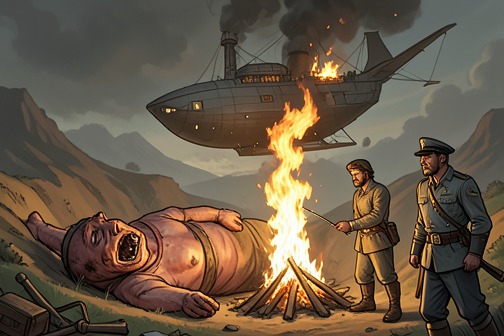
[Burning of the Deific Corpse](entity:event-recall-event-burning-of-the-deific-c-e2673e3343f9) is the expedition’s decisive act of purification and release: aboard the Endeavor, [Jonathan Heights](entity:character-recall-character-jonathan-heights-d9ccad9c719b), [Antomine](entity:character-recall-character-antomine-c73da0eb5297), and [Captain Montgomery](entity:character-recall-character-captain-montgomery-85ba416f8403) turn a dead god’s immense corpse into an ordinary-fire pyre, and the resulting conflagration drives the airship out of the foul interregnum surrounding it. The event is both funeral rite and propulsion system, binding reverence to desperate engineering and changing the expedition’s condition from entrapment to renewed eastward flight.
## Causes and Sacred Context
The Endeavor encounters the corpse as a landscape-scale obstruction rather than a conventional body. Its enormous hollow eye fixes a fetid attention upon the ship while the airship attempts to escape the grasping rot of the decaying titan. Trails of [Fire dust](entity:concept-recall-concept-fire-dust-a914d096c59a) outline a body whose land and space are so distorted that the Endeavor seems at times to fly through it rather than above it. The corpse therefore occupies a threshold between geography, deity, and hostile atmosphere: it is dead, yet its regard remains active, and its remains govern the movement of the living.
The crew’s response follows the pattern of a funeral rather than simple disposal. Antomine speaks the words, “[From dust ye were made and dust ye shall be](entity:expression-recall-expression-from-dust-ye-were-52dcd29c96ea),” in a formal voice, and everyone on the bridge observes the ceremony with sober respect for the being before them, however ancient and alien it may be. This ritual echoes the earlier treatment of the three dead crew members, whose caskets were rendered into dust and scattered in the wind after the destruction of [Danner’s Grasp](entity:location-recall-location-danner-s-grasp-1a3bfa423977). In both cases, death is not considered complete until the remains have been deliberately transformed and released.
The rite also creates an unusual accord among the expedition’s divided leaders. Antomine, representing religious authority, declares that the pyre must be lit; Jonathan agrees; and [Montgomery](entity:character-recall-character-montgomery-3d1e676073f0) supplies the match. Their agreement does not erase the conflicts among them, but the corpse demands a shared response in which doctrine, knowledge, and seamanship briefly point in the same direction.
## The Burning
Jonathan first determines that [Zint](entity:concept-recall-concept-zint-7c4de3867869) cannot serve as the fuel. When Montgomery asks whether zint will do, Jonathan rejects it because zint does not truly set things aflame. The distinction is crucial: the substance that powers the ship and illuminates the dark cannot perform the sacred work required here. The pyre must be made with ordinary fire, and Montgomery reaches for his pipe pouch and a match.
Antomine offers the paper bearing the corpse’s name. Montgomery takes it carefully, steps onto the rail, lights it, and drops the burning paper over the side. The paper flares more intensely than it should, descending slowly through dead air as the brand grows smaller and brighter near the corpse’s surface. When it reaches the Fire dust, the material ignites in a sudden roar, and the conflagration bites deeply into the land below, swallowing the corpse’s surroundings in a violent convulsion of flame.
The fire’s effect establishes a supernatural law of materials and origins. Ordinary fire would merely have subsisted on the corpse-briar, if it could have burned anything at all; but what was wrought from gods can burn gods. Flesh, bone, and even air catch together as the fire purifies the entire deific mass. The flames rise into patterns of alien symbology, prompting Antomine to warn the crew and leading the airmen to avert their eyes. Jonathan refuses to look away, because he believes that nothing revealed in those signs could surpass the knowledge represented by sunlight.
## Escape and Immediate Consequences
The burning is not only ceremonial. Heat from the titanic inferno catches the Endeavor and lifts it abruptly, while the engines find purchase they previously lacked. The ship surges forward, and fresh air floods through the vents, driving out the corpse’s fetor and carrying the sweltering evidence of the pyre with it. A dead god becomes, in literal terms, the force that frees the living ship.
The fire illuminates the surrounding country for miles. It reveals a lush landscape of blues and greens cut by sharp-edged canyons, marks that resemble enormous claws and suggest the violence that produced the corpse. The blaze reaches as far as [Widow’s Peak](entity:location-recall-location-widow-s-peak-43c661d3c2f2), where it outlines fleeting suggestions of a face and hands normally visible only in fragments. The corpse’s destruction thus makes the hidden geography legible even as it removes the immediate threat.
Everyone aboard breathes more easily as the Endeavor travels farther east. The end of the interregnum is experienced as a collective relief, and even Jonathan admits that fresh air is preferable to foul air. Captain Montgomery immediately converts relief into practical action: he orders the crew to get their bearings while the temporary light lasts, since the ship’s violent passage has left its location uncertain. [Jameson](entity:character-recall-character-jameson-088b0c7c6fda) works the triskolabe while the lookouts compare the newly revealed landmarks with the maps.
## Ritual Passage and Narrative Significance
The event belongs to a recurring pattern in which the expedition crosses dangerous thresholds through acts that combine sacrifice, knowledge, and ceremony. The three crew funerals after Danner’s Grasp establish the moral seriousness of transforming the dead into dust; the deific pyre expands that practice to a being whose scale and alien nature exceed ordinary human categories. The burning makes the corpse neither merely sacred nor merely material. It is treated as a god, a terrain, a danger, and a source of energy all at once.
Its value shift is stark. Before the fire, the Endeavor is trapped in a foul and unstable space under the attention of a dead power. During the rite, the crew must confront the corpse directly, while Antomine’s warning and the impossible symbols make the act spiritually dangerous. Afterward, the ship gains height, speed, breathable air, and light enough to navigate. The transition is therefore from stagnant entrapment to movement, from obscured orientation to provisional knowledge, and from passive exposure to an active choice made by the expedition.
The corpse’s burning also foreshadows the story’s larger logic of passage. Later, Jonathan Heights reaches [Bright Defile](entity:location-recall-location-bright-defile-18d73f1df73b) only after sacrificing accumulated possessions, relationships, and finally his cane, crossing an impossible gap through a sequence of losses. The deific pyre anticipates that pattern on a collective scale: progress requires a transformation that cannot be reversed, and the fire that permits survival is also an act of destruction. When the Endeavor finally leaves the burning titan behind, the expedition has not simply escaped a hazard; it has passed through a sacred boundary by making death itself the engine of departure.
## Aftermath and Recollection
The immediate aftermath is incorporated into the expedition’s wider memory of catastrophe. The crew’s return to [Beacon](entity:location-recall-location-beacon-05545c91a64e) contributes to the period later called the [Winter of Blood](entity:expression-recall-expression-winter-of-blood-d40bffbf7ef6), a season marked by unusual violence, wealth, gossip, and the public consequences of the Endeavor’s journey. Although the city’s inhabitants treat the combined incidents as extraordinary excitement rather than something fully outlandish, the deific pyre remains one of the expedition’s acts that cannot be reduced to ordinary travel or salvage.
The event’s persistence is also suggested by the later narrative of Jonathan’s final crossing. Among the sacrifices that illuminate his path are the act of laying a god to rest and the burning of its corpse, remembered as a source of ephemeral radiance. In that retrospective sequence, the pyre is no longer only a means of saving the Endeavor. It becomes one of the lights by which Jonathan understands the cost of reaching sunlight: an irreversible act of reverence and violence whose flame briefly opened a way through darkness.
Event 19
Glacilium Encounter
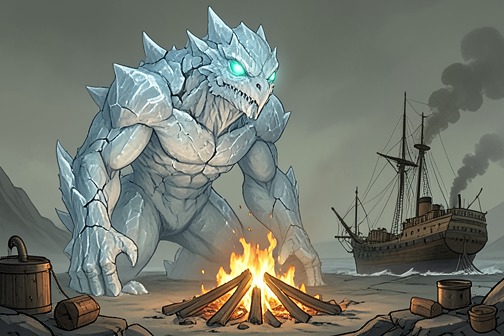
The [Glacilium Encounter](entity:event-recall-event-glacilium-encounter-3246f172da4b) is a pivotal supernatural confrontation in which the Endeavor is challenged by an immense sentient ice being after [Jonathan Heights](entity:character-recall-character-jonathan-heights-d9ccad9c719b) and his companions burn the corpse of a dead titan. What begins as an act of funerary duty becomes a trial of jurisdiction: the creature demands to know who has disturbed the dead and by what right, while Jonathan and [Antomine](entity:character-recall-character-antomine-c73da0eb5297) defend the expedition’s passage through a world whose ancient powers recognize neither human civilization nor its assumptions. The encounter leaves the ship damaged, bruised, and newly aware that the eastern wilderness is not empty but governed by intelligences whose scale makes ordinary categories of distance, language, and authority inadequate.
## Causes and Background
The immediate cause of the encounter is the Endeavor’s disposal of the dead titan’s remains. After the corpse has been reduced to a pyre, Antomine performs a formal rite, declaring, "[From dust ye were made and dust ye shall be](entity:expression-recall-expression-from-dust-ye-were-52dcd29c96ea)." The ceremony expresses a principle shared by the expedition’s religious and practical world: the dead should not remain in the realm of the living. Jonathan and Antomine briefly find common ground in lighting the pyre, even though their broader understandings of mystery and illumination differ sharply.
The burning produces a disturbance in the surrounding order. Jonathan has just dismissed the ruined landscape and withdrawn from the bridge when the ship’s atmosphere changes: cold floods the passage, his breath becomes visible, and frost spreads along the metal walls. The burning titan appears behind the Endeavor as a reflection in what seems to be a floating pane of glass, then resolves into a single gargantuan eye set in an icy bulk. The apparition resembles a [Glacilium](entity:creature-recall-creature-glacilium-fb0796ff3e3c), the mountain-sized ice beings whose migrations can cover [Beacon](entity:location-recall-location-beacon-05545c91a64e) in snow, but its scale and awareness make ordinary Glacilium seem like a misleading point of comparison.
The creature’s arrival also confirms Jonathan’s own fear that the destruction of the titan has altered the local balance of power. He understands that a profound change in the region would draw attention, and recognizes too late that the expedition has not merely passed through an uninhabited wilderness. Its route has crossed a living network of ancient beings, remnants, and forces whose presence can remain invisible until human action gives them reason to respond.
## Course of the Confrontation
The Endeavor turns away from the ice being, although the creature is miles distant and its movement cannot be measured against human intuition. Its size makes the question of whether it is moving almost meaningless. As Jonathan approaches the bridge, the first words strike the ship physically. Each syllable rings through the vessel like a bell, battering the bodies and minds of those aboard while remaining intelligible as thought despite being impossible for a human tongue to pronounce.
The being asks, "Who. Disturbs. The. Dead." [Eleanor](entity:character-recall-character-eleanor-f86629a4f595) reacts with incredulity, while Antomine asks Jonathan how the situation should be handled. Jonathan answers that the only possible response is tact, professionalism, clarity, and honesty. He specifically rejects joking about the creature, an instruction that reveals his limited but significant experience with nonhuman powers. Even he knows that places inhabited by beings of this magnitude are normally blank spaces on maps because those who enter them do not return.
Jonathan identifies himself and explains that the expedition has laid to rest what was already disturbed. The creature immediately asks, "By. What. Right." Its question transforms the burial into a dispute over authority. Antomine responds as chaplain, arguing that easing the suffering of the dead is part of his office and that the dead should not linger in the living world. He presents this not as a local custom but as ancient knowledge extending from the smallest insect to the gods.
The being then observes, "You. Serve. Mysteries." The statement is not clearly an accusation, and it does not specify whether it addresses Jonathan, Antomine, or both. Jonathan replies that the expedition’s secrets belong to the humans who carry them; they do not seek the creature’s secrets or those of its fallen brethren, and they wish only to continue east. When the creature turns its enormous eye toward the east, the cold intensifies inside the Endeavor. Eleanor and [Montgomery](entity:character-recall-character-montgomery-3d1e676073f0) hide their hands inside their coats, crew members work to prevent ice from forming over the controls, and Jonathan considers fire dust, unflame, and the ship’s zint artillery, while recognizing that none may be sufficient against a floating mountain.
The being answers with the single word, "Westward. Mysteries." Antomine resists the creature’s gaze and asserts the force of the [Illuminated King](entity:character-recall-character-illuminated-king-657c25addf69)’s reflected knowledge, while Jonathan insists that the expedition carries only human secrets and that the two sides belong to different worlds. He asks the creature to let them pass as strangers in the dark. The response, "Once. Met. Never. Strangers," functions both as a warning and as a declaration that contact itself has permanently altered the relationship.
## Immediate Consequences
The creature vanishes in a movement visible only as a nauseating flicker. The frost evaporates almost immediately, and the heat returns to the ship as though the cold had never existed. The disappearance is not a conventional retreat or resolution; it is an interruption in the ship’s reality, leaving the crew with no reliable sense of how the being arrived, departed, or might return.
The physical consequences remain visible. Most of the bridge crew are bruised by the force of the creature’s words, and Montgomery bears an obvious black eye. No one pauses to attend to the injuries because the ship must be sent north at once. The Endeavor’s course is therefore changed not by a navigational decision but by the need to escape a power that has claimed the surrounding region as its domain.
Jonathan’s final assessment is that the encounter is not an isolated impossibility. The wild places contain relics and remnants of civilizations and races long past, but even ruins possess dangers. His warning turns the Glacilium Encounter into a governing lesson for the expedition: distance from Beacon does not mean absence of life, law, or memory. It means entry into jurisdictions that human travelers may not understand until they have already violated them.
## Place in the Wider Expedition
The encounter gains additional force from the book’s broader pattern of nonhuman contact. In Beacon, ordinary Glacilium migrations are treated as seasonal hazards: their passage brings snow, and soldiers use unfamiliar zint weapons to kill the Glaciwings that descend with them. At the edge of civilization, nonhuman races occupy their own districts behind a great metal gate, while the [Fractured](entity:creature-recall-creature-fractured-5d3ef48e4511) and the tar-like [Umbraught](entity:character-recall-character-umbraught-3ce6ba54e2df) are viewed through human fear and estrangement. In the [Verdant Expanse](entity:location-recall-location-verdant-expanse-01f0675c6588), Jonathan can speak the whistle-and-click language of the [Caravaneers](entity:creature-recall-creature-caravaneers-cdffe1ff9745), while the human expedition also participates in the hunting and consumption of a huge beast. These scenes establish a spectrum between trade, exploitation, study, and violence.
The eastern ice being occupies a wholly different position within that spectrum. It cannot be reduced to a beast, a race encountered in commerce, or a monster attacked by artillery. It possesses language, memory, jurisdiction, and an ethical claim concerning the dead. Its questions force the humans to confront the limits of their own categories: Antomine’s religious law is presented as universal, yet the creature challenges the right to apply that law to a corpse connected to an older and more alien order.
The encounter also anticipates later confrontations with powers beyond ordinary human scale. The Endeavor will pass through the [Arch of Khokorron](entity:location-recall-location-arch-of-khokorron-5d801aa6e8a6), where passage requires the surrender of knowledge or a life, and Jonathan will ultimately cross into [Bright Defile](entity:location-recall-location-bright-defile-18d73f1df73b) only after sacrificing the accumulated attachments and instruments that enabled his journey, including his cane. The Glacilium Encounter is therefore an early threshold event: it does not stop the expedition, but it establishes that every eastward advance may demand an answer to an ancient power whose terms cannot be negotiated by force.
## Narrative Significance
The Glacilium Encounter is both an ordeal and a reversal of perspective. Jonathan begins by assuming that the funeral has resolved the problem of the dead titan; the creature’s arrival reveals that burial is not merely a humanitarian act but an intervention in a larger cosmology. The expedition’s civilized procedures—chaplaincy, formal speech, maps, navigation, and the stated right to continue east—remain useful, but none is automatically authoritative beyond the human world.
The scene also defines Jonathan’s distinctive method. He does not meet the creature with bravado or religious certainty. He relies on precise speech, restraint, accumulated knowledge, and a willingness to state the expedition’s limits. Antomine supplies conviction and ritual authority, but Jonathan supplies negotiation. Their temporary agreement over the pyre contrasts with their deeper conflict elsewhere, showing that shared action can exist without shared metaphysics.
Finally, the encounter gives the expedition’s eastward movement a moral and ontological cost. The phrase "Once. Met. Never. Strangers" denies the comfort of passing through untouched. After the Endeavor has been seen by the ice being, its travelers belong to a remembered network of encounters, debts, and possible claims. The event’s significance lies less in whether the creature attacks than in the fact that it notices them at all: the wilderness has answered their intrusion, and the answer remains embedded in every later attempt to cross the darkness toward sunlight.
Event 20
Sabotage of the Endeavor
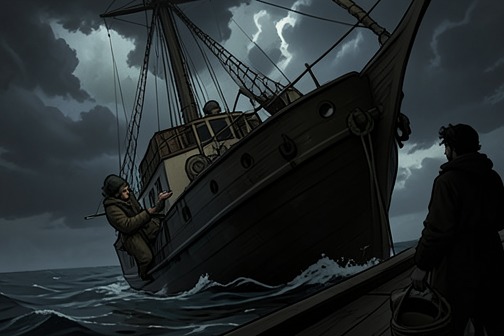
[Sabotage of the Endeavor](entity:event-recall-event-sabotage-of-the-endeavo-c1c93f7c135b) is the act of internal treachery that nearly destroys the expedition during its passage over [Widow’s Peak](entity:location-recall-location-widow-s-peak-43c661d3c2f2). A crewman named Robert smashes the ship’s main zint manifold and steals the two luminiferous gems housed inside it, leaving the Endeavor powerless in hostile air currents. The sabotage does more than damage machinery: it converts the expedition’s outward journey toward sunlight into a crisis of trust, pursuit, and containment, while revealing how dependent the grand project is on fragile equipment, scarce materials, and disciplined labor.
## Causes and Circumstances
The Endeavor reaches the region beyond the fallen monument of Widow’s Peak while navigating difficult winds above the [Bitter Pass](entity:location-recall-location-bitter-pass-2ba898b11301). The route already demands careful handling because the ship cannot safely tether near the monumental ruins, and the weather threatens to become a storm. The attack occurs at the worst possible moment. The wind howls through the Pass, the deck shudders, and then the spotlights fail; the ship falls into darkness and begins to list as the engines cease answering the pressure of the air.
[Captain Montgomery](entity:character-recall-character-captain-montgomery-85ba416f8403)’s experienced crew prevents an immediate crash by manually operating the vanes and ailerons. Veterans keep the unpowered vessel in something resembling controlled flight, but the Endeavor remains crippled until its zint mechanisms can function again. Most of the internal lights continue to work, and the backup gas lamps later reveal red-stone buildings and walls of a dead city directly below. The apparent accident therefore becomes inseparable from the ominous ruin into which the damaged airship is forced.
## [Discovery](entity:object-recall-object-discovery-074c5d88e879) of the Saboteur
Once the Endeavor’s trajectory has been stabilized, [Montgomery](entity:character-recall-character-montgomery-3d1e676073f0) identifies the cause as deliberate damage. He reports that someone has smashed the main zint manifold and declares that a member of his crew has injured the ship. [Jonathan Heights](entity:character-recall-character-jonathan-heights-d9ccad9c719b) immediately accepts the implication that the perpetrator must be found before repairs can begin. With Inquisitor [Antomine](entity:character-recall-character-antomine-c73da0eb5297) aboard, the expedition possesses an investigator capable of exposing the traitor, and Jonathan treats that presence as one of the few advantages created by the crisis.
The investigation quickly identifies Robert. [Eleanor McAvey](entity:character-recall-character-eleanor-mcavey-56495d17d879) reports that he broke the intermixer manifold, though she has little understanding of the technical terminology herself. Antomine explains that he can restore the damaged device if the expedition has sufficient glass stock. The repair is therefore possible, but the theft makes the sabotage far more serious: Robert has also taken the pair of luminiferous gems from inside the mechanism.
## Damage and Pursuit
The stolen gems are not ordinary replaceable components. They greatly improve the Endeavor’s zint machinery, and without them the ship must travel more slowly, refuel more often, and proceed with greater caution. Robert’s apparent escape into the abandoned city consequently threatens the expedition’s entire timetable and its ability to continue east. Jonathan finds the theft especially intolerable because the thief would have almost no chance of returning to civilization without a ship, yet the missing gems remain too valuable to abandon.
Robert has taken an entire kit with him, suggesting that he believes he can survive in the wilds. Jonathan regards that belief as evidence of his foolishness, but the kit also gives the pursuit a practical dimension: Robert is not merely hiding nearby but has prepared to remain away from the ship. [Eleanor](entity:character-recall-character-eleanor-f86629a4f595) proposes that [Sarah](entity:character-recall-character-sarah-7c634cfe73af) and [Marie](entity:character-recall-character-marie-38740b047e25) can track him through the city, where the built environment should make the search easier than tracking someone through wilderness. Jonathan joins the pursuit because he knows the eastern regions and understands that an apparently deserted city is unlikely to be truly empty.
Before descending, Jonathan gives Montgomery the bronze amulet and instructs him to hang it before the commissioning plaque while the ship remains tethered. He expects it to prevent most things from taking an interest in the Endeavor, providing a temporary defense while the crew searches the ruins. The expedition thus responds to the sabotage on two fronts: Antomine must expose the traitor and restore the manifold, while Jonathan and Eleanor must recover the stolen gems and protect the immobilized ship.
## Wider Expeditionary Context
The sabotage is made possible by the material complexity of the Endeavor’s mission. Before departure, the expedition has loaded a portable luminiferous terrestrite distillation apparatus, a lifting-gas separator, water siphons and filters, portable searchlights, crew-served zint guns, food, water, spare parts, raw materials, clothing, bedding, soap, and other supplies. The ship is already expected to become less agile under the weight and to spend more zint between distant stops. Damage to a central manifold therefore compounds the ordinary logistical burden of an eastern expedition.
The episode also belongs to a broader economy of scarcity and exchange. Jonathan has arranged for supplies to be shipped by train to [Danby’s Point](entity:location-recall-location-danby-s-point-89a41017e4ad), where loading is cheaper than storing everything in [Beacon](entity:location-recall-location-beacon-05545c91a64e). He pays for expeditionary arrangements with golden plates and encourages the crew to barter with raw metal stock, emphasizing that steel may be more valuable than gold or silver in the eastern settlements. Later, the expedition’s willingness to carry heavy discoveries becomes part of its labor discipline: Jonathan orders the crew to divide a massive golden find among the men and offers to carry the main trunk himself because the reward may improve their attitude. Against this background, Robert’s theft of the luminiferous gems is not an isolated act of greed but an attack on the material system that keeps the expedition moving.
## Consequences and Significance
The immediate consequence is forced tethering in the dead city and a delay while the Endeavor is repaired and guarded. The sabotage introduces suspicion into a crew already assembled for a long, arduous voyage in which the next stops will not offer ordinary city comforts. Jonathan’s impatience with delay becomes sharper because he believes sunlight is waiting in the east and views every obstacle as an assault on that purpose. Montgomery, meanwhile, responds as a captain whose ship and crew have been violated, promising punishment when the perpetrator is found.
The event also establishes a recurring pattern in the expedition: discovery and danger arrive through the same material channels. The Endeavor carries rare machinery, fuel, weapons, and supplies because the eastern world cannot be crossed without them; those necessities make the ship an attractive target and make every damaged component consequential. The missing gems expose how a seemingly small act by one crewman can diminish speed, range, and safety for everyone aboard.
In the larger arc, the damaged vessel nevertheless survives and eventually returns to Beacon battered and tattered, carrying an immense quantity of gold. That later wealth does not erase the sabotage’s cost. The Endeavor requires extensive repair, and even the repaired ship seems strangely familiar to the laborers who work on its spine and envelope, while its cats watch them with uncanny intelligence. Sabotage is therefore one of the episodes that marks the ship as more than a neutral vehicle: it becomes a wounded, altered participant in the expedition, carrying the physical and moral residue of the dangers through which it has passed.
Event 21
Death Assault of the Deserted City
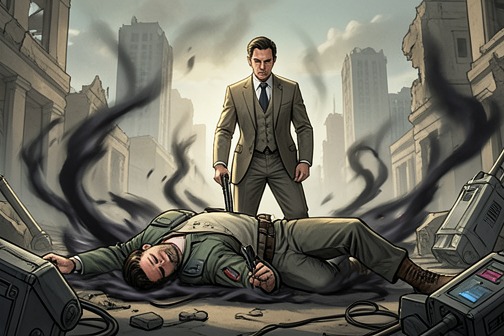
[Death Assault of the Deserted City](entity:event-recall-event-death-assault-of-the-de-aa4d911c7595) begins when [Jonathan Heights](entity:character-recall-character-jonathan-heights-d9ccad9c719b) kills an agent of the Exploration Society inside the abandoned city, and the violence summons something far more dangerous than an ordinary retaliation. The event is not simply an attack by a creature or army: it is the city’s awakening as a force of death-consciousness, one that invades thought, reshapes space, and makes every member of the expedition confront the desire to die. Its decisive significance lies in the way it tests Jonathan Heights’s newly acquired sunlight against a hunger that can reach flesh, stone, memory, and even the self’s most guarded convictions.
## The Killing That Awakens the City
Jonathan Heights enters the confrontation already carrying the accumulated grievance of his previous expeditions and his hostility toward the Exploration Society. When Robert, an agent of that organization, crosses his path, Jonathan Heights remembers his promise to destroy the next such agent he encounters. He seizes Robert by the throat and allows the fury he has been suppressing to take hold. Robert’s eyes burn out under the intensity of Jonathan Heights’s sunlit soul; the agent then collapses, scorched and smoking, before Jonathan Heights releases the body.
The killing immediately alters the expedition’s internal balance. [Antomine](entity:character-recall-character-antomine-c73da0eb5297) protests with rage, addressing Jonathan Heights’s act as an intolerable violation of authority and conduct, but his rebuke is interrupted when the presence behind the city’s doors and windows comes howling inward after Robert’s corpse. The sequence therefore joins personal vengeance to supernatural consequence: Jonathan Heights’s decision does not remain a contained execution. It becomes the immediate occasion for the deserted city to reveal its appetite, turning a conflict with the Exploration Society into a collective struggle for survival.
## The City as an Incarnation of Dying
The force awakened by Robert’s death has no visible or audible body. It is neither a ghostly creature nor a conventional supernatural attacker, but a raw concentration of lonely longing, nostalgia, and desire for the instant in which life passes into death. Its domain is the infinitesimal interval poised between existence and oblivion: not death itself, and not life, but the seductive final moment before the abyss closes. The presence imposes this sensation directly upon its victims, hammering memories and images of dying into their minds until the expedition staggers beneath emotions that do not originate in ordinary fear. Death becomes not merely an outcome to avoid but an exquisite experience the city urges them to seek.
## The Assault on Mind and Body
The city’s death-impulse reaches even Jonathan Heights, despite the sunlight filling him. Under its pressure, he grips his cane until his knuckles whiten and feels an urgent temptation to turn the weapon against his own throat or smash his head against the stone. The force does not distinguish among bodies, buildings, or insubstantial dreams: its ideation of dying finds purchase in anything capable of being affected. [Eleanor](entity:character-recall-character-eleanor-f86629a4f595) resists while clutching her dagger, but [Sarah](entity:character-recall-character-sarah-7c634cfe73af) and [Marie](entity:character-recall-character-marie-38740b047e25) faint; Antomine alone straightens with purposeful control, his eyes glowing as he orders his guards to disarm Eleanor and carry the unconscious women. Jonathan Heights survives the first assault not by destroying the presence, but by separating its intrusive commands from his own intentions and reducing them to an insistent murmur at the edge of consciousness.
## The Device That Blunts the Assault
The saboteur’s death intensifies the city’s appetite, but the expedition still has a practical objective: recovering the stolen mechanism containing the luminiferous gems taken from the Endeavor. Jonathan Heights hooks the sled toward himself, opens its bag despite the mental pressure, and seizes the broken glass-and-steel assembly. Antomine immediately claims it, and Jonathan Heights yields it because the inquisitor is not the enemy. When Antomine makes the gems flare and his own eyes shine with comparable brilliance, the suicidal compulsion recedes from an overwhelming command to a background scratch of contemplation. The assault is not defeated, but its intensity becomes resistible, revealing that concentrated illumination can interrupt the city’s influence without destroying the force producing it. The Lux Guards are unaffected from the beginning; Jonathan Heights suspects that the [Illuminated King](entity:character-recall-character-illuminated-king-657c25addf69) has altered them so thoroughly that even their lives are no longer theirs to spend.
## Escape Through Rewritten Streets
The reduced pressure gives the expedition only a temporary advantage. Jonathan Heights finds the room physically unchanged, yet the deserted city has begun to alter the route itself. Antomine takes the lead, while Jonathan Heights remains close enough to correct his direction, and the group moves through streets whose ordinary sounds are translated by the city into imagined acts of self-destruction: boots become the scrape of a drawn blade, a dagger’s movement, or the click of a zint-pistol being readied. Familiar intersections fail to appear where Jonathan Heights expects them, and each successive turn adds sharper corners, more treacherous street edges, and objects that seem prepared to break bones or open veins. A curb even cuts his cheek when he turns too quickly, proving that the city’s murderous suggestions can acquire physical consequences. Jonathan Heights refuses to follow its implied rules and offers Antomine his pistol, allowing the inquisitor to extract the luminiferous gems and fire a zint beam straight through walls and lampposts. The shot punches a visible corridor through the altered architecture, creating a path toward the ship. Eleanor runs first, followed by the guards carrying Sarah and Marie, while Jonathan Heights brings up the rear behind Antomine. When Antomine falters, Jonathan Heights lifts him and continues carrying him; Eleanor, meanwhile, manages to vault through the openings without yielding to the compulsion to stop and bleed. After roughly a minute of full-speed running, the group reaches the Endeavor, though the ship appears momentarily unfamiliar against the death-drunk city. They seize the tether and climb aboard with torn clothing and unsteady bodies, while Eleanor revives Sarah and Marie and Antomine retains the device and gems. Once the city disappears from sight, the ideation of dying vanishes as abruptly as it arrived, leaving the expedition alive but aware that escape, rather than victory, was the only achievement.
## The Event’s Wider Significance
Death Assault of the Deserted City is a threshold episode in which violence, illumination, and mortality become inseparable. Jonathan Heights’s execution of the Exploration Society agent is both a private act of retribution and the trigger for a force that exposes the limits of his sunlight. The event demonstrates that illumination does not make him invulnerable: it gives him the discipline to recognize the city’s suicidal suggestions as alien, but it does not prevent those suggestions from entering his mind. Antomine’s intervention provides the practical countermeasure, as the luminiferous gems reduce the assault without abolishing it, while the Lux Guards’ immunity hints at the more disturbing cost of service to the Illuminated King. The expedition therefore survives through cooperation among incompatible forms of power—Jonathan Heights’s self-command, Antomine’s consecrated light, the guards’ altered nature, and Eleanor’s physical resolve—rather than through any single character’s mastery.
The episode also establishes a recurring pattern in the wider journey: the eastern world is not merely populated by hostile beings but governed by conditions that rewrite perception, identity, and the meaning of survival. The city’s streets become dangerous because thought and architecture converge; its attack is psychological, yet a curb cuts Jonathan Heights’s cheek and the altered route must be breached by force. This unstable boundary between idea and matter anticipates later encounters with temporal distortion, divine dreams, the Players, and [Bright Defile](entity:location-recall-location-bright-defile-18d73f1df73b)’s demand that every attachment be sacrificed. Jonathan Heights’s escape is consequently not a conquest of the city’s death-consciousness. It is a temporary refusal to accept the terms it imposes, achieved by carrying the damaged device and its gems back to the Endeavor while the city remains physically intact and spiritually unexplained.
## The Assault on Mind and Body
The city’s death-impulse reaches even Jonathan Heights, despite the sunlight filling him. Under its pressure, he grips his cane until his knuckles whiten and feels an urgent temptation to turn the weapon against his own throat or smash his head against the stone. The force does not distinguish among bodies, buildings, or insubstantial dreams: its ideation of dying finds purchase in anything capable of being affected. Eleanor resists while clutching her dagger, but Sarah and Marie faint; Antomine alone straightens with purposeful control, his eyes glowing as he orders his guards to disarm Eleanor and carry the unconscious women. Jonathan Heights survives the first assault not by destroying the presence, but by separating its intrusive commands from his own intentions and reducing them to an insistent murmur at the edge of consciousness.
The death-impulse reaches even Jonathan Heights, despite the sunlight filling him. Under its pressure, he grips his cane until his knuckles whiten and feels an urgent temptation to turn the weapon against his own throat or smash his head against the stone. The force does not distinguish among bodies, buildings, or insubstantial dreams: its ideation of dying finds purchase in anything capable of being affected. Eleanor resists while clutching her dagger, but Sarah and Marie faint; Antomine alone straightens with purposeful control, his eyes glowing as he orders his guards to disarm Eleanor and carry the unconscious women. Jonathan Heights survives the first assault not by destroying the presence, but by separating its intrusive commands from his own intentions and reducing them to an insistent murmur at the edge of consciousness.
## The Assault on Mind and Body
The city’s death-impulse reaches even Jonathan Heights, despite the sunlight filling him. Under its pressure, he grips his cane until his knuckles whiten and feels an urgent temptation to turn the weapon against his own throat or smash his head against the stone. The force does not distinguish among bodies, buildings, or insubstantial dreams: its ideation of dying finds purchase in anything capable of being affected. Eleanor resists while clutching her dagger, but Sarah and Marie faint; Antomine alone straightens with purposeful control, his eyes glowing as he orders his guards to disarm Eleanor and carry the unconscious women. Jonathan Heights survives the first assault not by destroying the presence, but by separating its intrusive commands from his own intentions and reducing them to an insistent murmur at the edge of consciousness.
## The Assault on Mind and Body
The city’s death-impulse reaches every member of the expedition according to a different vulnerability, making the assault a collective ordeal rather than a uniform attack. Jonathan Heights, although sunlight fills him, feels the temptation to turn his cane against his throat or dash his head against the stone; the force can take hold of flesh, stone, and even insubstantial dreams because it is not merely a weapon but an ideation of dying. Eleanor clutches her dagger while struggling to remain herself, whereas Sarah and Marie lose consciousness under the pressure. Antomine resists more decisively: his eyes glow as he orders one [Lux Guard](entity:organization-recall-organization-lux-guard-be0b4e19435c) to seize Eleanor and remove her dagger, while the other assists the maids. Jonathan Heights finally regains control by recognizing the suicidal commands as foreign intrusions rather than authentic desires, reducing them to an insistent murmur that he can endure without mistaking it for his own will.
## The Assault on Mind and Body
The city’s death-impulse reaches every member of the expedition according to a different vulnerability, making the assault a collective ordeal rather than a uniform attack. Jonathan Heights, although sunlight fills him, feels the temptation to turn his cane against his throat or dash his head against the stone; the force can take hold of flesh, stone, and even insubstantial dreams because it is not merely a weapon but an ideation of dying. Eleanor clutches her dagger while struggling to remain herself, whereas Sarah and Marie lose consciousness under the pressure. Antomine resists more decisively: his eyes glow as he orders one Lux Guard to seize Eleanor and remove her dagger, while the other assists the maids. Jonathan Heights finally regains control by recognizing the suicidal commands as foreign intrusions rather than authentic desires, reducing them to an insistent murmur that he can endure without mistaking it for his own will.
## The Force Behind the City
The force awakened by Robert’s death is not a creature with a body, voice, or ordinary location. It is a concentration of lonely longing and nostalgia for the instant of dying: neither death itself nor life, but the final interval poised between them. Its attack reaches the expedition as intrusive memories and images, transforming mortality from an external danger into a seductive experience. The presence does not merely threaten to kill its victims; it presses them toward the exquisite moment of surrender, making the desire for death feel intimate, persuasive, and almost tender.
Event 22
Angkor Leng Protective-Radiance Treatment
[Angkor Leng Protective-Radiance Treatment](entity:event-recall-event-angkor-leng-protective-81701abc082a) is the expedition’s most consequential act of technical preparation: [Jonathan Heights](entity:character-recall-character-jonathan-heights-d9ccad9c719b) uses a functioning chamber in the ancient city of [Angkor Leng](entity:location-recall-location-angkor-leng-dfd69cfaf06c) to immerse the Endeavor in a protective radiance that strengthens its hull, envelope, and equipment against unnatural weather. The treatment makes survival possible beyond the safer routes of civilization, but its artificial golden light also becomes a diminished imitation of the sunlight Jonathan has witnessed, binding practical engineering to the book’s larger conflict between borrowed illumination and revelation.
## Purpose and [Discovery](entity:object-recall-object-discovery-074c5d88e879)
Jonathan presents the treatment as a necessity rather than a luxury. He explains to [Captain Montgomery](entity:character-recall-character-captain-montgomery-85ba416f8403) that one of Angkor Leng’s surviving mechanisms can proof the Endeavor against some of the regions they must cross in the East, even though fitting a ship with nonhuman technology is precisely the kind of decision likely to trouble both [Montgomery](entity:character-recall-character-montgomery-3d1e676073f0) and [Antomine](entity:character-recall-character-antomine-c73da0eb5297). The disclosure comes only after the expedition has reached the city and has little practical alternative. Jonathan knows that the machinery is still functional, and the danger of refusing it is greater than the discomfort of altering the ship with secrets whose original makers and purposes have disappeared.
The treatment chamber is large enough to contain an entire airship. Its opening is concealed within the city’s machinery and becomes accessible only after Jonathan works through a sequence of controls: a branching gold device shifts from tangled roots into a mandala-like wheel and then into connected spheres before returning to its initial form, while the nearby dock doors open. He identifies the revealed space as a massive bay open to the sky, surrounded by unevenly placed floodlights and rows of ancient, fogged glass enclosures resembling man-sized gas lanterns. These lanterns are the source of the radiance required for the operation. Jonathan orders Montgomery to bring the Endeavor inside and warns that the ship must remain tethered for a day or more.
The chamber’s location also establishes the treatment’s danger. Jonathan suspects that the forbidden underground regions of Angkor Leng contain something akin to the strange light associated with [Tor Ilek](entity:location-recall-location-tor-ilek-da8c883970ba), but he does not claim full knowledge of what lies below. The city’s surviving technology therefore offers protection without offering comprehension. The expedition can operate the machinery through notes, observation, and partial understanding, while remaining exposed to the consequences of activating an ancient system whose true design has been lost.
## Operation of the Treatment
Before beginning, Jonathan checks and rechecks his notebook, aware that the controls are not intuitive and that a previous sequence caused an earthquake. He lowers a heavy club, consults the recorded instructions, and activates the mechanism. The rumbling machinery changes tone as the gold device above the chamber shifts and vibrates, eventually flashing into a stark straight line. The lanterns then begin to glow, although what emerges is not ordinary light. It resembles molten gold transformed into a weightless yet ponderous liquid: insubstantial in form, but heavy in its effect, clinging to every exposed surface and flowing through cracks in the walls.
The radiance fills the hangar and soaks into the Endeavor. The airmen react with crude astonishment but refuse to cross the brass plate marking the chamber’s boundary. Jonathan tells Montgomery that the process will take time and stop by itself. He does not know what would happen if the ship were removed prematurely, nor whether he could halt the operation manually. Because partial treatment might be worse than no treatment, the ship’s apparent freedom to fly away is irrelevant; the procedure imposes its own timetable. Montgomery therefore accepts that the crew must establish a temporary camp while the vessel remains inside.
The expedition uses incense as an additional precaution. Jonathan lights the single available stick outside the chamber, where it produces a fountain of smoke that blocks sight and sound and forms an obscuring shroud around the approach. He warns the airmen not to leave without a tether, since they might be unable to find their way back, and tells them to inform Montgomery. The incense keeps the exterior from intruding visibly into the camp, but its scent enters through the cracks as something dark, cold, rigid, and difficult to define. The measure is practical, yet it also emphasizes that the treatment takes place inside a hostile and barely controlled environment.
The operation lasts through successive watches. Its intensity waxes and wanes over slow minutes while the airmen cycle through their duties, and the temporary camp accumulates the ordinary signs of waiting: cups, plates, cards, and dice scattered among the equipment. The delay is not passive, however. The crew’s exposure to the chamber turns maintenance into a vigil, with everyone listening for the change that will indicate whether the ancient process has completed successfully.
## Completion and Immediate Effect
Deep into the third watch, the machinery changes its rumble and the lanterns cease glowing. The thick liquid radiance gradually dissipates into the air. At first glance the Endeavor appears unchanged, but the result is perceptible as a new sense of substance: the ship feels somehow more, stronger and more trustworthy than before. The transformation is therefore both material and experiential. Nothing obvious has been added to the hull or envelope, yet the vessel has acquired a different capacity, as though the treatment has altered its relation to the surrounding world rather than merely reinforcing its visible structure.
The treatment’s completion allows Montgomery to recall the crew and dismantle the camp. The geode-like smell has nearly faded, and the obscuring incense is almost spent, making departure urgent. Jonathan’s success gives the expedition what he promised: a ship better prepared for the weather and environments ahead. It also confirms that Angkor Leng’s technology can still be made to serve human purposes, even when its principles are no longer fully understood.
Yet Jonathan’s response to the radiance is notably changed. Earlier in the expedition, artificial or alien illumination might have appeared wondrous; after his encounter with sunlight, he sees the chamber’s golden fluid as a clear fabrication, a pretense at purity and sanctity rather than an equivalent of the real thing. He recognizes that the builders of Angkor Leng drew their inspiration from something alien and uncomfortable, a force only barely constrained by four walls. The radiance strains against the chamber’s doors and cracks without quite escaping, suggesting power that has been confined rather than mastered. Jonathan could perhaps have studied its secrets, but he no longer cares to do so.
## Failure of Containment and Consequences
The treatment protects the Endeavor, but it does not make Angkor Leng safe. Once the ship is ready to leave, Jonathan inputs the same sequence that previously caused an earthquake, repeating it three times in rapid succession. The gold mechanism squeals and spins; machinery below groans; the ground shakes; and finally a metallic crash announces that something has given way. He runs for the descent line and is hauled upward as the ship rises, just as the fever heat of the city intensifies and the artifice restraining the doom beneath Angkor Leng fails.
A massive presence stirs below. As Jonathan reaches the deck, a hallucinatory wave overwhelms the people aboard, carrying a nonsensical jumble of images and sensations. He cannot comprehend the event through ordinary sight or hearing, yet knows it as directly as heat or cold because it has been impressed upon reality itself. The protective procedure thus has a double consequence: it prepares the Endeavor to escape the city, but its activation and the subsequent departure coincide with the collapse of the ancient containment system. The ship leaves strengthened, while Angkor Leng is exposed to the destructive force that its machinery had held back.
The treatment also belongs to a recurring pattern in which technical instruments make passage possible without reducing the world to human knowledge. Jonathan’s triskolabe allows navigation beyond [Danby’s](entity:location-recall-location-danby-s-5218a4688a5c) through devices incorporating the inverted zint loop, Zumar’s Bones, and the Lens of Fools; his alien navigational implement can orient itself by locking symbols into place; and the [Arch of Khokorron](entity:location-recall-location-arch-of-khokorron-5d801aa6e8a6) later opens only after Jonathan manipulates another immense mechanism. In each case, survival depends on exact procedures, specialized notes, and instruments whose logic exceeds ordinary human reasoning. The protective radiance is the most physically intimate version of this pattern because it enters the ship itself and changes the vessel’s status.
## Narrative Significance
Angkor Leng Protective-Radiance Treatment marks a threshold between preparation and irreversible exposure. The Endeavor is no longer merely carrying an expedition toward the East; it has been remade to enter environments for which human technology was never designed. The process protects the vessel from unnatural weather, but it cannot protect the expedition from the moral and metaphysical costs of its route. As later passages show, Jonathan’s journey is paid for through losses including [Tiuni](entity:character-recall-character-tiuni-517876ba3162)’s death, the destruction of Tor Ilek, the burning of a dead god, the sacrifice of Angkor Leng, the loss of [Eleanor McAvey](entity:character-recall-character-eleanor-mcavey-56495d17d879)’s friendship, and his banishment from [Ukaresh](entity:location-recall-location-ukaresh-085787e2ce38). The treatment is one of the earlier material investments in that progression: a protective act that helps make the later sacrifices possible.
Its artificial radiance also sharpens the novel’s contrast between technological survival and sunlight’s final revelation. The chamber’s light is liquid, engineered, inherited from an alien civilization, and limited by walls; sunlight is encountered by Jonathan as truth, liberty, and an order beyond the shrouded lands. The Endeavor emerges from Angkor Leng stronger and more dependable, but Jonathan emerges with less reverence for the imitation that has protected it. When he finally sacrifices even his cane to cross the last gap into [Bright Defile](entity:location-recall-location-bright-defile-18d73f1df73b), the decisive passage is no longer accomplished by an ancient device or a protective treatment. The ship’s radiance enables the journey, but it cannot substitute for the final act of entering sunlight itself.
Event 23
Umbraught Assault on Angkor Leng
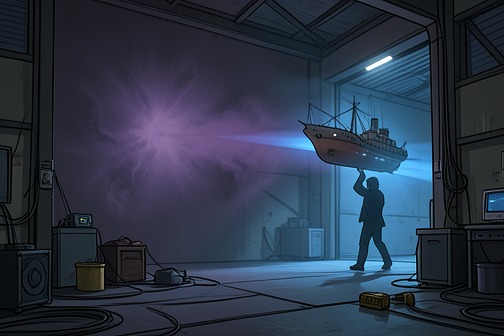
[Umbraught Assault on Angkor Leng](entity:event-recall-event-umbraught-assault-on-an-17e43038daf3) is the decisive incursion that converts the Endeavor’s dangerous refueling and repair stop into an immediate defensive crisis. The [Umbraught](entity:character-recall-character-umbraught-3ce6ba54e2df) are not merely another hostile presence in the eastern darkness: they are an ancient species opposed to the zint-based light on which human civilization depends. Their attack exposes the cost of carrying that civilization’s illumination into forbidden places, forces [Jonathan Heights](entity:character-recall-character-jonathan-heights-d9ccad9c719b) and his companions into close combat, and leaves the expedition divided over whether survival requires retreat or a wider campaign against the creatures.
## The Umbraught Threat and the Approach to [Angkor Leng](entity:location-recall-location-angkor-leng-dfd69cfaf06c)
The assault begins before the attackers are visible. As the Endeavor approaches the hangar, a dark purple-grey radiance appears opposite the ship’s blue zint lights, painful to the eyes despite its relative dimness. [Antomine](entity:character-recall-character-antomine-c73da0eb5297) identifies the source as the Umbraught, beings that consume luminiferous terrestrite and were supposedly destroyed or driven away by the [Illuminated King](entity:character-recall-character-illuminated-king-657c25addf69) centuries earlier. The ship’s unusually powerful spotlights have therefore done more than illuminate the ruins: they have announced the expedition’s presence to a species drawn to the very substance that powers human civilization. Antomine also suspects that his own presence may have been a more likely provocation than the Endeavor’s lights, linking the creatures’ return to the older conflict between the Inquisition and the forces it once attempted to eradicate.
The first response is not an attack but an argument over whether an attack can be avoided. [Eleanor](entity:character-recall-character-eleanor-f86629a4f595) immediately urges the party to reach the ship and have its lights extinguished, fearing that the Umbraught may already be too close. Jonathan agrees that the expedition cannot afford an unnecessary battle while the Endeavor is still being treated, since damage to the ship’s mechanisms could close the most promising route into the true east. Antomine initially insists that the creatures should be exterminated on sight, but finally concedes that no battle is required if they fail to find the party. The compromise leaves the group moving back toward the hangar under pressure, aware that the Umbraught are following or scouting them even though the broken buildings and competing city lights prevent anyone from judging their distance.
## The Breach of the Endeavor’s Control Room
The retreat becomes a siege when the group reaches the hangar. The Endeavor is being hauled inside on tether lines rather than fully landed, since compressing its envelope would make a rapid departure difficult, and Antomine orders a defensive perimeter formed with cold steel rather than zint weapons. Jonathan then moves toward the semicircle of airmen gathered at the enormous brass plate that seals the control room. It is the room’s only practical entrance: anyone approaching from above would have to cross the Umbraught radiance, whose effects on living bodies remain uncertain. The door itself cannot be reinforced or obstructed, because its massive movement depends on mechanisms the defenders dare not touch.
The Umbraught enter as soon as the brass panel slides aside. They are almost invisible dark figures shaped nearly like men, distinguished by reversed colors at their eyes, teeth, and clothing and by the baffling spheres they carry. These lanterns emit the creatures’ painful purple-grey light, which overwhelms the zint lanterns and seems to hide the attackers’ rapid movements. The first impact is immediate: a [Lux Guard](entity:organization-recall-organization-lux-guard-be0b4e19435c) at the door is thrown backward, his baton clattering across the floor before his armored body crashes into the airmen behind him. The ease with which the guard is defeated shakes the men holding the entrance, while the assault demonstrates that the Umbraught’s light is not merely an environmental hazard but an active tactical advantage.
Jonathan answers the breach with the nearest weapon available: the heavy gold branch recovered from Angkor Leng. A dark, glass-like blade rises to meet his swing and snaps under the force of several hundred pounds of metal in motion. The Umbraught behind it folds around the impact and is hurled into its companions. Jonathan’s intervention breaks the defenders’ hesitation, and he orders the airmen forward while Eleanor attacks faster still, her daggers flashing through the suppressed light. Her maids join her, whereas Antomine and his guards are temporarily impaired by the presence of the creatures and their inverted illumination.
The fight is brief despite the attackers’ numbers. Jonathan uses the gold branch as an improvised club, smashing through Umbraught heads and limbs; Eleanor and her maids cut down those attempting to flee; and the airmen recover enough to overwhelm the remaining figures. Antomine identifies the crucial target by ordering the defenders to crush the lanterns. Jonathan stamps on one of the luminous spheres until it shatters, after which the airmen destroy others with clubs and swords. Once the spheres break, the eye-stinging radiance recedes, removing the Umbraught’s concealment and weakening the basis of their assault. The victory is therefore achieved not by matching the attackers’ strange light but by destroying the objects that make that light possible.
## Casualties, Material Aftermath, and the Unresolved Threat
The immediate victory does not make the assault harmless. The remaining Umbraught spheres crunch underfoot, and Jonathan’s eye pain fades, but the human defenders have paid for the control-room breach with bleeding cuts, sprains, bruises, and at least one fractured limb. A Lux Guard lies incapacitated, and Antomine kneels beside him, visibly paler than usual, while the ship’s doctor treats the wounded airmen. The creatures themselves begin to dissolve once deprived of their peculiar illumination: their bodies, disturbingly close to human in outline yet distorted into impossible colors, fade into something increasingly ephemeral, as though their existence cannot persist in the presence of the zint-centered human world. Even Eleanor’s dark, glass-like dagger dissipates from her hand, and the blood on Jonathan’s gold club wisps away. The attack therefore leaves behind injuries, damaged confidence, and a material lesson about incompatible forms of life, but no stable enemy remains for the victors to examine or pursue.
Jonathan closes the massive brass door and turns his attention back to the expedition’s interrupted work, yet the danger has not been contained. The defenders cannot know whether every Umbraught has been killed or whether the survivors have carried news of zint back to a larger nest. Antomine consequently argues that Angkor Leng must be purged before the creatures learn to hunt the substance that powers human civilization and travel westward toward human settlements. Jonathan rejects the proposal as an unacceptable diversion: the Endeavor is not a navy, the party lacks the personnel and resources to survey and cleanse a city of Angkor Leng’s size, and the journey toward sunlight already depends on completing the repairs and reaching the eastern gateway. Their disagreement turns the assault into more than a closed skirmish. Antomine sees a strategic frontier emergency whose consequences could spread beyond the ruins; Jonathan sees another obstacle threatening the single objective that has organized his life. The Umbraught are defeated inside the ship, but their appearance proves that the expedition’s technology has altered the balance of the surrounding world, making retreat itself a form of exposure and leaving the larger question of whether human civilization can safely carry its light eastward unresolved.
Event 24
Awakening and Destruction of Angkor Leng
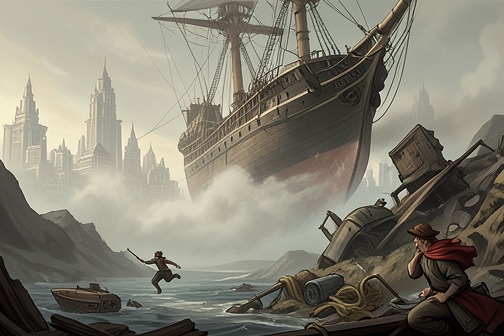
[Awakening and Destruction of Angkor Leng](entity:event-recall-event-awakening-and-destructi-6d1aa49af379) is the decisive catastrophe that ends the Endeavor’s stay above [Angkor Leng](entity:location-recall-location-angkor-leng-dfd69cfaf06c). [Jonathan Heights](entity:character-recall-character-jonathan-heights-d9ccad9c719b) deliberately breaks the mechanisms preserving the city’s buried supernatural stasis, then escapes aboard the rising ship as the streets, walls, gold, and apparent solidity of Angkor Leng dissolve into the fevered dream of a convalescent god. The event transforms a dangerous expeditionary problem into a revelation of cosmic scale: the city was not merely built over a hidden threat, but formed part of an afflicted deity’s reality.
## Causes and Deliberate Sabotage
[Eleanor McAvey](entity:character-recall-character-eleanor-mcavey-56495d17d879) recognizes that Jonathan is concealing a plan and confronts him as [Antomine](entity:character-recall-character-antomine-c73da0eb5297) withdraws. Jonathan admits that danger lies below the city, while withholding the nature of that danger. His immediate objective is practical and ruthless: disturbing what lies beneath Angkor Leng should be sufficient, provided the Endeavor is already in the air. He therefore asks [Captain Montgomery](entity:character-recall-character-captain-montgomery-85ba416f8403) to prepare a lift-line and to rise high and quickly as soon as the ship’s tethers are released.
The preparation turns Jonathan’s private knowledge into a timed operation. While Captain Montgomery urges the crew to clear the control room and return to the Endeavor, Jonathan consults his notebooks to verify the remembered procedure. Once the ship is airborne and centered in the hangar, he places the notebook in the inner pocket of his suit and enters the same sequence of commands that had previously caused an earthquake. He repeats the commands three times in rapid succession. The gold mechanism above him squeals and spins, while massive machinery far below groans and heaves; the sequence ends when something gives way with a prolonged metallic shriek and a sudden crash.
Jonathan’s action is not an accidental consequence of the expedition. He knows enough about the buried systems to use them against themselves, but he does not disclose the full danger even to [Eleanor](entity:character-recall-character-eleanor-f86629a4f595). His secrecy creates the event’s central moral tension: the Endeavor’s survival depends on an act whose consequences Jonathan can anticipate only in outline. Unlike Antomine, who dismisses the fate of any “savage ruin” so long as the [Illuminated King](entity:character-recall-character-illuminated-king-657c25addf69)’s enemies are removed, Jonathan’s stated concern is the continuation of the ship’s journey, regardless of whether the result benefits the Illuminated King.
## The City Awakens and Dissolves
The ground stops moving just as Jonathan reaches the descent line. He runs with his cane tucked beneath one arm, seizes the line, and is hauled upward by the airmen while the Endeavor climbs hastily. As the artifice preserving the doom beneath Angkor Leng fails, the city’s heat intensifies around him. The physical danger of the ascent is immediately joined by a more disorienting disturbance: something massive stirs below, and a hallucinatory wave strikes the ship as Jonathan steps onto the deck.
The disturbance cannot be reduced to ordinary sight or sound. Images and sensations form a nonsensical jumble that passes through Jonathan and forces him to depend on his cane for balance. Yet the experience is also presented as direct knowledge, imprinted upon reality rather than merely perceived through the senses. Jonathan understands that Angkor Leng belongs, by chance or purpose, to the fevered dreams of a convalescent god sick and sleeping deep beneath the city.
The buried mechanisms had been bent toward a single purpose: keeping that dream whole. By activating the commands, Jonathan shatters the stasis, and the dream begins to end. The fever surrounding the city is therefore literal rather than metaphorical. It is the sickness of a being grander and older than any human can comprehend, and the city’s apparent permanence proves weaker than the dream that sustains it.
As the Endeavor rises, Angkor Leng loses its material stability. Its dried, shrunken streets and walls twist and shimmer before vanishing like soap bubbles. Gold melts out of the disappearing buildings, precipitating into impossible rivers that pour as glowing waterfalls into the newly revealed depths. The chasm releases whispers, hints, and flashes of things unknown and unknowable to humanity; the molten gold reflects them into fanciful and terrible shapes before those forms collapse as the dream moves onward.
## The Buried Deity and the [Umbraught](entity:character-recall-character-umbraught-3ce6ba54e2df)
Beyond the flickering hallucinations lies a tremendous figure resting fitfully in the crevasse. Its shape and scale defeat rational measurement, and its appearance is both entrancing and enticing, intensifying the delusions produced by the awakening. The revelation does not provide a clear identity or explanation for the being. Instead, it establishes the limits of human interpretation: the figure is encountered as a presence whose very form overwhelms the processes meant to understand it.
The danger reaches the Endeavor’s crew as well as Jonathan. One airman, able to see through the hatch, tries to throw himself bodily into the opening in order to reach what he perceives below. Jonathan catches and restrains him, preventing another crew death at a moment when the ship has already lost too many people. The airman later thanks Jonathan, nervous as he looks at his face, while Jonathan simply nods and releases him. The intervention is small beside the destruction of Angkor Leng, but it gives the catastrophe a human measure: survival depends not only on navigating the ship away from the abyss but also on stopping those exposed to its visions from surrendering themselves to it.
A tiny flash of purple-grey light appears somewhere within the fevered heat and gold-flecked darkness, then disappears beneath the landscape’s phantasmagoric flickering. The Umbraught, whatever their provenance, are not real enough to persist within the afflicted deity’s fevered imagination. Their failure to remain marks a second consequence of the awakening: the forces associated with the strange liquid light are banished as the Endeavor passes beyond the realm of the dream.
Jonathan can only infer that the changes created by the strange liquid light may have been the embodied whimsy of the buried being, a stray thought made manifest and later harnessed by an ancient, vanished race. This conclusion links the city’s machinery, the Umbraught, and the god-dream without making them fully intelligible. The event destroys the possibility of treating Angkor Leng as a comprehensible ruin with a hidden mechanism; its technologies become fragments of a reality shaped by an intelligence outside human categories.
## Escape and Aftermath
The Endeavor continues east, far above the collapsing city, while its engines drive the ship farther from the buried sickbed. Jonathan remains on the cargo deck to watch the airman he restrained and to ensure that he does not attempt to go overboard. The liquid gold’s glow slowly fades, as do the hallucinatory echoes, but the fever does not vanish immediately. Heat remains clinging to the survivors, and the airman’s flushed face and sweat show that the experience has left a bodily residue.
By the time the crew begins recovering, the airman’s eyes have cleared and he wipes his forehead with his sleeve. Jonathan tells him nothing further and offers no reassurance beyond releasing him after his thanks. Jonathan himself has possessed some knowledge of what was buried beneath Angkor Leng, but the event exceeds even his expectation of its scope. His notebook has enabled the destruction, not mastery, of the phenomenon.
The wider crew emerges from reverie as Jonathan moves to the passenger deck. Everyone he passes is stirring from the same altered state, and a lingering heat still affects those aboard. The ship’s controls had fortunately been set before the fever dreams struck them with full force; otherwise, the Endeavor might have remained trapped in whatever realm of nonexistence had expelled the Umbraught. The ship escapes physically, but the event leaves no clean victory. Angkor Leng is gone, the buried god-dream has been disturbed, the Umbraught have been erased from its unstable reality, and the survivors carry the fevered aftermath with them as they continue east.
## Narrative Significance
The event reverses the expedition’s understanding of place. Angkor Leng begins as a city whose hidden danger can apparently be reached through investigation and machinery, but its destruction reveals that the city itself was part of a supernatural preservation system. The streets and buildings were not simply sheltering a sleeping power; they were components of the dream that kept that power’s condition intact. Jonathan’s intervention therefore destroys both the containment structure and the world-picture that made the city legible.
Its horror develops through delayed revelation. First comes the concealed danger below the city, then the commands, the mechanical failure, and the rising heat. Only after the Endeavor is airborne does the event disclose its true scale: the ground gives way to a chasm, gold pours from dissolving architecture, impossible shapes flicker into being, and a figure too vast for rational comprehension rests beneath it all. The sequence turns an engineered escape into cosmic dread, confronting human action with a reality that cannot be safely observed, much less controlled.
The catastrophe also embodies a stark value shift. Jonathan’s priority is the Endeavor’s continued flight, and that priority is achieved, but only through the destruction of Angkor Leng and the release of forces that imperil the crew’s minds and bodies. Escape becomes inseparable from violation. The ship survives because Jonathan breaks the boundary that made the city stable; the price of survival is that the crew witnesses the collapse of a reality older and larger than human civilization, then carries its fever eastward. Униң
Event 25
Rescue of Airman Stutt
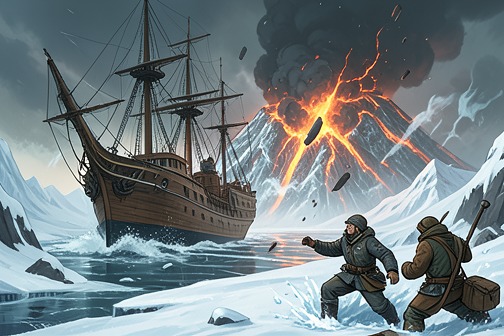
The [Rescue of Airman Stutt](entity:event-recall-event-rescue-of-airman-stutt-b222d2aec2bf) is a carefully improvised recovery aboard the Endeavor in the [Crimson Caldera](entity:location-recall-location-crimson-caldera-f34c82d45880), a place where an erupting volcano, falling debris, buildings, and human actions have been arrested in temporal suspension. The operation converts an apparently lost airman into a living survivor, but the rescue is never wholly triumphant: Stutt returns confused, physically unstable, and vulnerable to the [Caldera](entity:location-recall-location-caldera-397c885f84d1)’s continuing effects, while the ship must immediately resume a prescribed course through the frozen eruption.
## The Crimson Caldera and the Rescue’s Conditions
The Endeavor approaches the Crimson Caldera through an immense conflagratory glow that reveals a glassy mountain slope on one side and an abyss on the other. Only when the ship draws close does the source of the light become visible: a volcanic eruption has been frozen in time. Lava remains suspended in mid-churn, fiery rocks hang in the air, and fractured stone is held in the instant of splintering. The temporal force reaches toward the Endeavor and makes the ship shiver, but the protection granted by [Angkor Leng](entity:location-recall-location-angkor-leng-dfd69cfaf06c) repels it.
The frozen eruption contains more than natural violence. The crew discovers roads, fields, burning crops, and faceted glass buildings scattered across arrested fragments of landscape, suggesting that a settled population was caught in the catastrophe. Bone-white towers rise from the tilted debris, each terminating in an open bell tower. Their bells provide the only reliable means of navigation: Jonathan explains that the crew must fly toward each bell when it rings, because any other route may leave the ship hopelessly lost. The Caldera therefore turns rescue into a problem of ritualized movement through a landscape in which space and time have become inseparable.
[Captain Montgomery](entity:character-recall-character-captain-montgomery-85ba416f8403) brings the Endeavor to a halt beside the first tower, which rises from the canted roof of one of the glass dwellings. Shadows cast by the suspended lava suggest that people remain trapped inside, while a human figure hangs motionless above the structure, still gripping a tether and frozen in the act of opening its door. The sight transforms the Caldera from an abstract temporal anomaly into a field of individual catastrophes, each person preserved at the precise instant when ordinary action failed.
## Identifying [Airman Stutt](entity:character-recall-character-airman-stutt-44ba738069e9)
Jonathan recognizes the figure as Airman Stutt, drawing the name from memory. Stutt had absorbed some of the strange light associated with Angkor Leng and had believed that this exposure would make him immune to the Caldera’s effect. Professor Loren had warned him, but curiosity or greed overcame caution. His entrapment is consequently linked not only to the Caldera’s external power but also to a decision made in pursuit of knowledge or advantage.
The recognition also gives the rescue a retrospective dimension. Jonathan remarks that he had paid closer attention to the people traveling with him the first time around, establishing that the Stutt being recovered belongs to a prior passage through the expedition’s history. The event is therefore not merely a new encounter but a return to an earlier failure, with Jonathan now able to identify a person whom the present expedition had inherited from the past.
[Montgomery](entity:character-recall-character-montgomery-3d1e676073f0) proposes using the Endeavor’s bottom hatch to retrieve Stutt without sending anyone outside. The practical incentive is clear: an additional airman could offset some of the losses the ship has suffered. Yet the decision is not reduced to manpower. Jonathan recognizes that the attempt might endanger the vessel, although he cannot name a specific threat, and warns that it may already be too late for Stutt. He also insists that [Antomine](entity:character-recall-character-antomine-c73da0eb5297) should attend the recovery, since the consequences of temporal displacement may be occult or medical rather than nautical.
## The Extraction from Frozen Time
The Endeavor descends toward the dwelling with its engines pulsing and its pilot making careful adjustments. A bell sounds from somewhere beyond the ship while the crew prepares the operation, but Jonathan explains that such sounds are normal in the Crimson Caldera and that bells are the only noises that can be heard there. At the cargo deck, airmen gather around the opened bottom hatch, large enough for a carriage, while instructions are shouted upward and relayed to the bridge through a speaking-tube: the ship is ordered port, forward, and then to stop with minute corrections.
The pilot handles the Endeavor’s bulk with enough precision to bring Stutt and his attendant tether upward through the hatch. Stutt is short and densely built, with shaggy hair and a heavy moustache and beard that nearly conceal his eyes and mouth. His body remains unresponsive to his surroundings. The crew catches him with another tether and pulls him aside, but nobody immediately touches him to help him descend. The reason is simple and dangerous: contact might assist him, or it might transmit the temporal suspension to the rescuer.
As Antomine approaches, Stutt begins to drift downward. At first Jonathan cannot determine whether the Endeavor is rising or whether the change belongs to Stutt himself. Antomine’s white-pupiled eyes then blaze with light, and the descent accelerates. The movement is grotesquely gradual at first: Stutt falls while slowly becoming aware that he is falling, reaching out as though he might catch himself. The rescue thus becomes a visible struggle between two temporal conditions, with the airman’s body and perception returning at different speeds.
Time finally catches up with Stutt all at once. He drops heavily onto the deck and lands in a crouch, while the remains of the tether fall beside him. He is aboard a human airship, but not the same ship he remembers leaving, so his first response is confusion rather than alarm. Antomine offers him a hand and identifies himself as an inquisitor aboard His Majesty’s Ship the Endeavor, adding that approximately five years have passed. The extraction succeeds, but the announcement makes clear that rescue has also become a confrontation with lost time.
## Recognition, Recovery, and Uncertainty
Stutt recognizes Jonathan and asks whether the elapsed time is genuine, observing that Jonathan looks different. Jonathan confirms the situation without emphasizing his own unfamiliarity with Stutt, and attributes the rescue chiefly to Captain Montgomery and Antomine. Stutt apologizes and accepts Antomine’s hand, admitting that he has never met an inquisitor before. Antomine responds with an unusually broad, youthful smile and immediately begins assessing the survivor’s condition, asking what Stutt remembers and whether he feels capable of remaining upright.
Stutt remembers almost nothing. He can recall only that he was trying to open the door and then found himself aboard the Endeavor. Jonathan takes this lack of recollection as evidence that Stutt has not absorbed any esoteric knowledge during his imprisonment, though he admits that such knowledge could theoretically remain undiscovered within the survivor’s mind. For Jonathan, the result is disappointing as well as medically uncertain: the rescue has not yielded the hidden understanding he associates with unusual exposure, and the absence of knowledge does not guarantee that Stutt has escaped the Caldera unharmed.
A further bell rings, and Stutt alone reacts immediately. He clutches his head and groans, while Antomine reaches toward him and looks to Jonathan for guidance. Jonathan refuses to interfere, judging Antomine and the ship’s doctor better equipped to deal with the aftereffects. The reaction demonstrates that Stutt’s return is incomplete. Although his body has re-entered ordinary time, the Caldera remains capable of reaching him through sound, memory, or some other temporal residue.
## Consequences and Narrative Significance
The crew members responsible for the extraction respond with grins and back-slapping, hoping that Stutt will not be permanently afflicted and can eventually work again. Their relief is practical as well as humane: every available hand matters after the Endeavor’s losses. Montgomery’s decision to attempt the recovery therefore produces a limited but concrete gain, restoring a possible crew member without requiring the ship to expose someone directly to the frozen landscape.
Jonathan’s own response is more detached. Once Antomine and the ship’s doctor escort Stutt toward the stairs, he returns to the observation deck, looks out over the arrested landscape, and taps his fingers on his cane. The gesture places the rescue beside the larger danger rather than allowing it to conclude the sequence emotionally. Stutt has been recovered, but the Caldera remains full of suspended people, frozen buildings, and an eruption that could become catastrophic if time resumes or if the ship enters a fragment positioned only moments ahead of the rest.
The Endeavor moves again after another bell sounds from a different direction. The crew follows the prescribed route because nobody is willing to discover what happens if the bells are ignored. In this way, the rescue does not release the expedition from the Caldera; it returns the ship to its hazardous passage. The event shifts the value of Stutt’s condition from certain loss to uncertain survival, while preserving the larger threat that made his recovery necessary. Its decisive pattern is therefore a reversal without full restoration: a man is brought back from five years of frozen time, yet the forces that trapped him remain active, and his future health, usefulness, and memory are all unresolved.
Event 26
Stutt's Caldera Affliction
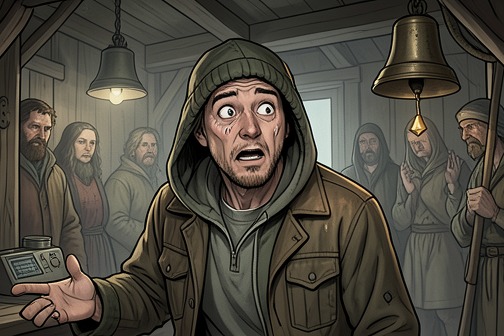
[Stutt's Caldera Affliction](entity:event-recall-event-stutt-s-caldera-afflict-8acf9197e03b) is the episode in which [Airman Stutt](entity:character-recall-character-airman-stutt-44ba738069e9)'s rescue becomes a new danger to the Endeavor. The crew has recovered him from the frozen landscape of the [Crimson Caldera](entity:location-recall-location-crimson-caldera-f34c82d45880), but the bells governing the ship's movement have left him altered. His illness is not merely physical: it binds him to the strange figures fixed within the [Caldera](entity:location-recall-location-caldera-397c885f84d1), turning a rescued crewmember into the means by which those inhabitants can continue to find and follow the ship.
## Symptoms and Immediate Crisis
After each bell, Stutt had complained of headaches that soon passed, and the crew initially treated the episodes as temporary aftereffects of his imprisonment. The pattern changed after another bell sounded. Stutt went berserk inside his cabin, forcing the crew to bar the door while he thumped and shouted. The ship's doctor, Timothy, reported that the disturbance followed the bell directly and suspected that the problem belonged to the occult expertise of [Jonathan Heights](entity:character-recall-character-jonathan-heights-d9ccad9c719b) and Inquisitor [Antomine](entity:character-recall-character-antomine-c73da0eb5297) rather than to ordinary medicine.
The summons itself establishes the event's divided authority. An able airman fetched Jonathan and Antomine from their respective quarters, while the doctor waited outside the cabin and the crew kept their distance. Stutt was not simply sick; he was speaking a language no one aboard could recognize. Antomine therefore called on Jonathan to determine whether the speech concealed knowledge of the Caldera or its inhabitants.
## Jonathan's Interpretation
Jonathan could understand only fragments of Stutt's speech, so he took a notebook and stick of charcoal from inside his jacket and began recording what he heard. His knowledge of the tongues of the true east was moderate, and Stutt's language belonged to an older related dialect, making the translation difficult. Even so, repeated phrases supplied the essential meaning: Stutt said that he was there, demanded to be let out, and urged the ship to stop and find the bells.
The words showed that Stutt was addressing the figures scattered through the frozen landscape. As the Endeavor moved through the Caldera's unstable temporal fragments, more of those figures had become visible: stretched metallic faces, long vertical slit-like eyes, and narrow mouths with a lugubrious cast. They remained fixed while time flickered around them, yet their attention was unmistakable. Jonathan concluded that Stutt, not the ship's otherwise evanescent presence, had become their object of interest.
Jonathan's first practical judgment was severe. Exposure to the secrets beyond human regions had changed Stutt, and Jonathan thought it might be safest to release him back into the world of stasis. Stutt had returned from the Caldera, but he had not returned wholly untouched. His condition threatened the ship precisely because it was a connection rather than an isolated injury: while he remained aboard, the things dwelling in the frozen landscape would continue to dog the Endeavor's path.
## Antomine's Decision and the Ship's Risk
Antomine asked whether removing Stutt from the Caldera would end the connection, and Jonathan answered that it would probably fade, perhaps instantly, because of the peculiar nature of the place. Antomine nevertheless refused to solve the problem by sacrificing the rescued airman. Instead, he ordered the captain to drive the engines at full power, choosing to trade efficiency for time while the ship crossed the dangerous region.
That decision carried a concrete mechanical cost. The Endeavor's zint reserves were not yet exhausted, but their potency had begun to diminish; full thrust would consume the remaining supply much faster than normal. Until the crew could refine more zint beyond the Caldera, the ship risked draining its entire system. Stutt's affliction therefore transformed a medical emergency into a navigational and logistical crisis: keeping him aboard might draw the frozen inhabitants after the ship, while accelerating away from them could leave the vessel without the energy needed to survive what came next.
Jonathan admitted that he would need to research the condition and that he had rarely found cures for such afflictions. He regarded treatment as more properly belonging to the Inquisition, but Antomine's options were limited and he ordered Jonathan to see what he could do. Jonathan, irritated at being commanded, nevertheless told the crew to ensure that Stutt did not leave his cabin. The order protected the ship from an uncontrolled breach while preserving the possibility that the connection might weaken or be studied.
## Escalation and Aftermath
The engines reached full power before Jonathan had even cleared the stairwell. The Endeavor shivered, lurched, and trembled as metal squealed below, and the immediate danger became ambiguous: either the ship had struck something, or something had struck the ship. The acceleration intended to escape the Caldera thus produced no secure resolution. Stutt's condition had already altered the passage's terms, making every bell, every movement through frozen time, and every contact with the surrounding landscape potentially consequential.
The event's decisive reversal is that rescue does not restore Stutt to ordinary crew life. Earlier, the men responsible for finding him celebrated and hoped that he would recover sufficiently to work and offset some of the Endeavor's losses. The later episode reveals that his survival has a cost. He may still be saved, but his altered state now endangers everyone aboard and exposes the ship to beings whose presence Jonathan cannot fully explain or cure.
## Narrative Significance
Stutt's Caldera Affliction dramatizes the expedition's recurring exchange between knowledge and survival. Jonathan's translation gives the crew enough understanding to act, but not enough mastery to remove the threat. The bells remain unexplained, the figures remain fixed beyond ordinary time, and Stutt's speech supplies only a partial bridge between human perception and the Caldera's alien inhabitants. Knowledge improves the crew's judgment while simultaneously proving how little control that judgment can secure.
The episode also turns bodily suffering into a form of contact. Stutt's headaches, groans, violent behavior, and involuntary speech are not decorative signs of fear; they are the physical manifestations of a connection that crosses the boundary between the Endeavor and the frozen world. Antomine's response places compassion against operational necessity, while Jonathan's response places interpretation against containment. Neither man can restore the old separation between rescued airman and hostile landscape. By the end, Stutt is both crewman and conduit, and the Endeavor's flight through the Crimson Caldera has become a race against a danger carried inside its own hull.
Event 27
Endeavor Collision in the Crimson Caldera
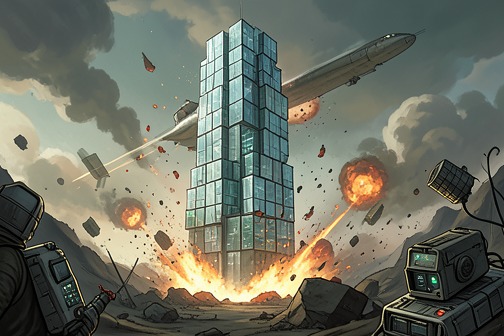
The [Endeavor Collision in the Crimson Caldera](entity:event-recall-event-endeavor-collision-in-t-6e6d249f57d9) is the decisive mechanical and temporal crisis of the Endeavor’s passage through the [Crimson Caldera](entity:location-recall-location-crimson-caldera-f34c82d45880). A tower of fused cubes and faceted glass appears directly in the ship’s path, apparently without warning, and the Endeavor strikes it before the pilot can react. The impact draws the airship into a world where debris, buildings, lava, and metallic beings occupy shifting relations to time; survival depends not simply on repairing damage, but on understanding how motion through space has exposed the ship to another temporal condition.
## Causes and Setting
The collision occurs as the Endeavor travels through the strange city within the Crimson Caldera. The landscape is not stable in an ordinary physical sense: buildings seem to congeal from the air, extra structures appear as though produced by the extra degrees of a circle, and bells dictate changes of course. The city’s frozen cataclysm includes glass buildings and cube-wrought towers, while lava bursts from below without radiating warmth, behaving more like colored wax than molten rock. This environment makes ordinary navigation unreliable, since an obstacle may appear only when the ship has already entered its path.
The immediate obstacle is a large tower made from amalgamated cubes and faceted glass. The Endeavor smashes into one of its glass protrusions, an impact [Jonathan Heights](entity:character-recall-character-jonathan-heights-d9ccad9c719b) does not blame on the pilot because the structure likely appeared out of nowhere. The collision therefore arises from the city’s altered spatial and temporal reality as much as from the ship’s movement. The ship is not merely flying through a dangerous landscape; it is passing between incompatible states of existence, with the consequences becoming visible only at the moment of contact.
## The Collision and Initial Response
Jonathan Heights reaches the observation room as the Endeavor shakes from the impact, nearly bowling over [Eleanor McAvey](entity:character-recall-character-eleanor-mcavey-56495d17d879), who has just emerged from her cabin. Through the forward windows they see debris hanging in the air, arrested midflight. Jagged glass fragments claw into the hull and envelope, producing a screech that damages both ear and mind. Although the engines pull the ship away from the tower, pieces embedded in the Endeavor come with it, accompanied by several metallic creatures attached to or emerging from the wreckage.
Eleanor McAvey immediately asks whether the beings can be fought and produces her long dagger. Jonathan answers that they will have to fight them, but identifies the more urgent task as removing the glass from the hull. Running outside would expose the crew to freezing, and the ship’s light treatment may or may not protect them from the surrounding conditions. The exchange establishes the event’s two simultaneous dangers: hostile inhabitants have entered the ship’s immediate space, while the collision itself is converting the Endeavor into a leaking, structurally compromised vessel.
Jonathan Heights and Eleanor McAvey divide the work without needing to discuss it. [Eleanor](entity:character-recall-character-eleanor-f86629a4f595) goes to the mid-deck, where the damage is lighter, while Jonathan descends to the cargo deck, where a massive faceted-glass beam has been driven through the hull. He finds two airmen attempting to clear broken crates, spilled parts, and cracked wood so they can reach the intrusion. Rather than wait, he tucks his cane under one arm, vaults over the scattered brass bolts and steel washers, and balances on a crate to reach the beam.
The glass is partly inside and partly outside the Endeavor’s temporal stasis. As the ship pulls away, the beam shifts unpredictably and enlarges the puncture. Jonathan breaks off its jagged tip, removes metal that has wrapped around it, braces himself against a structural beam, and seizes the blunt end. He then forces the spar back through the hole it made. Glass splinters drive beneath his fingernails, but the injury does not stop him; after a final exertion, the beam falls away and drifts behind the ship.
## The Metallic Intruders and the Shipboard Counterattack
A second breach reveals that the glass is not the only danger carried aboard. After a crewman indicates a smaller puncture on the opposite side of the cargo deck, Jonathan Heights climbs through stacked crates and cuts their securing ropes aside. Behind them he finds a metallic hand punched through the hull, its fingers spread as though questing for a hold. The digits move slowly as the Endeavor’s protective treatment begins to affect them.
Jonathan crushes the hand in his own grip. The metal is warm and cunningly wrought, and a vital substance resembling oil and old blood spurts from the limb when it deforms. He pushes the mangled hand back outside and cleans his hands with his handkerchief. The episode makes his physical strength a practical instrument of shipboard survival, while the uncanny warmth and dark fluid confirm that the metallic figures are not inert machinery. They possess bodies that can be damaged, but their presence remains alien and difficult to classify.
Jonathan then follows shouting and creaking metal to the bridge. The forward windows are shattered, a thick glass shard has pierced the front of the ship and embedded itself in the ceiling, and several metallic figures cling to the beam. The surviving [Lux Guard](entity:organization-recall-organization-lux-guard-be0b4e19435c) works to pry the debris from the hull, while the ship’s changing position causes the fragment and the beings to shift between pieces of the surrounding stasis. None of the figures has yet entered the ship, but their proximity makes the bridge an active battlefield.
Jonathan recognizes that continued movement is helping preserve the danger. He orders [Captain Montgomery](entity:character-recall-character-captain-montgomery-85ba416f8403) to cut the engines. [Montgomery](entity:character-recall-character-montgomery-3d1e676073f0) initially appears ready to argue, then understands the reasoning and gives the order. Once the Endeavor stops, the temporal relation changes: the beings are not entirely fixed in time, but they cannot move while the ship no longer travels through space. This does not make the situation safe, because glass continues tearing the hull and other invaders may remain undiscovered, but it limits the immediate motion of the threat.
Jonathan pushes the Lux Guard aside and removes the largest bridge fragment himself. With both hands he wrestles the glass spar out of the ceiling and drives it back through the broken forward windows, resisting the stasis that holds it in place. The beam bucks and quivers as he forces it outside, where it returns to the still time from which it came. Smaller pieces remain scattered across the bridge, but they appear harmless enough for the moment, allowing Jonathan to turn from emergency removal toward a wider survey of the ship.
## Damage, Escape, and Aftermath
The collision leaves the Endeavor slowly sinking because glass has impaled the envelope and allowed lifting gas to escape. The ship is not immediately expected to crash into the frozen cataclysm, but it can no longer fly high over the landscape. Its envelope is compartmentalized, so the crew will not lose all of the gas at once; nevertheless, the loss of vertical mobility becomes a serious hazard until repairs and fresh lifting gas can be obtained.
Captain Montgomery, the mechanic, and the pilot respond as though the ship were in a running battle. They cannot safely send men outside to inspect and patch the holes, so the Endeavor must continue with incomplete knowledge of its condition. Jonathan learns that a vein of zint lies only a few hours east of the [Caldera](entity:location-recall-location-caldera-397c885f84d1) and that hunting may replenish food supplies, but reaching those resources requires crossing the city while the vessel is damaged and descending.
The pilot maneuvers with exceptional care, avoiding buildings that appear to form from the air and adjusting course when the bells sound. The ship scrapes along something at its keel, and lava erupts nearby without giving off heat. Even so, the Endeavor clears the city wall and avoids a spray of red-hot stone. Once it reaches the broken volcanic landscape beyond, the sound of [Airman Stutt](entity:character-recall-character-airman-stutt-44ba738069e9)’s screams fades from the bridge and the crew briefly relaxes, though the ship remains damaged and the larger dangers of the Crimson Caldera have not ended.
The event’s consequences extend beyond the immediate repairs. Earlier and later passages frame the Endeavor as a vessel repeatedly forced through thresholds that alter bodies, supplies, time, and identity: it leaves the smoldering remains of [Danner’s Grasp](entity:location-recall-location-danner-s-grasp-1a3bfa423977) after a funeral service, discovers an impossible settlement around a terrestrite vein, and later enters the [Arch of Khokorron](entity:location-recall-location-arch-of-khokorron-5d801aa6e8a6) through a tunnel whose machinery transforms space into unrecognizable vistas. Against that pattern, the collision is a material demonstration of the expedition’s governing danger. The farther east the Endeavor travels, the less reliable the categories of distance, shelter, infrastructure, and even movement become.
## Narrative Significance
The Endeavor Collision in the Crimson Caldera converts a spectacular setting into a test of practical knowledge. Jonathan Heights does not survive by treating the city as scenery or by relying on the ship’s protections; he observes the relation between motion and stasis, orders the engines stopped, and physically removes the intrusions one by one. His cane, usually associated with age, injury, and cultivated self-presentation, becomes a tool for climbing, hooking, balancing, and fighting. The collision thus joins the expedition’s intellectual hazards to a sharply bodily struggle.
The event also foreshadows the wider transformation of Jonathan Heights. At the Arch of Khokorron, passage requires the payment of knowledge or a life; at [Bright Defile](entity:location-recall-location-bright-defile-18d73f1df73b), the final barrier demands that every remaining attachment and shadow be shed. The collision is less metaphysical than those later thresholds, but it teaches the same structural lesson: passage is never free, and movement through an altered world changes the traveler. The Endeavor escapes the city, yet it loses lifting gas, suffers hull and envelope damage, and must proceed at reduced altitude. Its survival is therefore not a restoration of the prior state, but a damaged continuation toward the sunlight that Jonathan ultimately reaches.
Event 28
Passage through the Crimson Caldera
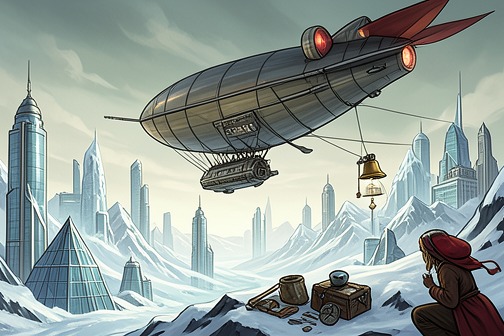
[Passage through the Crimson Caldera](entity:event-recall-event-passage-through-the-cri-6c6e06591df3) is a defining threshold event in the eastward voyage of the Endeavor: a crossing through a volcanic eruption frozen in time, where navigation depends on bells rather than maps and survival depends on respecting a broken temporal order. The journey transforms the [Caldera](entity:location-recall-location-caldera-397c885f84d1) from a spectacular obstacle into a hostile archive of an extinct or otherwise inaccessible civilization, while the rescue of [Airman Stutt](entity:character-recall-character-airman-stutt-44ba738069e9) exposes the physical and mental cost of treating that archive as an object of exploration.
## Causes and Setting
The Endeavor reaches the [Crimson Caldera](entity:location-recall-location-crimson-caldera-f34c82d45880) after continuing eastward through a wilderness already marked by mechanical damage, missing tools and supplies, and the need to replenish its stores. The ship has spent three days patching leaks and covering punctures in its envelope, wings, and steering surfaces; the engines remain intact, but embezzled or emptied crates have left fewer replacement parts than expected. When a dull glow of luminiferous terrestrite appears ahead, [Jonathan Heights](entity:character-recall-character-jonathan-heights-d9ccad9c719b) anticipates a mineral source in the wilderness. Instead, the spotlights reveal rumbling machinery, white walls, mooring towers, busy streets, and other signs of an apparently impossible settlement shining in the darkness. That encounter establishes the eastern world as a place where human infrastructure may appear far beyond human lands, and where every promise of safety can conceal a different order of danger.
The Crimson Caldera itself first appears as a conflagratory glow drawing the eye across impossibly high mountains and an abyss that resists sustained inspection. Only when the Endeavor approaches does the cause become visible: a volcanic eruption has been arrested mid-event. Lava froth hangs in motion, fiery projectiles remain suspended, and rocks are fixed in the act of breaking apart. The temporal force reaches toward the Endeavor and makes the ship shiver, but the protection granted by [Angkor Leng](entity:location-recall-location-angkor-leng-dfd69cfaf06c) repels it. The crossing therefore begins in a state of unstable privilege: the crew can move through the frozen catastrophe, but only because an earlier power temporarily shields them from the Caldera’s governing condition.
## Navigation Through Frozen Time
Jonathan’s ancient records provide the central rule of passage. The crew must listen for the bells and fly toward each one when it rings; any other route risks leaving the ship hopelessly lost. The instruction replaces ordinary navigation with a ritualized response to sound. Visibility is unusually clear because the volcanic illumination exposes the landscape for miles, yet that clarity is deceptive. The Endeavor is moving through space and through successive frozen moments, with each apparent landscape shifting subtly as the ship crosses an invisible temporal boundary.
The first stages of the journey pass over a churning sea of lava, where fragments of dwellings and their attendant bell towers float like islands. Farther in, whole hills and valleys appear suspended in the act of disintegration. The ship sometimes changes course after only a few minutes and sometimes waits for hours before another bell sounds. No pattern becomes apparent to Jonathan, and nobody is willing to test the consequences of ignoring the prescribed route. A third bell eventually sends the Endeavor onward from a new direction, confirming that progress depends not on the crew’s understanding of the system but on obedience to a rule whose logic remains inaccessible.
The route carries the Endeavor almost directly through the Caldera’s center. Jonathan remembers that the [Discovery](entity:object-recall-object-discovery-074c5d88e879) took a different course on an earlier expedition, skirting the shattered city mounds, whereas the Endeavor flies above the city itself. Beneath them, opalescent cubes as large as city blocks and faceted glass buildings grow from fractured ground; strange vehicles with sharp angles and faceted curves clutter the broken streets. The visible remains suggest a civilization caught at the moment of destruction, but they do not make that civilization intelligible. Narrow openings in cracked glass and ruptured mother-of-pearl expose interiors composed of shapes and colors that hint at meaning without resolving into anything the eye can grasp.
## Temptation, Observation, and Stutt’s Rescue
The Caldera’s suspended ruins invite investigation. [Eleanor McAvey](entity:character-recall-character-eleanor-mcavey-56495d17d879) proposes that, after retrieving one person, the crew might collect other objects encountered along the route. Jonathan rejects the idea of wasting time on random glass or metal, distinguishing the practical value of rescuing an airman from the merely speculative value of examining the ruins. His refusal is not simple indifference: the broken city remains compelling precisely because it appears to promise knowledge, but the crossing has already shown that curiosity can become a physical hazard.
The danger becomes explicit when the crew encounters the remains of those who once inhabited the city. The beings are long-limbed and metallically gleaming. [Captain Montgomery](entity:character-recall-character-captain-montgomery-85ba416f8403) studies them through a spyglass and concludes that they seem to be looking toward the ship. They cannot move within the frozen world, yet their apparent attention follows the Endeavor across temporal divisions. Jonathan maintains that the crew has not lost Angkor Leng’s protection, because everything remains still except at the moments when the ship crosses from one time-slice into another. Even so, the figures continue to stare, creating a disturbing feedback between observer and observed. In a realm where time is broken, the gap between stillness and concealed action cannot be trusted.
Airman Stutt is found within the Caldera and successfully pulled out, but the rescue is not a clean triumph. He clutches his head, groans, and later produces hoarse screams and thumps audible from the bridge. [Antomine](entity:character-recall-character-antomine-c73da0eb5297) immediately reaches toward him and looks to Jonathan, who acknowledges that the inquisitor and the ship’s doctor are better equipped to manage the aftereffects. The crew celebrates the rescue with grins and back-slapping because every surviving hand matters after the losses suffered by the Endeavor, yet Jonathan’s interest remains chiefly logistical: Stutt may recover sufficiently to work and offset some of the ship’s depleted manpower. The scene turns exploration into an ethical and operational calculation, showing that the expedition’s human value is measured against its continuing need for labor.
## The Exit and Immediate Aftermath
The final stages of the passage remain dangerous even after Stutt is aboard. More bells send the Endeavor along an indirect arc toward the far end of the Caldera. Along the route, the crew sees scattered remnants of civilization and another airship of a noisome design, equally trapped in the frozen catastrophe. No one attempts to approach it, since the rescue of Stutt has demonstrated the cost of contact with the suspended world. The Caldera preserves not only landscapes and people but also unanswered histories whose origins may never be recoverable.
The end arrives abruptly at a final bell tower marking the boundary between volcanic light and familiar darkness. The lava’s radiance fails to illuminate anything beyond the boundary, while the Endeavor’s zint beams freeze in the air a short distance beyond the hull. Only scattered points of luminescence, a faintly shining river, and a solitary sheltershroom indicate that the ordinary eastern world continues on the other side. When Captain Montgomery orders the ship forward, glass and metal fragments trapped in the Endeavor’s wake fall onto the upper decks or crash below. The Caldera’s light disappears, and the reflected tubes show only the lone bell tower standing in a broad plain.
The sensory change is as consequential as the geographical one. Fresh air enters the open bridge, carrying the smell of river, rock, and growing things rather than the atmosphere of suspended catastrophe. Jonathan explains that anything of human stock can travel west without difficulty and that the barrier chiefly troubles those native to the Caldera. Once beyond the boundary, he directs [Montgomery](entity:character-recall-character-montgomery-3d1e676073f0) toward a river marked on his esoteric maps. The river becomes their guide to a zint deposit roughly a dozen miles away, shifting the expedition from impossible temporal transit back toward the practical work of refitting and resupplying the ship.
## Significance as a Threshold Event
The crossing is structurally a passage between orders rather than merely a flight across hostile terrain. Inside the Crimson Caldera, ordinary chronology, motion, distance, and historical sequence have been split apart. The crew can move, but the world cannot; the ship advances, yet its wake remains entangled with the frozen debris. Bells provide the only usable law, and the Endeavor’s protection permits passage without granting understanding. The Caldera thus functions as a threshold in which the expedition’s usual instruments and assumptions are suspended, while an inherited rule and a foreign protective power temporarily substitute for them.
The event also establishes a pattern that recurs throughout Jonathan Heights’s eastern journey: survival depends on crossing spaces that cannot be mastered through curiosity alone. The Caldera offers extraordinary visibility but denies reliable knowledge; it displays an entire civilization while withholding access to its meaning; it allows a rescue but punishes attempts at unregulated exploration. Its apparent stillness is not peace but catastrophe held in reserve, with the possibility that resumed time would release lava, shockwaves, falling rock, and every halted instant at once.
Finally, the passage links the expedition’s material needs to its metaphysical dangers. The Endeavor enters the Caldera because it must continue eastward and later leaves it to reach a river and acquire raw zint for renewal. The same journey that exposes the crew to alien ruins and temporal dislocation ends with quarrying, repairs, tethering, and preparations to keep the wilds from destroying the ship. The Crimson Caldera is therefore both wonder and infrastructure problem, revelation and delay: a suspended world that the expedition must survive before it can return to the ordinary labor of keeping an airship flying.
Event 29
Transformation of the Black Garden
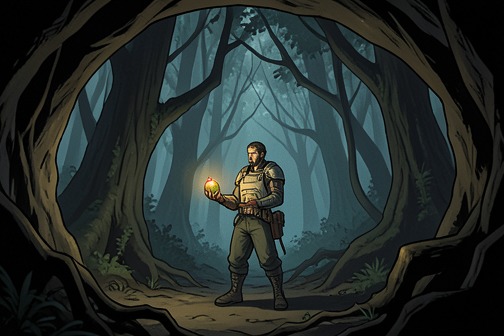
The [Transformation of the Black Garden](entity:event-recall-event-e7e2141cbb6d) is a decisive collision between [Jonathan Heights](entity:character-recall-character-jonathan-heights-d9ccad9c719b)’s faith in sunlight and the [Black Garden](entity:location-recall-location-black-garden-f93df487fc90)’s predatory knowledge. In the [Pits of the Condemned](entity:location-recall-location-pits-of-the-condemne-dc9d40d6e49f), Jonathan brings [Eleanor McAvey](entity:character-recall-character-eleanor-mcavey-56495d17d879) to harvest a creature whose sacrifice produces a living heart-fruit. When [Eleanor](entity:character-recall-character-eleanor-f86629a4f595)’s contact with the fruit makes her feral and turns the Garden against Jonathan, he releases sunlight to defend himself. The light does not destroy the Garden; instead, it changes the nature of its darkness, allowing it to flourish in a new and more expansive form until the Pits themselves become a forest of growing trees.
## Setting and Immediate Cause
The event occurs in the Pits of the Condemned, an ancient gallery of arches and pits reached during the Endeavor’s eastern travels. Jonathan has already learned to regard the eastern world as a sequence of places where ordinary geography, law, and reason become unreliable. The journey first reveals a supposedly impossible infrastructure deep in the wilderness: after repairs to the Endeavor, its crew sees machinery, walls, mooring towers, streets, and a bright human settlement around a vein of terrestrite. Later, [Terminus](entity:location-recall-location-terminus-9fe35f8062b8) presents itself as a tempting trap whose purpose Jonathan judges to be malign, while [Ukaresh](entity:location-recall-location-ukaresh-085787e2ce38) is governed by little beyond power and requires unusual negotiation for a safe berth. These settings establish the expedition as movement through threshold spaces rather than a straightforward voyage across a stable map.
The Pits are more extreme than those earlier locations. Their arches repeat without apparent end, their engravings watch with gouged-out eyes, and the [Keeper of the Pits](entity:character-recall-character-keeper-of-the-pits-658212596770) moves through them on a grotesquerie of limbs while using music to illuminate and alter the apparent dimensions of the chambers. Jonathan has previously arranged a purchase there, and he brings Eleanor specifically because he believes her knowledge of the Black Garden can perform the required harvest. His objective is practical and controlled in conception: obtain the fruit, then manage Eleanor’s state afterward. The setting and the plan both imply that forbidden knowledge can be handled as a transaction, but the event exposes that assumption as dangerously false.
## Harvest of the Heart-Fruit
Jonathan leads Eleanor down the long ramp into the still gallery, where she immediately responds to the pits with delighted, dangerous curiosity. She laughs, looks fearlessly over one edge, and declares that she can feel material there to harvest. When the Keeper’s music breaks her concentration, she turns on the creature with a dagger, forcing Jonathan to hold her back while he asks the Keeper to take them to the purchased sacrifice.
The Keeper reveals the massive near-cat frozen at the bottom of a pit. Its music makes the pit appear to contract, not through visible movement but through a distortion of distance and light. Jonathan then asks Eleanor to harvest it, carefully maintaining a polite tone because that act is the reason he brought her. Eleanor agrees in a crooning voice and raises her dagger. What follows exceeds Jonathan’s understanding: the act evokes blood, crawling vines, immense leaves, roots reaching toward the heart of the world, and the savage thirst of growing things.
The sacrifice leaves no creature behind, only a spreading pool of blood and a single red fruit in Eleanor’s hand. The fruit is smooth, enclosed in a nearly transparent lacework of hide and fur, and contracts like a beating heart. Its vitality is so forceful that it resembles a demented lantern rather than ordinary food or botanical matter. Eleanor laughs and strips away its skin-husk, apparently intending to bite into it herself. Jonathan stops her by the wrist, takes the fruit, and hides it inside his jacket. Although his hand comes away clean, he experiences the fruit as if it had wet him with blood.
## The [Sunlight](entity:state-recall-state-sunlight-28d75af2a2d6)-Black Garden Collision
Removing the fruit does not restore Eleanor. The Garden’s knowledge has corrupted her mind more deeply than Jonathan anticipated, and she becomes entirely feral. She turns on him with a murderous glare, reaches for his face, and attempts to enact the harvest again, this time upon Jonathan himself. He must evade both Eleanor and the Keeper, whose musical movements suggest that the stitched creature is ready to spring and whose destruction might unleash consequences Jonathan cannot predict.
Jonathan’s response is to invoke sunlight. He believes that esoteric knowledge can remain true even when different bodies of knowledge contradict one another, so possession of one secret cannot protect a person from another. His confidence rests instead on sunlight’s purity, sanctity, and reality. He releases its power from within himself as a scorching blaze, intending it to drive back the Garden’s dark roots and crimson appetite.
The result reverses his expectation. Sunlight denies the primacy of the dark vines, but the Black Garden does not simply retreat or perish. Through Eleanor, it looks into the light and absorbs what it encounters. The two incompatible secrets join in a palpable alteration of the Garden’s nature: the darkness becomes greener and greater, flourishing in the one true light. The transformation is not purification but mutation, a new growth whose illumination makes it more expansive without making it less consuming.
## Outbreak in the Pits
The altered Garden bursts into the Pits of the Condemned. Something claws its way out through Eleanor and bathes itself in the radiance of Jonathan’s memory, while both of them remain protected from the worst of the immediate force. The surrounding space is not protected. The Keeper of the Pits gains two new limbs as woody trunks erupt from its barrel; it waves them with apparent cheer before the barrel splits apart and a blood-slick trunk thrusts toward the ceiling, its roots cracking the stone floor.
Eleanor tries to wrench herself away from Jonathan. Blood leaks from her eyes, tongue, and nails as the transformation spreads through her body and the chamber. Around them, every pit begins to tremble. Under the flickering torchlight, hundreds of trees rise, one from each pit, until the Black Garden has physically entered and claimed the entire gallery. The outbreak therefore changes more than a single person or captive creature: it converts the architecture of punishment into a system of propagation, making each pit a point from which the Garden can grow.
Jonathan finally suppresses the sunlight. Its domineering radiance fades from his mind, but the Garden continues to expand after the light is withdrawn. It is no longer black, and its limbs pierce through the ceiling while stone falls into the Pits. Jonathan abandons any attempt to contain the result and runs for the staircase, dragging Eleanor with him. Just before leaving, he sees one of the endless defiled engravings smile, a final image that suggests the outbreak has awakened or fulfilled something already embedded in the place.
## Consequences and Narrative Significance
The Transformation of the Black Garden turns Jonathan’s supposed mastery of sunlight into a source of unintended creation. He has relied on sunlight as a principle capable of ordering or defeating the darkness, yet his intervention produces a hybrid force that is greener, larger, and still devouring. The scene consequently complicates the opposition between light and dark: sunlight can expose and overpower one form of knowledge while also giving another form the condition in which it can flourish.
Eleanor is both participant and medium. Jonathan chooses her for her ability to harvest the sacrifice, but the process strips away the restraint he expects to restore later. Her laughter, dagger, blood, and attempts to harvest Jonathan show the personal cost of contact with the Garden’s knowledge. The outbreak makes her corruption visible on an environmental scale, linking bodily transformation to the growth of trees throughout the Pits.
The event also belongs to the larger pattern of threshold experiences that governs the eastern expedition. The Endeavor later passes through the [Arch of Khokorron](entity:location-recall-location-arch-of-khokorron-5d801aa6e8a6) and emerges at the [Lofted Lakes](entity:location-recall-location-lofted-lakes-dd1cb1f7c158), where glowing flowers illuminate spheres of water suspended above the ground. Elsewhere, Jonathan encounters the [Dead Battle](entity:location-recall-location-dead-battle-30b0e0946d83), whose observation room slowly expands as its apparently fixed tableau becomes an approach, and ultimately reaches [Bright Defile](entity:location-recall-location-bright-defile-18d73f1df73b), where the final barrier is a darkness that can be crossed only by shedding every remaining attachment. Against that later passage into sunlight, the Black Garden outbreak is a distorted rehearsal: light enters a forbidden space, changes its ontology, and leaves the traveler with consequences rather than mastery.
The outbreak’s deepest irony is that both Jonathan and [Antomine](entity:character-recall-character-antomine-c73da0eb5297) treat darkness as something that can be bounded, opposed, or subordinated. Antomine insists that humanity belongs to the light and rejects alien things as spiritual contamination, while Jonathan’s own faith in sunlight leads him to unleash it inside the Garden. Yet the Pits demonstrate that neither prohibition nor confidence guarantees control. Knowledge is not neutral property, and sunlight is not merely a weapon. In the Pits of the Condemned, illumination becomes an encounter, and the encounter makes the Black Garden bloom.
Event 30
乌卡丽放逐乔纳森
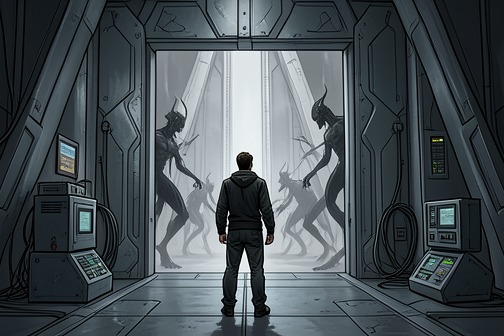
[Ukaresh](entity:location-recall-location-ukaresh-085787e2ce38)’s Expulsion of Jonathan is the event in which [Ukari](entity:character-recall-character-ukari-5a39e56211e2) transforms personal grievance into sovereign punishment, permanently severing [Jonathan Heights](entity:character-recall-character-jonathan-heights-d9ccad9c719b) from Ukaresh after sunlight changes the [Black Garden](entity:location-recall-location-black-garden-f93df487fc90). The judgment preserves his life while destroying the expedition’s access to the eastern center on which its future depends, making exile the price of knowledge, intrusion, and a past intimacy that no longer protects him completely.
## Causes and Setting
The expulsion grows out of Jonathan’s expedition into a world organized by competing claims of light, civilization, secrecy, and supernatural authority. The journey aboard the Endeavor began under the authority of the [Illuminated King](entity:character-recall-character-illuminated-king-657c25addf69) and the Reflected Council, with Jonathan pursuing the sunlight he claimed to have seen despite its public dismissal as myth. Far from the human lands, however, the expedition repeatedly encounters powers that cannot be treated as ungoverned wilderness. [Danby’s Point](entity:location-recall-location-danby-s-point-89a41017e4ad) is the easternmost terminus of human civilization, where zint-lit human construction meets alien architecture and nonhuman peoples behind a great metal gate; trade exists there only alongside containment, suspicion, and the Inquisition’s unstable authority.
Jonathan’s conduct throughout this frontier establishes the pattern that culminates in his expulsion. He treats knowledge of the east as something to be gathered, mapped, and operationally used. At Danby’s Point, [Tiuni](entity:character-recall-character-tiuni-517876ba3162) supplies intelligence about the movements of forces and beasts around the [Verdant Expanse](entity:location-recall-location-verdant-expanse-01f0675c6588), information Jonathan records while narrowing the expedition’s possible routes. He also claims the right to interpret unfamiliar customs and enforce practical judgments, as when he decides that Martin will live but loses a hand after violating the caravaneers’ guesting agreements. His authority is therefore already a mixture of exploration, trade, violence, and improvised jurisdiction before he reaches Ukaresh.
The immediate cause is the alteration of the Black Garden. Jonathan had believed that [Eleanor McAvey](entity:character-recall-character-eleanor-mcavey-56495d17d879)’s introduction to the Garden would be useful, but sunlight affects the place itself and produces a new form rather than leaving it intact. When Ukari confronts him, she identifies the result as an assault on one of Ukaresh’s pillars: the Black Garden is gone in its former state, and Jonathan is responsible. Jonathan attempts to redirect the accusation by arguing that the Garden has changed rather than simply vanished, and that its new secrets may be extraordinarily valuable, perhaps rivaled only by those held beyond the [Arch of Khokorron](entity:location-recall-location-arch-of-khokorron-5d801aa6e8a6). The argument reduces Ukari’s anger, but it does not erase the damage or the violation of her sovereignty.
## The Confrontation
Ukari’s arrival makes the imbalance of power visible before she issues any sentence. As the Endeavor flees and [Montgomery](entity:character-recall-character-montgomery-3d1e676073f0) drives the engines to their limits, her voice reaches from the receding palace with enough force to craze and crack glass. Ukari then towers over the city, retaining the same impossibly perfect appearance as before but becoming large enough to seize the airship in one hand. Her claws reach toward the vessel while Jonathan and [Antomine](entity:character-recall-character-antomine-c73da0eb5297) stand on the railed walkway, confronting a ruler whose physical scale is an expression of her authority rather than merely a threat of bodily violence.
Antomine’s presence briefly complicates the encounter. His white eyes glow as he invokes mysteries Jonathan cannot perceive, and Ukari’s reaching hand pauses. Jonathan uses that instant not to challenge her but to bow and address her respectfully. He apologizes for the unintended effects of his attempt to address [Eleanor](entity:character-recall-character-eleanor-f86629a4f595)’s behavior and insists that he never intended to disrupt Ukaresh or affect the Black Garden. This is a calculated appeal: Jonathan has already concluded that a direct challenge to Ukari’s primacy would fail, so he tries to divert her with an invitation to value the Garden’s transformation.
Ukari rejects the language of accident. She accuses Jonathan of entering her city, abusing her hospitality, and striking one of her pillars. When Jonathan explains that sunlight caused the Garden’s change and that the altered place may now contain unparalleled knowledge, she asks whether that value is enough to offset what he has done. The question marks a temporary shift in the encounter. Her rage becomes conditional rather than absolute, but the possibility of usefulness affects only the severity of the punishment, not the legitimacy of the judgment.
The personal history between them then becomes explicit. Ukari laughs at Jonathan’s attempt to invoke their relationship, calls him shameless, and acknowledges that this quality had once pleased her. The admission makes the scene more than a conflict between explorer and territorial power: it reveals that Jonathan’s survival depends partly on an earlier intimacy with the very ruler whose domain he has violated. That intimacy does not restore his welcome. Instead, it becomes the stated reason that Ukari chooses mercy without forgiveness.
## The Sentence and Its Immediate Result
Ukari’s sentence is precise. She declares that, in recognition of what she and Jonathan once shared, he may live, but she will not allow him to go unpunished. She then casts out Jonathan Heights and his companions, declaring Ukaresh forbidden to them from that point until the end of time. The ruling therefore separates two consequences that Jonathan might have hoped to keep connected: survival is granted, but access is revoked; the expedition remains physically intact, but its eastern future is closed.
The expulsion is accompanied by a violent disappearance. A great rush of wind and a roar like cracking thunder pass over the scene, and Ukaresh is gone. Beneath the Endeavor’s spotlights lies cracked stone and tangled briars, with lumpen mushrooms rising among buried shapes that may suggest the remains of a city. The visual aftermath refuses a clean distinction between disappearance and destruction. Ukaresh has vanished, the city has become dark desolation, and the former center of the expedition’s east is no longer available as a stable place of return.
Jonathan immediately recognizes how narrowly he has escaped. He understands that Ukari’s restraint may be connected to the fact that he transmuted the Garden rather than destroying it outright, and perhaps also to her enjoyment of the chaos produced by the destruction of the Pits. The event thus ends not with Jonathan’s triumph but with a negotiated survival whose conditions remain dependent on the ruler’s mood, memory, and evaluation of the altered Garden. His rhetorical success has deflected annihilation, not cancelled responsibility.
## Consequences for the Expedition
Antomine asks whether the city is simply gone. Jonathan’s answer is more exact and more consequential: it is gone for them. He turns away from the place he had once marked as the center of the true east, a port without which significant exploration is impossible, and concedes that Ukari’s ban makes the city inaccessible even if other travelers may still find it. The expulsion therefore changes the geography of the narrative. Ukaresh does not necessarily cease to exist for the entire world, but it disappears from Jonathan’s reachable map.
That distinction matters because Jonathan’s expedition had been built on the assumption that the far east could be approached through accumulated intelligence, preparation, and nerve. He had educated his companions in local hazards, relied on Tiuni’s information, negotiated at the borders of human civilization, and resisted Antomine’s demand that the Endeavor divert itself to cleanse [Angkor Leng](entity:location-recall-location-angkor-leng-dfd69cfaf06c). Yet Ukaresh demonstrates the limit of those methods. Mapping, trade, artillery, Inquisition authority, and personal audacity cannot guarantee passage through a territory whose ruler can simply declare a destination forbidden.
The event also sharpens the conflict between Jonathan and Antomine. Antomine warns that Jonathan is not absolved merely because he managed to deflect Ukari’s wrath, and he says that the future of the expedition must be reconsidered. Jonathan answers that such dangers are intrinsic to traveling so far east: every landmark beyond the human sphere is steeped in powers and secrets, and every significant place has a protector or ruler. For Jonathan, caution cannot eliminate the danger because the danger is the condition of exploration itself. For Antomine, the same fact is evidence that the expedition’s conduct has become intolerable and that civilization cannot simply pass threats by when they are inconvenient.
The expulsion also clarifies the limits of the Inquisition’s power. Earlier, Antomine could invoke the Inquisition to threaten treason when demanding Montgomery’s cannon against a town infected by the Third Gospel. Jonathan even supports the necessity of destroying buildings that might retain its echoes, showing that he is not opposed to catastrophic measures when they serve his understanding of contamination. In Ukaresh, however, Antomine’s institutional authority cannot overrule Ukari’s local sovereignty. The encounter exposes a frontier order in which the crown’s agent may supervise, threaten, and punish within human jurisdiction, but remains vulnerable before a ruler whose power is older, larger, and territorially absolute.
## Narrative Significance
Ukaresh’s Expulsion of Jonathan is a value reversal built around survival and belonging. Jonathan enters the confrontation seeking continued movement through the east and perhaps hoping that clever speech can convert disaster into advantage. He leaves alive but excluded, with the most important eastern port removed from his route. The positive value of survival remains, but freedom of movement, access to knowledge, and the expedition’s strategic future shift sharply into loss.
The event also turns intimacy into an instrument of sovereignty. Ukari’s recognition of what she and Jonathan once shared prevents his death, yet the same recognition emphasizes that their former relationship has become part of the legal and emotional basis of his punishment. Jonathan cannot return to the informal privilege that intimacy once provided. His past grants him life only so that the present can impose a more enduring sentence: he may continue elsewhere, but never again in Ukaresh.
Finally, the expulsion crystallizes the novel’s larger opposition between the human doctrine of civilization and the realities of the eastern world. The expedition begins as an effort to push beyond the known limits of light and humanity, but every advance reveals that the frontier is not empty. Its cities, gardens, gates, ruins, races, and rulers possess their own laws and claims. Jonathan’s exile is consequently not a random setback. It is the eastern world answering the explorer’s attempt to turn its secrets into a route, a map, and a resource. The answer is neither simple death nor simple victory, but a living prohibition that follows him from the place he can no longer find.
Event 31
逃离迷雾海
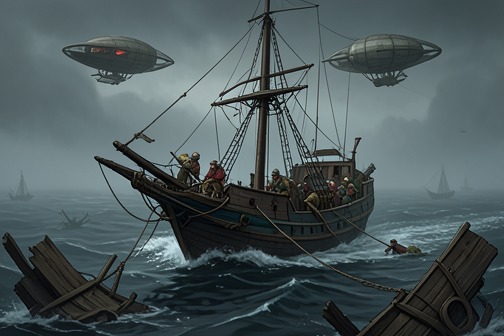
Escape from the [Sargasso](entity:location-recall-location-sargasso-e991791e0739) is the Endeavor’s controlled emergence from a maritime labyrinth where mist, wreckage, and distance cannot be trusted. What begins as a temporary attempt to regain the expedition’s bearings becomes a dangerous operation requiring fire dust, coordinated labor, and a willingness to endure the lingering fever associated with the dream beneath [Angkor Leng](entity:location-recall-location-angkor-leng-dfd69cfaf06c). The escape restores a navigable route, but it also reveals that the landscape itself has been an active deception rather than a stable stretch of sea.
## Entering a Hostile and Unstable Waterway
The Endeavor reaches the sargasso after the visible shore unexpectedly founders and crumbles away, leaving water spreading in every direction. Mist rises from the dark surface and wraps around the remains of wooden and iron ships, while ancient airships continue to float above the water despite age and decay. The scene transforms the sargasso from a geographical location into a threshold where ordinary bearings lose their authority.
[Jonathan Heights](entity:character-recall-character-jonathan-heights-d9ccad9c719b) does not regard the place as merely a battlefield or a physical obstruction. He prefers not to remain there and uses it only to determine the expedition’s position, recognizing that the sargasso resists precisely the practical act of orientation. Even so, he judges it less immediately terrifying than many eastern regions and suspects that the careful deployment of fire dust will pose a greater danger than the becalmed waters themselves. This judgment establishes the episode’s central tension: survival depends not only on confronting external creatures, but also on manipulating a place whose apparent reality is unreliable.
## The Stranded Flame Cult Vessel
The Endeavor’s first major discovery in the sargasso is an older cargo airship bearing the insignia of the [Cult of Flame](entity:organization-recall-organization-cult-of-flame-06c23d21df47). Its myceliplank body and treated-canvas envelope contrast with the Endeavor’s sleek metal construction, and the vessel appears aged but still serviceable. Its crew are alive and visibly desperate, greeting the approaching ship with jubilation. Their presence also expands the episode beyond the Endeavor’s private crisis: the sargasso has trapped travelers from a distant operating sphere, and its temporal or spatial distortions make the vessel’s exact origin uncertain.
[Captain Montgomery](entity:character-recall-character-captain-montgomery-85ba416f8403) approaches cautiously, ordering the Endeavor’s artillery and chase guns to be manned before closing with the stranger. The crews speak different languages, though the airmen and [Antomine](entity:character-recall-character-antomine-c73da0eb5297) can follow enough of the exchange to establish communication. Antomine refuses to forbid contact outright after calculating that he would not find support for such an assertion of authority. Instead, he insists on presiding over meetings and discussions and on preventing illicit conduct. [Montgomery](entity:character-recall-character-montgomery-3d1e676073f0) welcomes this arrangement, sincerely or at least practically, while the expedition’s ordinary crew demonstrate greater respect for the Inquisition than Jonathan Heights or [Eleanor McAvey](entity:character-recall-character-eleanor-mcavey-56495d17d879) do.
## Fire Dust Against the Mirage
The two crews cut substantial pieces from a floating wooden geodesic structure and tow the pieces outward after anointing them with fire dust. The work takes hours in the near silence of the sargasso, with only distant water and mist-laden wind interrupting the labor. Once both crews retreat to their vessels, the detached pieces form a barely visible ring around them. This perimeter is not ornamental: it creates the conditions for burning away the mist and testing whether the surrounding landscape can survive exposure to flame.
At Montgomery’s command, a rope taken from the Flame Cult ship serves as an improvised fuse. A thin line of flame races away from the Endeavor, and the fire dust erupts into a broad wall of orange-red heat that consumes the mist. The flames also awaken the expedition’s continuing connection to Angkor Leng. Every airman on the bridge experiences a sudden fever and malaise as the fire dust recalls the heat of the convalescent god’s dream. Some men visibly wilt, but none collapse; the crew must continue working through an affliction that the expedition has carried forward from an earlier catastrophe.
The fire reveals an immense field of water, wrecks, and derelict vessels, apparently confirming the environment the crew has been navigating. Then the revealed vista itself begins to burn. The landscape wavers and tears open as the fire consumes the mirage, leaving not an endless sea but barren, parched hills crossed by abandoned canals and fallen locks. When the flames die, only the two ships and the skeletal floating wood remain. The escape therefore depends on destroying a false landscape rather than crossing it: fire changes the value of the surroundings from an apparently boundless threat into a finite, comprehensible route.
## Charity, Suspicion, and Departure
The Flame Cult vessel departs abruptly in a propulsion-driven burst of fire, heading south as soon as the mirage has been removed. Its crew have received the chance to escape, but the rescue does not produce unanimous goodwill. Antomine would have preferred to destroy the vessel with the Endeavor’s guns and clearly disapproves of an act of charity that benefits [Beacon](entity:location-recall-location-beacon-05545c91a64e)’s neighbors. He is careful not to voice the position too loudly, since the Cult of Flame is not formally at war with Beacon and neither vessel belongs to the official navy; attacking it could not easily be called treason, but it would still carry political and moral consequences.
The successful breakout improves morale aboard the Endeavor after the strain that followed [Ukaresh](entity:location-recall-location-ukaresh-085787e2ce38). The crew regain enthusiasm, encouraged by their gold and looted objects and by the prospect of returning home wealthy. Jonathan Heights does not regard the expedition as having suffered a true catastrophe at this stage, despite the dangers and accumulated losses. With the deceptive waterway behind them, Captain Montgomery identifies an eastward route across the hills toward a more reliable river and ultimately toward the [Arch of Khokorron](entity:location-recall-location-arch-of-khokorron-5d801aa6e8a6).
## Threshold Toward the Arch of Khokorron
Escape from the sargasso is not a return to ordinary safety. It is one stage in a larger sequence of threshold crossings that includes the Endeavor’s earlier passage along the [Khorus River](entity:location-recall-location-khorus-river-ee80c1bda628), its approach to Angkor Leng, and the coming entrance into the Arch of Khokorron. The expedition repeatedly survives by converting unstable environments into temporary corridors: engines hold the ship against impossible turns, controlled fire strips away deceptive geography, and specialized instruments replace ordinary maps when the world ceases to obey familiar dimensions.
The episode’s immediate value shift runs from disorientation toward provisional control. At first, the Endeavor is surrounded by mist, decaying craft, and an apparently limitless expanse that defeats navigation. By the end, the false sea has been burned away, the allied vessel has escaped southward, and the crew can see a route east. Yet the cost of that clarity is physical and metaphysical. [Fire dust](entity:concept-recall-concept-fire-dust-a914d096c59a) exposes the men to Angkor Leng’s lingering fever, while the disappearance of the water reveals that perception itself has been part of the danger. The sargasso thus prepares the expedition for the Arch of Khokorron by teaching the same lesson in a smaller form: the farther Jonathan Heights and his companions travel east, the less securely movement, knowledge, and reality can be separated.
Event 32
死战中的博弈者会面
Encounter at the [Dead Battle](entity:location-recall-location-dead-battle-30b0e0946d83) is the decisive confrontation between [Jonathan Heights](entity:character-recall-character-jonathan-heights-d9ccad9c719b) and the Players, the incomprehensible powers whose Game underlies the apparently frozen combat witnessed from the Endeavor. What first seems like an altered view of a strange battlefield becomes an invitation to surrender human limits for access to primordial knowledge. Jonathan’s refusal preserves his independence, but it also marks him as an unusual figure at the boundary between humanity and forces that no longer belong to it.
## The Dead Battle Becomes a Threshold
Jonathan’s encounter begins during a return visit to the Dead Battle, a spectacle in which two forces remain locked in desperate combat while the Endeavor passes above them unnoticed. At first, he treats the scene as impressive but ultimately passive: a recurring display whose violence has no immediate effect on the ship or its crew. Only after a full day does he recognize that this visit differs from earlier ones. The observation room has expanded by imperceptible degrees, its windows growing larger while the carpet flows outward over borders that seem to recede. At the same time, the battlefield becomes more visible under the Endeavor’s spotlights, as though the distant tableau has contracted.
The alteration reveals an approach rather than a change in ordinary geography. Two immense figures emerge in the distance, mountain-sized forms shaped like people but concealed by shadow and obscurity. Jonathan recognizes them as beings comparable in transcendence to [Ukari](entity:character-recall-character-ukari-5a39e56211e2) and as impossible to perceive in their true nature, much as the [Illuminated King](entity:character-recall-character-illuminated-king-657c25addf69)’s body resists human understanding. Their presence explains both the raw force of the Dead Battle and the fact that its particulars change from visit to visit. The battlefield is not merely a frozen historical scene; it is an instrument or projection of a larger contest.
## [The Players](entity:character-recall-character-the-players-0f378ed3b41b) and Their Game
Jonathan understands the two figures as Players directing a Game from an observation deck enlarged by the residue of their presence. Their Game is not a conventional contest for territory or political control. It extends across time and distance, reaching into mysteries, histories, secret fires, and forbidden knowledge. The visible conflict below is therefore only an outward form, a misleading miniature of strategies whose consequences reach into the deepest past and the most remote future.
The Players speak through apparently ordinary voices, which makes their power more disturbing rather than less. One addresses Jonathan in the language of [Beacon](entity:location-recall-location-beacon-05545c91a64e) without an accent and identifies him by name. The voice is soft, commonplace, and deliberately unremarkable, while another voice is raw and ragged. Their words suggest that they possess a form of recognition that Jonathan cannot explain: they tell him that he and the speaker are acquainted and invoke the principle, “Once met, never strangers.” The encounter thus implies that Jonathan’s previous journeys have already established connections he does not understand.
They also distinguish Jonathan from the other people aboard the Endeavor. When they refer to the Lightless Life, the Illuminated Order, and Jonathan himself, they say that even they cannot identify the hooks he has sunk into their world. The remark places his history within a larger network of powers and suggests that his pursuit of sunlight has made him more consequential than an ordinary explorer. [Eleanor McAvey](entity:character-recall-character-eleanor-mcavey-56495d17d879) and [Antomine](entity:character-recall-character-antomine-c73da0eb5297) are present, but the Players treat the rest of the crew as ephemeral beings who barely touch the surface of the larger structure and do not belong to the east.
## The Invitation and Its Refusal
The immediate purpose of the meeting is an offer. After Jonathan presses the Players to state their deeper intention, one asks whether he wants to play a round. Jonathan sees the board and the Dead Battle simultaneously: simple pieces and massive forces, a shipboard object and a structure spread across time. The invitation appears to offer nearly unlimited access to knowledge and agency. Jonathan imagines himself made imperishable by sunlight, no longer dependent on the unenlightened, and able to pursue fundamental secrets wherever he wishes.
That vision is also the trap. The more knowledge the Players offer, the more clearly Jonathan perceives the loss hidden inside it. Complete insight would narrow rather than enlarge his freedom; every action could become rote, personal aims could lose their meaning, and even the pursuit of sunlight might cease to matter. [The Game](entity:concept-recall-concept-the-game-f65915a88ddf) promises power by turning the player into an instrument of understanding. Jonathan therefore declines, saying, “I respectfully decline,” and insisting that the offer is not meant for him. Antomine responds with a faint but unmistakable sigh of relief, indicating that the inquisitor already knows enough about the Players to fear what Jonathan might become by accepting.
The refusal is a value reversal at the center of the event. Jonathan begins with the possibility of gaining a greater order of power and ends by defending the imperfect freedom that power would erase. The Players describe his decision as unusual because most who play have already secured their own stakes, including the Illuminated King or [She-Who-Must-Be-Obeyed](entity:character-recall-character-she-who-must-be-obe-471db7027261). Jonathan has not entered the Game on behalf of such a power. His stated interests remain his own, and he continues to insist that his destination lies beyond the [Arch of Khokorron](entity:location-recall-location-arch-of-khokorron-5d801aa6e8a6).
## [Eleanor](entity:character-recall-character-eleanor-f86629a4f595), [Penelope](entity:character-recall-character-penelope-82d0d91517fc), and the Limits of Qualification
Eleanor attempts to seize the opportunity Jonathan rejects. She declares that she wants to play and offers to take his round, advancing toward the board with evident hunger. Yet the distance refuses to behave physically: despite her step, she does not appear to draw closer. The Players tell her that she does not qualify because she is “not yet herself.” The statement leaves her angry and bewildered, but it establishes a different barrier from Jonathan’s voluntary refusal. His obstacle is the danger of excessive knowledge; Eleanor’s is an incomplete or unstable identity.
Penelope, the Endeavor’s cat, becomes the strange agent of the scene’s next alteration. She reaches out and nudges one of the pieces, which is simultaneously a small figurine and one of the enormous statues associated with the Game. The movement produces a minor realignment across interlocking perspectives and bodies of knowledge. Jonathan looks away rather than risk understanding too much, while Penelope retreats with the smug composure of an animal that has acted deliberately. She later curls up in Antomine’s chair, leaving Eleanor furious but unable to force her way into the Players’ order.
The episode makes qualification depend on more than desire, courage, or proximity. Jonathan can refuse because he remains recognizably himself, while Eleanor’s hunger cannot compensate for the Players’ judgment that her selfhood is not yet complete. Penelope, by contrast, can touch the board without submitting herself to its invitation, introducing an animal intelligence that neither Jonathan nor Eleanor can fully interpret.
## Aftermath and the Human Boundary
The Players warn Jonathan that their offer will not be repeated. By rejecting the favor of their master, he must reach the Arch of Khokorron by the hard way. Jonathan accepts the consequence. The distorted observation room then returns to normal: the Dead Battle remains below, the deck resumes its ordinary size, and the strange expansion disappears without resolving what it did to the Endeavor or whether the Players will remain uninvolved.
Antomine explains the encounter afterward in terms of the Illuminated King’s prohibition. Those who play the Players’ Game cannot be allowed into human lands; the Players stand as one of the signposts dividing what is human from what is not. The explanation also reveals that the Illuminated King expected the Players to notice Jonathan. Antomine’s silence during the offer, his grip on his medallion, and his relief at Jonathan’s refusal all show that the confrontation has consequences beyond Jonathan’s private ambition.
The encounter’s importance lies in its refusal of an easy heroic reward. The road east has already carried the Endeavor through places where ordinary law, geography, and logic fail, from the impossible civilization encountered in the wilderness to [Ukaresh](entity:location-recall-location-ukaresh-085787e2ce38) and its rule by power. At the Dead Battle, that movement reaches a more abstract threshold: the ship enters an observation space where a battlefield becomes a board and knowledge becomes an instrument of control. Jonathan does not return with a new weapon or secret. He returns with a boundary intact. Later, at the final barrier of [Bright Defile](entity:location-recall-location-bright-defile-18d73f1df73b), the rejection of the Players and the Game is remembered among the sacrifices lighting his path, confirming that this refusal is not an isolated hesitation but one of the costs by which Jonathan preserves a self capable of choosing.
Event 33
开启并穿越科霍科隆之拱
Opening and Crossing the [Arch of Khokorron](entity:location-recall-location-arch-of-khokorron-5d801aa6e8a6) is the expedition’s great technological and metaphysical threshold. [Jonathan Heights](entity:character-recall-character-jonathan-heights-d9ccad9c719b) must activate an immense ancient transit structure, repair a failure that exists in reality rather than ordinary machinery, and guide the Endeavor through its several-mile-wide tunnel. The crossing succeeds, but the Arch demands a payment that alters what the travelers know and threatens to take a life when the prepared toll disappears.
## The Arch and the Expedition’s Approach
The Arch of Khokorron first appears after the Endeavor has passed through the shifting [Dead Battle](entity:location-recall-location-dead-battle-30b0e0946d83). Its dull red burning-lights are enormous glass bulbs containing sourceless fire, and the structure is not a simple gateway but a monument miles tall, miles wide, and deeper than anyone has measured. Pistons and gears churn through an agglomeration of metal, while doors heavier than cities stand before an interior sea of intermeshed machinery and light. The opening seems so destructive that entering it in its initial configuration would unmake the Endeavor.
The Arch nevertheless offers the only evident route through the desolate region. Within its mechanisms, fleeting symbols and patterns suggest different destinations, but they vanish before they can be read as stable directions. The expedition therefore approaches a place whose function is recognizable while its operating principles remain alien. Jonathan’s maps and accumulated experience make him the only member of the group capable of attempting the passage, but even his knowledge is partial and conditional.
## Opening the Passage
Jonathan begins at an oversized control panel and turns its wheels by hand. The lower sections of a network of pipes shift with metallic groans, opening gaps between pipes that run upward into darkness and those descending from below. The resulting howl is physically painful even through earplugs, but the sound itself is only the surface effect of a deeper operation. Each wheel must be locked into one of a limited number of arrangements that create proper connections; the controls open the way without revealing or mastering the Arch’s true mysteries.
The operation requires several minutes of labor and experimentation because Jonathan’s notes do not fully account for the machine’s present condition. Once the pipes are aligned, the shrieking abruptly stops. A shaft that had been motionless begins to turn, machinery engages throughout the structure, and forms half-seen in the red light lurch into motion. The Arch is no longer dormant, but activation exposes a failure that ordinary mechanical skill cannot explain.
Jonathan climbs beside the rotating shaft and finds that its movement stops without any visible physical obstruction. Under the burning-light, and through the vision granted by his contact with sunlight, he perceives the problem as a flaw in reality itself. Earlier expeditions by different races have altered the Arch’s distances and dimensions, with each group operating according to its own rules and esoteric knowledge. Their accumulated interventions have left the mechanism conceptually askew between what it is and what it should be, while the secrets carried by Jonathan, [Antomine](entity:character-recall-character-antomine-c73da0eb5297), and [Eleanor](entity:character-recall-character-eleanor-f86629a4f595) add further weight to an already compromised system.
He identifies the defect as a gap requiring an anchor between intention and present condition. Jonathan abandons ordinary caution and uses brute force with exact understanding. He draws the blade from Jonathan’s sword-cane, drives it through the rotating cylinder and into the collar beyond, and lets the weapon become part of the Arch’s impossible geometry. The blade appears to shear, distort, and become alternately whole and incomplete as the machinery draws it through its interlocking dimensions. The intervention restores motion, making Jonathan’s personal instrument the material bridge that allows the larger passage to function.
## The Toll of Passage
After Jonathan returns to the platform, he tells the others that the way is open and insists that only he remains at risk. The Arch’s opening then changes from impossible patterns into a long tunnel several miles in diameter, lined with burning-lights and extending beyond sight. The Endeavor is pulled into it by the rising wind. Inside, the red illumination passes through the travelers as the machinery rearranges itself into vistas that may never have existed, while a cold, rigid, alien presence enters with the light.
The crossing exacts a toll not measured in ordinary cargo, fuel, or labor. A strange sense of familiarity and unfamiliarity overtakes the travelers as the very moment of ignorance becoming knowledge is removed from them. Jonathan understands that the toll cannot be paid twice. He has therefore prepared the life heart-fruit as payment, or else the Arch will demand a life. The fruit is supposed to be in the secret compartment of his safe, but when Jonathan reaches for it inside the moving tunnel, it is gone.
The disappearance changes the immediate crisis from controlled transit to a struggle over who will bear the cost. Jonathan instantly suspects [Eleanor McAvey](entity:character-recall-character-eleanor-mcavey-56495d17d879) and sees her retreating toward her room. He pursues her, tearing the door from its hinges, while the Endeavor continues through the Arch and the toll begins to take effect. The event thus joins mechanical repair to interpersonal rupture: the passage is not merely a route through space but a test of trust, possession, and the limits of sacrifice.
## Emergence at the [Lofted Lakes](entity:location-recall-location-lofted-lakes-dd1cb1f7c158)
The eastern end of the Arch gradually gives way to black metal and a few isolated burning-lights. The Endeavor emerges through an aperture set into a sloping hill at the far end of a barren desert, an opening much smaller than the monument through which the ship entered. The destination is not a familiar city or western port but the Lofted Lakes, where blue points of light mark great glowing flowers and innumerable spheres of water rise from the ground, bounded by air rather than earth.
The change of environment confirms that the Arch has performed its purpose while preserving its strangeness. [Montgomery](entity:character-recall-character-montgomery-3d1e676073f0) recognizes the destination from the map, yet even foreknowledge cannot make the sight ordinary. Jonathan explains that the zint lies on the surface and that navigation is safer below the floating lakes; above them is unlikely, while the space between them can be hazardous. The expedition has crossed into a region where maps remain useful only when joined to experience of a world that does not conform to western logic.
## Consequences and Narrative Significance
Opening and Crossing the Arch of Khokorron is a passage from one order of reality into another, but it is not a clean heroic transition. Jonathan’s success depends on accumulated esoteric knowledge, physical courage, and the willingness to sacrifice Jonathan’s sword-cane, an object personally important to him. The repair is therefore both practical and symbolic: the tool associated with his identity becomes an expendable anchor in a machine whose failure reflects the burden of conflicting histories and incompatible rules.
The Arch also turns knowledge into a material economy. Passage removes the boundary between ignorance and understanding from those aboard, and the travelers’ altered awareness is treated as payment rather than enlightenment freely granted. Jonathan’s missing fruit reveals the fragility of any plan that attempts to control such an exchange. A prepared sacrifice can be stolen, withheld, or rendered insufficient, leaving a living person exposed to the Arch’s demand.
The event’s larger consequence is the continuation of Jonathan’s movement toward sunlight. The Endeavor reaches the Lofted Lakes rather than being destroyed, and the route remains open for the expedition’s further eastward progress. Yet the crossing anticipates the final cost of that quest. By the time Jonathan eventually enters [Bright Defile](entity:location-recall-location-bright-defile-18d73f1df73b), he has sacrificed possessions, relationships, places, and finally his cane to bridge the last impossible gap. The Arch is the earlier, concentrated form of that pattern: a machine that opens only when something irreplaceable is placed between what the traveler intends and what the world will permit.
Event 34
Grave of Wood Guardian Attack
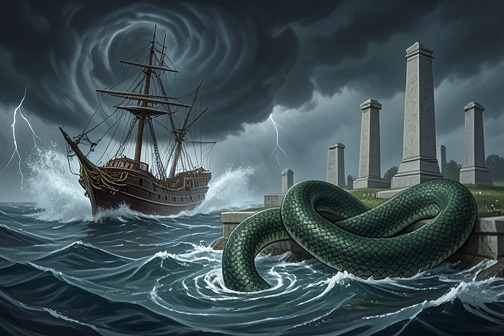
[Grave of Wood Guardian Attack](entity:event-recall-event-grave-of-wood-0541aee1bde3) is the decisive encounter in which the Endeavor escapes a pursuing cyclone only to confront the immense serpent that protects the cemetery. The event transforms a desperate act of sheltering into a lesson in the [Grave of Wood](entity:location-recall-location-grave-of-wood-2991ab0ec704)’s absolute authority: tethering is apparently safe, but disrespect toward the dead provokes a force capable of swallowing a lightning-shot storm.
## Flight Toward the Grave of Wood
The event begins with the Endeavor racing toward the Grave of Wood while the gale drives the vessel ahead of the vortex. [Captain Montgomery](entity:character-recall-character-captain-montgomery-85ba416f8403) pilots the ship toward the cemetery’s enormous funerary monuments as the storm shakes the entire frame. Orders pass continuously between the bridge and the crew, and the bos’n’s voice booms through the speaking-tube over the wind and creaking metal. The approach is therefore both tactical and interpretive: [Jonathan Heights](entity:character-recall-character-jonathan-heights-d9ccad9c719b) knows enough of the site’s rules to advise the crew, but not enough to offer certainty.
Jonathan warns that nothing may be taken from the Grave of Wood, perhaps not even the wood itself. He explains that merely tethering the Endeavor there should be safe, while admitting that his earlier visit was brief and hurried and that the rules governing such places had been learned only through difficult experience. His incomplete knowledge gives the shelter an unstable status. It is not a refuge granted by friendly inhabitants, but a narrow permission that the crew must avoid turning into trespass.
As the ship descends, the cemetery’s forms emerge from the storm: enormous, carved biers topped by crystalline figures whose faces are hidden beneath cloth. The scene offers no leisurely archaeological inspection. The Endeavor is too damaged or endangered to pause, and the crew can only register the solemn monuments while trying to survive the weather. When a bridge pane crazes and cracks, an airman pushes the broken glass outward before the wind can turn it into a weapon. Salt air and the dry, earthy smell of wood enter the bridge, but the place carries no living scent, making the cemetery feel sealed within its own dead order.
## The Guardian’s Attack
The pilot cuts across the gale and drives the Endeavor into the lee of a bier broad and tall enough to shelter the vessel. The storm’s pounding is briefly muffled as airmen leap down with tethers, using zint devices to anchor them in the rocky ground. Other crew members hurry to cover exposed parts of the ship with cloth tarps and metal shutters. The apparent success of the maneuver creates a brief expectation that the Grave of Wood will function as a sanctuary.
That expectation changes when a slow sliding sound announces a presence larger than the ship. A massive, sinuous silhouette rises above the graves like a great snake and strikes into the storm with blinding speed. The guardian is initially conveyed through shadow and scale rather than through a complete view, preserving the terror of an unseen or only partly seen power. The cemetery’s darkness and the storm’s illumination make the creature’s outline legible without making it comprehensible.
The wind’s groaning and howling becomes screaming as the guardian coils around the storm as though the cyclone were solid. In a reversal that exceeds the crew’s understanding, the immense titan consumes the lightning-shot storm, drawing its luminous threads into its obscured gullet. The wind, debris, and storm-noise die away over several minutes as the serpent swallows the entire cylinder. It then returns among the graves, appears for a moment to look toward the Endeavor, and disappears into the darkness between the biers. The attack is thus not an assault aimed at the crew but a territorial response directed at the storm, with the ship surviving because it has remained within the cemetery’s apparent limits.
## Rules of the Cemetery
[Eleanor McAvey](entity:character-recall-character-eleanor-mcavey-56495d17d879) immediately identifies the guardian’s presence as the reason the crew must proceed carefully. Jonathan confirms that the Grave of Wood is guarded and clarifies the apparent condition of its violence: from what he has observed, it reacts to disrespect toward the dead. The event therefore converts an obscure prohibition into demonstrated fact. Jonathan’s warning about taking objects is no longer merely scholarly caution; it is part of a living system of funerary protection.
Captain Montgomery asks whether the monuments contain actual bodies or are only tombs. Jonathan answers that he thinks they are both, while observing that their scale seems appropriate to the construction of the [Arch of Khokorron](entity:location-recall-location-arch-of-khokorron-5d801aa6e8a6) and that they are clearly unrelated to the builders of [Tor Ilek](entity:location-recall-location-tor-ilek-da8c883970ba) and [Angkor Leng](entity:location-recall-location-angkor-leng-dfd69cfaf06c). The cemetery consequently becomes evidence of civilizations whose histories survive only in isolated remains. Yet the crew refuses investigation. Whatever archaeological value the biers possess, the guardian attack has established that curiosity cannot override the Grave of Wood’s prohibition on taking from the dead.
The scene’s central value shift is from shelter to conditional safety. The Grave of Wood saves the Endeavor from the cyclone, but it does not become domesticated by that rescue. Its protection is inseparable from its threat, and the guardian’s ability to consume the storm places the crew beneath a power that does not need to explain itself. Safety exists only through restraint.
## Consequences and Narrative Significance
The guardian attack leaves the Endeavor alive but chastened. The crew can shelter behind a bier and tether to the cemetery’s ground, yet the encounter denies them possession of the place. The distinction between using a refuge and claiming it becomes crucial: the Endeavor may pass through or remain temporarily, but the dead and their monuments are not resources for exploration or repair.
Narratively, the event enlarges the world’s ancient sites from inert ruins into environments governed by particular laws. The crystalline figures, shrouded faces, oversized biers, and missing historical connections already suggest a civilization beyond ordinary historical recovery; the serpent makes that buried past active. It also gives material force to the [Grave of Wood prohibition on taking from the dead](entity:rule-recall-rule-grave-of-wood-prohibitio-3d1a09c1a74e), while contrasting human machinery with a guardian that treats a cyclone as something edible. The crew’s engines, tethers, tarps, shutters, and speaking-tube represent organized improvisation, but none of them explains or controls the cemetery’s defender.
The event’s horror develops through gradation. First comes anticipation: the ship flees the vortex and struggles toward shelter. Then comes recognition of the silhouette, followed by the more terrible revelation that the guardian can coil around and consume the storm itself. The final glance toward the Endeavor is quieter but no less significant, because it leaves the crew uncertain whether they have merely been tolerated. The Grave of Wood is not made safe by the guardian’s intervention; it is shown to be safe only so long as the living remember that they are guests among the dead.
Event 35
Discovery号远征灾难
[Discovery Expedition Disaster](entity:event-recall-event-discovery-af19336086e2) is the failed eastern expedition that left the [Discovery](entity:object-recall-object-discovery-074c5d88e879) stranded in the [Grave of Wood](entity:location-recall-location-grave-of-wood-2991ab0ec704), with its crew vanished and its lifting gas largely escaped. Years later, the Endeavor finds the derelict beside a defaced bier, turning the disaster into both a material recovery mission and a stark measure of how far human exploration can proceed before the unknown overwhelms its instruments, ambitions, and people.
## Causes and Background
The disaster belonged to the Discovery’s attempt to reach farther east than any human vessel had gone. Its expedition ended in the Grave of Wood, a region of enormous carved biers protected by a gigantic serpentine guardian. The wreck’s position beside a grave that had been defaced, with an enormous sledge leaning against cracked wood and salt and something shining within, shows that the expedition was not simply lost to mechanical failure. Someone or something disturbed the dead, and that intrusion brought the guardian down upon the explorers.
The exact contents of the bier were never known. [Jonathan Heights](entity:character-recall-character-jonathan-heights-d9ccad9c719b) understood that trying to enter it had summoned the guardian, and he explicitly rejected repeating that mistake. The disaster therefore preserves a boundary between exploration and desecration: the Discovery could be approached, but the grave could not safely be opened, and the expedition’s attempt to cross that distinction appears to have destroyed it.
## Destruction of the Expedition
When the Endeavor reaches the site years later, the Discovery hangs close to the ground, its lifting gas having escaped over the intervening period. It is smaller and squatter than the Endeavor, held in place by tether chains beside the damaged bier. The vessel itself remains accessible, but the surrounding graveyard is undisturbed, with no tracks or other signs of later human activity. The physical scene makes the catastrophe visible as suspended abandonment rather than as a conventional wreck: the ship survives, while the expedition that brought it there has disappeared.
Inside, the Discovery is almost exactly as Jonathan left it years earlier. Uniforms lie in puddles on the floor without any trace of the bodies that wore them, as though the men had evaporated. The implication is not a clean evacuation but a violent or uncanny removal, and [Antomine](entity:character-recall-character-antomine-c73da0eb5297) treats each abandoned uniform as a place requiring words of remembrance. The ship’s small size allows the inspection to be completed quickly, after which airmen begin preparing it for salvage.
The disaster is also part of the larger chain of dangers surrounding the Endeavor’s eastern passage. The crew has already survived boarding by a mercenary force, the corruption and destruction of [Danner’s Grasp](entity:location-recall-location-danner-s-grasp-1a3bfa423977), a lava flood in which the landscape itself awakens around molten rock, and the time-distorting hazards of the [Crimson Caldera](entity:location-recall-location-crimson-caldera-f34c82d45880). At the Grave of Wood, the threat takes a different form: the ship is endangered not by an attack that can be fought, but by a guardian enforcing a prohibition that the earlier expedition failed to respect.
## The Grave of Wood and the Guardian
The Endeavor reaches the graves while fleeing a violent cyclone. [Montgomery](entity:character-recall-character-montgomery-3d1e676073f0) lowers the ship into the lee of one of the enormous biers, allowing the carved wooden structure to shelter the vessel while airmen secure it with tethers, tarps, and metal shutters. Before the storm can strike, a vast sinuous silhouette rises among the graves. The guardian coils around the cyclone as though the storm were solid and swallows its lightning-filled body, silencing the wind and debris within minutes before disappearing among the biers.
This encounter retrospectively clarifies the Discovery’s fate. The guardian is not merely a monster occupying the expedition’s route; it is an active protector of the dead. Its response to the Endeavor is restrained because the crew remains outside the graves, whereas the Discovery’s derelict condition and the defaced bier indicate that its expedition crossed the forbidden threshold. The wreck is thus evidence of a rule enforced by a power older and stronger than human technology.
The wreck itself is safe enough to salvage because the guardian does not attack it. Lingering zint glow still shines from the Discovery’s bridge, and Jonathan explains that the guardian has left the ship untouched. The contrast is precise: only the vessel is safe, while anything belonging to the east would have extinguished the zint as a matter of nature. The technological remains therefore survive within a hostile environment not because humanity has mastered that environment, but because the guardian’s attention is limited by its own law.
## Survivors, Memory, and Recovery
The only living remnant discovered aboard the Discovery is [Dreyfus](entity:character-recall-character-dreyfus-97bd3b9ac865), its tortoiseshell ship cat. He flies through the open hatch after [Penelope](entity:character-recall-character-penelope-82d0d91517fc) appears on the Endeavor, somehow still alive after the attack and years of solitude. Penelope briefly confronts him, then sneezes and walks away; Dreyfus follows and quickly finds refuge in [Sarah](entity:character-recall-character-sarah-7c634cfe73af)’s arms. His survival creates a guarded optimism among the crew, but it does not soften the fate of the human expedition. The cat is a living continuation of the ship, while the missing crew remain represented by uniforms, empty spaces, and Antomine’s rites.
Jonathan’s return to the Discovery produces a more complicated recovery. The vessel stirs vague and uncomfortable memories in him, but sunlight burns those emotions away and replaces them with a sense of certainty. He sees the ship simultaneously as the relic of a profound discovery and as useful salvage: a waypoint rather than a destination. That double vision marks his altered relationship to the expedition. The Discovery once belonged to the path that made him, but after his later encounters with sunlight, death, lost friendships, exile, and the Players’ Game, it no longer possesses the authority it once held over him.
The inspection confirms that the ship remains a monument to absence. Antomine leads the examination because determining the final fate of the men is part of his religious and inquisitorial duty, while Jonathan leads because he knows the ship. Their cooperation joins practical salvage to ritual witness. Antomine’s observation that this was the furthest east any human vessel had reached, and yet only an abandoned derelict remained, makes the Discovery a compressed history of exploration’s ambition and cost. Jonathan answers that the greatest risk is always the unknown, a judgment Antomine regards with disapproval but that the wreck itself seems to substantiate.
## Consequences and Significance
The disaster establishes the eastern frontier as a place where technological persistence cannot substitute for understanding. The Discovery traveled farther than any human vessel, but distance did not produce mastery; it produced a derelict beside a grave whose contents remained unknowable. The event therefore changes the meaning of exploration in the narrative. Progress is measured not only by how far a ship travels, but by whether its crew can recognize the laws of the world it enters.
Its consequences also remain personal. Jonathan carries the expedition as part of the accumulated cost that eventually leads him toward [Bright Defile](entity:location-recall-location-bright-defile-18d73f1df73b). In the final reckoning of what he must sacrifice or remember, the books he threw from the Endeavor, the death of [Tiuni](entity:character-recall-character-tiuni-517876ba3162), the destruction of [Tor Ilek](entity:location-recall-location-tor-ilek-da8c883970ba), the laying of a god to rest, the sacrifice of [Angkor Leng](entity:location-recall-location-angkor-leng-dfd69cfaf06c), his loss of [Eleanor](entity:character-recall-character-eleanor-f86629a4f595)’s friendship, his banishment from [Ukaresh](entity:location-recall-location-ukaresh-085787e2ce38), and his rejection of the Players and the Game all illuminate his path. The Discovery is not named there as an isolated triumph; its disaster belongs to the history of abandoned routes and irreversible choices that Jonathan must pass beyond.
For the surviving crew of the Endeavor, recovery offers only limited consolation. Dreyfus survives, the ship can be inspected, and salvage can begin, but the expedition’s human cost cannot be repaired. The Discovery remains a warning preserved in wood, salt, escaped gas, empty uniforms, and a cat that should not have lived. Its final significance lies in that contrast: a ship can endure as an object long after the purpose that sent it east has been annihilated, leaving later travelers to decide whether the wreck is a prize, a memorial, or a boundary marker against repeating the same error.
Event 36
Jonathan's First Visit to Bright Defile
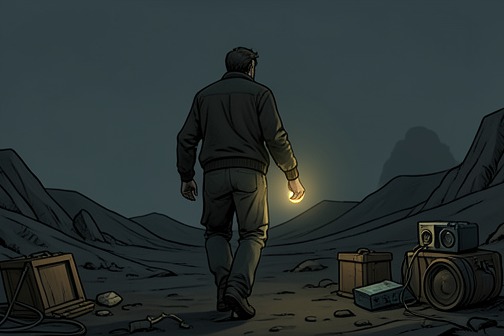
[Jonathan's First Visit to Bright Defile](entity:event-recall-event-dc84034c4939) is the decisive threshold event in [Jonathan Heights](entity:character-recall-character-jonathan-heights-d9ccad9c719b)'s quest for [Sunlight](entity:state-recall-state-sunlight-28d75af2a2d6). It transforms the expedition from a hazardous journey through the [Lightless World](entity:state-recall-state-lightless-world-bb4332a00a7f) into a spiritual and ontological trial, in which knowledge demands the abandonment of history, possessions, loyalties, and selfhood. Jonathan succeeds where he had previously failed, but his arrival is also an act of irreversible separation: he reaches the green country beyond [Bright Defile](entity:location-recall-location-bright-defile-18d73f1df73b) only after turning nearly every bond to the past into fuel for the crossing.
## Causes and Preparation
Jonathan's first approach to Sunlight is defined by the memory of failure. The last time he had reached it, he could go no farther because he lacked both the understanding and the will to proceed. His attention had remained fixed on himself, his place in the world, and what might be gained or lost. The second expedition therefore becomes an exercise in deliberate self-revision rather than merely a geographical return. Jonathan spends the journey clarifying his mind and honing himself toward the single purpose of entering Sunlight, consciously discarding his previous concerns as unworthy of the person he must become.
That preparation is practical as well as inward. At the edge of the map, where no one before him has returned, Jonathan searches his cabin for tools, tricks, references, or records that might help with the final leg and finds nothing useful. The absence is important: he cannot solve the approach to Bright Defile through accumulated equipment or inherited instructions. Even his expedition's material resources have been consumed or exhausted, leaving books and notes among the few remaining possessions. The crossing must therefore be made through a changed relation to knowledge itself, not through another instrument.
The expedition's earlier stages establish the cost of reaching this point. The Endeavor leaves the ruins of Danner's Grasp under a somber mood, passing beyond a settlement reduced to smoldering [Zint](entity:concept-recall-concept-zint-7c4de3867869), lingering fire, and fragments of glowing sheltershrooms. [Antomine](entity:character-recall-character-antomine-c73da0eb5297) conducts funerals for the three dead crew members, including George, whose casket is empty because his body cannot be recovered from the corrupted ruins. The bodies are reduced to dust in distilled [Luminiferous terrestrite](entity:object-recall-object-luminiferous-terrestri-097a4a16a904) and scattered into the wind; Antomine then performs the same final rites for the dead mercenary boarders. These ceremonies place the approach to Bright Defile within a chain of deaths, losses, and acts of witness rather than presenting the final threshold as an isolated adventure.
## The Route Through Thresholds
Jonathan's route toward Bright Defile is marked by machines and rituals that make passage possible while exposing the limits of human control. At [Angkor Leng](entity:location-recall-location-angkor-leng-dfd69cfaf06c), he uses a remembered sequence of commands three times, causing the gold mechanism to spin, deep machinery to groan, and the ground to shake until the artifice sustaining the doom beneath the city gives way. The release produces a hallucinatory wave that imprints incomprehensible events directly upon reality. Jonathan survives not by understanding the phenomenon analytically, but by recognizing its presence as immediately as light, sound, heat, or cold.
The journey also requires the opening of the [Arch of Khokorron](entity:location-recall-location-arch-of-khokorron-5d801aa6e8a6). Its machinery withdraws to expose a tunnel several miles in diameter, lined with burning lights and extending beyond sight. The Endeavor is drawn inside by the wind, while the red illumination produces vistas that may not exist and carries a cold, rigid presence unlike any human being. Passage demands a knowledge toll that cannot be paid twice. Jonathan expects to offer the fruit he has kept hidden in his suit, but when he reaches for it, it is gone, leaving the alternative payment of a life. The Arch thus turns knowledge into a material and ethical obligation: understanding is not acquired freely, and a completed passage may require an irreversible sacrifice.
The expedition's religious ceremonies provide a contrasting form of passage. Antomine's service for the dead culminates in the words, "[From dust ye were made and dust ye shall be](entity:expression-recall-expression-from-dust-ye-were-52dcd29c96ea)." Later, while confronting the corpse of an ancient dead titan, the same rite places the ship and its crew in a posture of respect before an alien and immense being. Antomine and Jonathan are divided by doctrine and method, yet they briefly stand in agreement over the necessity of honoring and burning the dead. These episodes make Bright Defile the endpoint of a procession through funerals, destruction, and purification, with each threshold requiring the travelers to recognize that survival does not erase what the expedition has consumed.
## [The Sunlight Trial](entity:action-recall-action-the-sunlight-trial-cf59043c1987)
At the final approach, Sunlight ceases to be a destination that can simply be reached by distance. Jonathan walks along a narrow path while the light presses upon spirit, self, history, and deed. The trial rises within his mind as a labyrinth made from the very nature of a person, and the experience reveals every individual, place, possession, discovery, and loss that has shaped him. [Beacon](entity:location-recall-location-beacon-05545c91a64e) and his home, Danby's Point, [Autochthon Reach](entity:location-recall-location-autochthon-reach-692fa43be704), and Danner's Grasp appear as illuminated substances of memory and meaning. [Terminus](entity:location-recall-location-terminus-9fe35f8062b8) embodies the temptation to settle for what is merely good enough, while the Players and their Game represent the temptation to pursue the wrong dream. [Tor Ilek](entity:location-recall-location-tor-ilek-da8c883970ba), Angkor Leng, and [Ukaresh](entity:location-recall-location-ukaresh-085787e2ce38), with [She-Who-Must-Be-Obeyed](entity:character-recall-character-she-who-must-be-obe-471db7027261) at its heart, are likewise made present for judgment.
The trial is not limited to Jonathan. Antomine follows behind him with the Lux Guards, but Sunlight exposes the inquisitor's strain. Antomine appears haggard and worn, as though he has crossed a thousand miles rather than a few feet, while progressively less substantial versions of him stream behind him as faith and belief are stripped toward inscrutable truth. The Lux Guards show no comparable suffering because the light reveals them as things rather than people beneath their human trappings. Antomine eventually declares that he and his followers have reached their limit. He opens a device of glass, crystal, and mirrors designed to trap and carry a small portion of Sunlight, attempting to turn revelation into an object that can be transported. Jonathan watches without knowing whether the apparatus works, then continues forward when Antomine orders him to stop.
The final barrier has no statues and no ordinary physical form. It appears as a gulf where the difference between a barrier of understanding and a barrier in the land itself disappears. In a world defined by revelation, the darkness is nevertheless perfectly clear: it is the region of what remains to be surrendered. Jonathan's empty estate burns first. His connections to his chauffeur and housekeeper become additional lights in the gulf. Each decision by which he has erased a route back to his former life contributes to the crossing.
The sacrifice continues through the accumulated history of the expedition. The death of [Tiuni](entity:character-recall-character-tiuni-517876ba3162) and the destruction of Tor Ilek illuminate the path. The books Jonathan threw from the Endeavor become individual stepping-stones. The laying of a god to rest and the burning of its corpse provide another light, while the sacrifice of Angkor Leng appears as a golden city inside a god's dream, radiating briefly before being consumed. Jonathan gives up his friendship with [Eleanor McAvey](entity:character-recall-character-eleanor-mcavey-56495d17d879) and his banishment from Ukaresh. The image of She-Who-Must-Be-Obeyed appears, stern and commanding, and seems to acknowledge him before joining the pyre. He also rejects the Players and the Game, refusing the dark counterpart of Sunlight's truths.
The last object surrendered is Jonathan's cane. He lays it like a thin sword blade across the final stretch and releases it as the price of crossing the impossible gap. The gesture completes the pattern: a tool associated with his identity and movement becomes a bridge only when he relinquishes it. Jonathan takes the final step through darkness washed by light and enters Bright Defile.
## Arrival and Consequences
Beyond the narrow valley lies a vast green country that rises toward proud mountains beneath clouds of purest white. Leaves, grass, stones, and the swift rivers all contain the secrets of time and space, while the sun itself appears older than worlds and older than time. Behind Jonathan, the shrouded lands of the expedition shrink into a dim mote suspended between sunbeams, an overlooked corner of creation. The scale of the view reverses the hierarchy that had governed his journey: the cities, ruins, doctrines, enemies, and possessions that once seemed enormous become almost negligible beside the reality he has entered.
Jonathan's arrival is therefore both triumph and severance. He feels the warmth of the sun, a free wind at his back, and the liberty of truth before him, and he smiles. Yet the smile follows the destruction of the self he previously brought to the threshold. He does not return with an elixir, restore his former relationships, or preserve the expedition's world intact. Bright Defile is reached through a one-way logic of relinquishment, and its revelation confirms that Jonathan's success depends on the loss of the person who once measured every choice by reputation, possession, and personal advantage.
## Narrative Significance
As a narrative event, Jonathan's First Visit to Bright Defile completes a separation ritual rather than a conventional homecoming. The expedition departs from communal grief, passes through funerals and the burning of the dead, crosses mechanical and metaphysical gates, and ends with Jonathan abandoning the final object that can accompany him. The sequence repeatedly moves from possession toward dispersal: bodies become dust, cities become sacrifice, knowledge becomes toll, and the cane becomes a bridge before disappearing from his hand.
The event also clarifies the difference between Jonathan's earlier and present selves. His first failure arose from attachment and insufficient will; his second attempt succeeds because he has treated attachment itself as the obstacle. That success is morally and emotionally ambiguous. Bright Defile grants him truth and freedom, but only after the deaths, betrayals, exiles, and renunciations that make the path visible. The final smile is not a return to ordinary life. It is the expression of someone who has crossed beyond the limits that formerly made him recognizable, leaving the dark world behind as a tiny and distant remnant.
Event 37
明亮裂谷远征
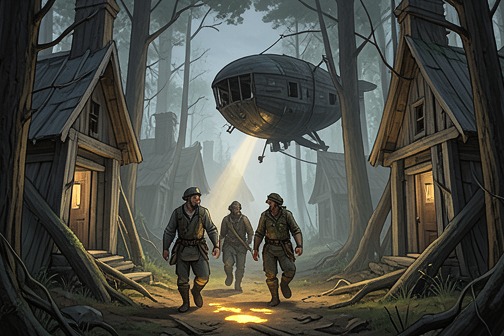
The [Bright Defile](entity:location-recall-location-bright-defile-18d73f1df73b) Expedition is the decisive final approach to sunlight in [Jonathan Heights](entity:character-recall-character-jonathan-heights-d9ccad9c719b)’s eastern journey. After the Endeavor reaches the point beyond which Jonathan will not allow the ship to proceed, he leads a small party on foot through the [Grave of Wood](entity:location-recall-location-grave-of-wood-2991ab0ec704) toward Bright Defile. The expedition begins as a practical departure from the limits of air travel but becomes a ritual passage through death, memory, sacrifice, and revelation. Its culmination is Jonathan’s crossing into the illuminated valley, where sunlight replaces every prior image of knowledge and freedom with immediate, overwhelming truth.
## Departure from the Endeavor
The expedition is set in motion when Jonathan decides that the Endeavor should go no farther. Although the airship has reached the vicinity of the [Discovery](entity:object-recall-object-discovery-074c5d88e879) and the eastern route remains open, he identifies the ship itself as the line beyond which no vessel should pass. Proceeding by foot, he argues, will be faster than waiting for the ship, but the decision also marks a separation from the machinery, crew, and logistical protections that have carried the party through the dark world. The Endeavor remains behind as a retreat and a boundary, while Jonathan chooses to enter the final region under his own power.
The detachment is notably small. It consists of Jonathan, [Eleanor McAvey](entity:character-recall-character-eleanor-mcavey-56495d17d879), [Antomine](entity:character-recall-character-antomine-c73da0eb5297), [Captain Montgomery](entity:character-recall-character-captain-montgomery-85ba416f8403), and six airmen, among them [Airman Stutt](entity:character-recall-character-airman-stutt-44ba738069e9) and the two notably brawny and wiry crewmen. Most of the Endeavor’s remaining crew refuse to approach sunlight, preferring to stay aboard and repair the damaged ship. Jonathan does not fully understand their reluctance, but it makes the expedition more manageable. The group therefore embodies both commitment and refusal: a handful accept the unknown, while the larger company remains attached to the familiar darkness and the practical work of survival.
## The Road through the Grave of Wood
Jonathan knows from personal experience that Bright Defile lies no more than a day’s brisk walk eastward. The party brings a supply sled, though he expects to require little of it. The route crosses the Grave of Wood, a strangely quiet place without creatures or weather to trouble travelers. Its road is made of long metal flagstones, and on either side stand the looming forms of salt bodies and wooden biers. The expedition thus moves through a landscape in which the dead are not an incidental reminder but the defining architecture of the route.
The directness of the road becomes part of Jonathan’s reasoning and part of the expedition’s symbolism. When [Eleanor](entity:character-recall-character-eleanor-f86629a4f595) asks why he would choose this path after the Discovery went down, Jonathan answers that paths lead somewhere and are preferable to becoming lost among monuments or wilderness. His response is practical, but it also reveals his characteristic faith in directional movement. The road offers no safety in itself; it offers only an intelligible line. Following it means accepting whatever destination has been built into its course.
The march also exposes a change in Jonathan. He has little appetite, yet forces himself to eat hard bread and dried meat because he wants to meet the final stretch at his best. He appears unusually happy, prompting Eleanor to call the expression unsettling after his prolonged seriousness. Jonathan describes himself as merely anticipating the culmination of the journey. His anticipation is not casual excitement. It is the concentrated expectation of someone who has organized his life around a single threshold and now fears missing the instant when it opens.
## The Threshold of [Sunlight](entity:state-recall-state-sunlight-28d75af2a2d6)
The dark path runs straight east, while Eleanor and Antomine exchange remarks and Captain Montgomery mutters to his men. Jonathan alone keeps his attention fixed ahead, waiting for the arrival of the vision he has already experienced once before. As [Montgomery](entity:character-recall-character-montgomery-3d1e676073f0) begins to suggest stopping for the night, sunlight appears. The suddenness of the moment gives the expedition its central reversal: the object treated by the people of the dark world as myth is not merely discovered but encountered as an indisputable presence.
Bright Defile opens from a narrow valley between two mountains. A single ray descends into it, pure and bright, yet casting no shadows, only more light. The illumination makes colors more vivid than ordinary reality can sustain: greens and browns of immense trees, and reds and oranges in flowers of extraordinary intensity. Its warmth reaches the travelers even before they enter it, soothing body and soul. Sunlight is therefore presented as both environment and revelation, a physical condition that immediately alters perception and a force that makes the visible world intelligible.
The path into the valley is not harmless. Statues made of salt stand along the ancient stone road in an irregular, weathered line. Some are so old that their original forms cannot be identified; others clearly represent beings foreign to humanity. The two newest statues are human, making the danger immediate rather than merely historical. The expedition’s travelers stop at the sight of sunlight, but the salt figures show what may happen to those who advance without understanding the rules of the threshold.
The first reflected touch affects every member of the party. Each traveler is arrested by the sight and sensation, and each recognizes the truth of what is before them. Captain Montgomery says, "Well, I’ll be damned," and confirms that it really is sunlight. Yet seeing is not enough for Jonathan. He has already experienced the vision in another form and now yearns to approach the source rather than remain at its edge. When one crewman moves forward as if drawn by an invisible force, Jonathan stops him, recognizing that the impulse toward sunlight carries peril as well as wonder.
## Sacrifice and Passage
The expedition’s final movement is not a simple walk across a visible distance. Jonathan experiences the approach as a passage whose cost has been accumulating throughout the journey. His empty estate burns first in memory, followed by his connections to his chauffeur and housekeeper. Other losses then become fuel for the crossing: the death of [Tiuni](entity:character-recall-character-tiuni-517876ba3162), the destruction of [Tor Ilek](entity:location-recall-location-tor-ilek-da8c883970ba), the books he cast from the Endeavor, the laying of a god to rest, and the sacrifice of [Angkor Leng](entity:location-recall-location-angkor-leng-dfd69cfaf06c). His lost friendship with Eleanor McAvey and his banishment from [Ukaresh](entity:location-recall-location-ukaresh-085787e2ce38) also join the reckoning, as does the rejection of the Players and the Game.
This retrospective accounting changes the meaning of the expedition. The road through the Grave of Wood is not merely the last geographical segment of an eastern map. It is the visible form of a life spent severing connections in pursuit of a final truth. Jonathan reaches the threshold because he has repeatedly surrendered possessions, places, companions, identities, and possible returns. The expedition therefore makes exploration inseparable from self-erasure: every step toward sunlight narrows the world to which he could go back.
At the final gap, Jonathan sacrifices his cane. He lays it like a thin sword-blade across the remaining darkness and gives up the object that has supported him throughout his travels. The gesture is both practical and emblematic. The cane has been part of his physical identity, a tool of mobility and a familiar extension of his body; surrendering it completes the sequence in which the material signs of his former life are converted into passage. He then takes the final step, leaving darkness washed by light and entering Bright Defile.
## Consequences and Significance
Beyond the narrow valley lies a great green country, rising toward proud mountains beneath pure white clouds. Every leaf, blade of grass, stone, and drop of river water seems to contain the secrets of time and space. Above it stands the sun, described as older than worlds and older than time. Behind Jonathan, the lands of darkness become a dim mote suspended between sunbeams, reduced from the total world he once knew to an overlooked corner of creation.
The expedition’s consequence is therefore not simply that Jonathan reaches a destination. He acquires a new position in relation to reality. The warmth of the sun touches his face, a free wind rises behind him, and truth lies before him as liberty. He smiles at the end of the crossing. That smile completes the emotional movement begun when Eleanor noticed his strange happiness on the road, but it also confirms the cost of the achievement: Jonathan’s freedom is founded on the destruction of his former attachments rather than on their preservation.
The wider return to [Beacon](entity:location-recall-location-beacon-05545c91a64e) does not restore the expedition’s participants to an uncomplicated ordinary life. After the Endeavor returns, the destruction of Tor Ilek and the circulation of artifacts produce excitement among collectors, while nearly all the airmen become wealthy and some retire. Their fortunes attract thieves, but the veteran airmen prove difficult targets, and several would-be attackers disappear, leaving only occasional scorched shadows. Beacon’s gossiping public calls the period the [Winter of Blood](entity:expression-recall-expression-winter-of-blood-d40bffbf7ef6) or, mockingly, the Winter of the Shadow. The labels reduce extraordinary upheavals to urban rumor, while Captain Montgomery soon prepares the Endeavor for another expedition. In that contrast, the Bright Defile Expedition remains both a public aftermath and a private rupture: civilization absorbs the consequences as gossip and commerce, but Jonathan’s crossing has carried him beyond the assumptions that made the old world coherent.
Event 38
乔纳森进入阳光
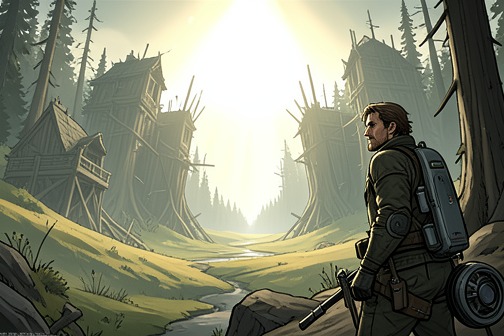
Jonathan's Entry into [Sunlight](entity:state-recall-state-sunlight-28d75af2a2d6) is the climactic threshold event of [Jonathan Heights](entity:character-recall-character-jonathan-heights-d9ccad9c719b)’s expedition. The veteran explorer, who had endured a world of lightless skies while pursuing the supposedly laughable myth of sunlight, finally crosses into [Bright Defile](entity:location-recall-location-bright-defile-18d73f1df73b) and encounters the reality that has organized his life. The achievement is not merely geographical. It is a passage from guarded knowledge to total revelation, purchased through the deliberate destruction of every attachment that could cast a shadow across the truth.
## Approach to the Final Barrier
Jonathan’s approach is governed by a severe progression: each step toward Bright Defile strips away uncertainty, weakness, and the distinction between inner identity and outer world. Ancient salt statues mark the path, preserving the remnants of failed understandings and the histories of those who could not pass. Jonathan’s own memories remain with him, but they no longer function as a refuge. They are both a source of strength and a burden, evidence of what he has done and a measure of what must still be surrendered.
At the threshold, the physical gulf and the barrier of understanding become indistinguishable. In a land defined by sunlight, darkness appears before him, but it is not a region of concealed facts. Its nature is completely intelligible: it is the final distance between Jonathan and a reality in which no secret can remain. Bright Defile’s final barrier demands that everything else be shed. To live in sunlight is to have no shadow left.
This requirement gives the event its ritual structure. Jonathan does not simply discover a hidden landscape; he passes through separation, ordeal, and irreversible transformation. His journey has repeatedly involved leaving human settlements, crossing hostile boundaries, witnessing funerals, and paying passage through sacrifice. Here those earlier passages converge in a final rite of departure from the self he once possessed.
## The Sacrifice of the Past
The first sacrifice is Jonathan’s empty estate, which burns like paper and illuminates a small portion of the gulf. His connection to his chauffeur and housekeeper follows, represented as two further candles. These losses are not incidental details of his biography. They are the concrete ties that would have allowed him to return to an established domestic life, and their destruction makes his commitment to the sunlight irreversible.
The path then becomes an inventory of the expedition’s moral and personal costs. The death of [Tiuni](entity:character-recall-character-tiuni-517876ba3162), the destruction of [Tor Ilek](entity:location-recall-location-tor-ilek-da8c883970ba), and the books Jonathan threw from the deck of the Endeavor appear as separate points of light, each becoming a stepping-stone across the impossible gap. The laying of a god to rest and the burning of its corpse provide another radiance; the sacrifice of [Angkor Leng](entity:location-recall-location-angkor-leng-dfd69cfaf06c) appears as the fleeting light of a golden city existing within a god’s dream. The sequence turns the expedition’s disasters into a material record of passage, while refusing to let Jonathan treat them as events that can simply be left behind.
His losses in human relationship are equally necessary to the crossing. The loss of his friendship with [Eleanor McAvey](entity:character-recall-character-eleanor-mcavey-56495d17d879) and his banishment from [Ukaresh](entity:location-recall-location-ukaresh-085787e2ce38) join the pyre. The stern visage of [She-Who-Must-Be-Obeyed](entity:character-recall-character-she-who-must-be-obe-471db7027261) appears briefly and seems to acknowledge him before adding to the fire. Jonathan has also rejected the Players and the Game, described as the dark inverse of sunlight’s bright truths. The event therefore gathers political exile, intimate estrangement, failed expeditions, destroyed cities, forbidden knowledge, and rejected systems of power into one cumulative act of relinquishment.
The last personal object is his cane. It becomes a thin sword-blade laid across the final stretch, and Jonathan sacrifices it to cross the gulf. The gesture is especially significant because the cane is part of the identity he has carried through the expedition: a practical aid, a recognizable possession, and a sign of the damaged but controlled explorer others have encountered. Giving it up leaves him with no instrument of retreat or support. The final step is made only after this last release.
## Crossing into Bright Defile
Jonathan crosses the threshold in darkness washed by light, closing the last infinitesimal gap between himself and sunlight. The action is presented as a passage beyond ordinary spatial measurement. Earlier distances are rendered irrelevant beside the intensity of the light; here, the true obstacle is not miles but the residue of selfhood and concealment. Once Jonathan has surrendered what remains, the barrier ceases to be impassable, and he stands within Bright Defile.
Beyond the narrow valley lies a vast green country extending in every direction, with proud mountains, pure white clouds, swift rivers, and a blue sky. Every leaf, blade of grass, stone, and drop of water bears the secrets of all time and space. The sunlight is therefore not merely a source of illumination or a natural phenomenon. It is a total condition of knowledge, in which the world’s visible forms and its deepest truths are the same reality.
The sun itself is older than worlds, older than time, and larger than anything Jonathan could imagine. The scale of this revelation places his quest in perspective without making it meaningless. The shrouded lands behind him, including the human world that treated sunlight as a myth, become a dim mote suspended in a gap between sunbeams. Civilization is not the center of creation; it occupies an overlooked corner of it.
Jonathan feels the sun’s warmth, the freedom of the wind, and the liberty of truth before him, and he smiles. The smile is the event’s final immediate value shift: a life organized around deprivation, suspicion, violence, and pursuit culminates not in another command or discovery to exploit, but in direct contact with the reality he had sought. His success is expressed through recognition and release rather than possession.
## Consequences and Final Image
Jonathan’s entry into sunlight also produces a final image of immense consequence in the lands he has left behind. A flash appears westward from Bright Defile, followed by the great silhouette of a man. Jonathan’s shadow stretches from the furthest east all the way to [Beacon](entity:location-recall-location-beacon-05545c91a64e), where the [Illuminated King](entity:character-recall-character-illuminated-king-657c25addf69) stands in his tower. For a moment, Jonathan becomes a titan apparently capable of bestriding the world, and then the image disappears.
The shadow creates a paradox at the heart of the achievement. Jonathan has entered the realm where no shadow should remain, yet his passage casts one across the entire known world. The sunlight that frees him also transforms him into a figure visible to the political and religious center represented by the Illuminated King. His triumph is therefore both emancipation and disturbance: he has escaped the institutions that defined the limits of human knowledge, but his existence beyond those limits reaches back into their domain.
The event resolves Jonathan’s stated objective while preserving its danger. He proves that sunlight was not simply a fairy tale, but the truth he reaches is too expansive to be reduced to a resource, doctrine, or device. Earlier attempts to contain knowledge through maps, machines, ceremonies, or the authority of the Inquisition are surpassed by the direct revelation of Bright Defile. The crossing is consequently the culmination of the expedition and the point at which its political, ethical, and metaphysical consequences become impossible to contain.
## Narrative Significance
Jonathan's Entry into Sunlight completes a long pattern of thresholds. The Endeavor leaves the human lands; [Danby’s Point](entity:location-recall-location-danby-s-point-89a41017e4ad) exposes the unstable boundary between human civilization and darker forces; Angkor Leng’s machinery is broken open; the [Arch of Khokorron](entity:location-recall-location-arch-of-khokorron-5d801aa6e8a6) reveals a passage whose toll cannot be paid twice; and the final approach to Bright Defile converts all those earlier crossings into preparation for one irreversible entrance. The expedition’s ceremonies of death, including [Antomine](entity:character-recall-character-antomine-c73da0eb5297)’s formal words that the dead are made from dust and return to dust, echo here as Jonathan turns his own former identity into fuel for passage.
The event is also a recognition scene in the strongest possible sense. Jonathan does not learn that the world contains a hidden object and then remain unchanged. He discovers the truth by becoming capable of receiving it. The sunlight trial exposes the attachments, beliefs, and failures that still trail behind him; at the threshold, even the memory of those things must be converted into sacrifice. What he reaches is therefore inseparable from what he has given up.
The achievement carries an unresolved moral tension. Jonathan’s path is lit by deaths, destruction, exile, and the loss of Eleanor McAvey, and the final vision does not erase those costs. It incorporates them into the light. His smile signals genuine freedom, but the shadow over Beacon suggests that freedom has created a new disturbance rather than restoring the old order. The event closes the search for sunlight while opening the question of what a human being becomes after surviving complete revelation.
Event 39
Antomine and Jonathan's Confrontation
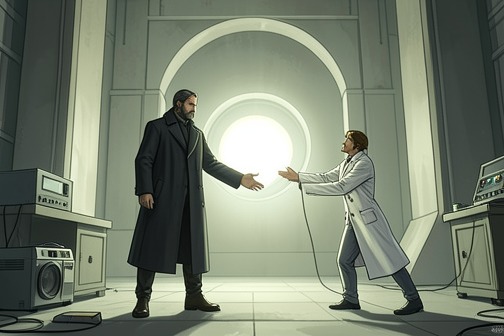
[Antomine](entity:character-recall-character-antomine-c73da0eb5297)–Jonathan Confrontation is the climactic contest between a human empire that defines itself through controlled light and an explorer who seeks the reality beyond every inherited definition of humanity. At [Bright Defile](entity:location-recall-location-bright-defile-18d73f1df73b), Antomine attempts to stop [Jonathan Heights](entity:character-recall-character-jonathan-heights-d9ccad9c719b) from crossing the final barrier into sunlight, not merely to protect a political interest but to prevent knowledge that could exceed the [Illuminated King](entity:character-recall-character-illuminated-king-657c25addf69)’s power. Jonathan answers by exposing and burning away the connection that gives the king’s command access to him, leaving Antomine powerless and opening the way to the revelation that has governed the entire expedition.
## Causes and Background
The confrontation grows out of the world’s central contradiction. Humanity lives beneath lightless skies and treats itself as a vigil of civilization against eternal darkness, while the Illuminated King and the Reflected Council present their authority as protection from the secrets beyond human lands. Jonathan’s expedition eastward therefore carries a political charge from its beginning. He claims to have seen sunlight, a possibility dismissed as myth, yet the Illuminated King has taken a direct interest in that claim and sends an agent to safeguard royal interests. The king’s faintly glowing token, placed inexplicably into Jonathan’s hand, already suggests that the monarchy’s concern is more than ordinary patronage: sunlight may be a resource, a threat, or a truth capable of unsettling the entire order of [Beacon](entity:location-recall-location-beacon-05545c91a64e).
Antomine embodies that order in its most uncompromising form. Trained primarily as a chaplain, but also prepared in languages and zint weaponry, he understands his role as the purification of humanity. He insists that humanity belongs to the light and that secrets drawing people away from it must be purged. His conduct during the expedition repeatedly turns exploration into a question of doctrine. At [Danby’s Point](entity:location-recall-location-danby-s-point-89a41017e4ad), the eastern terminus of the illuminated human track, human construction and the architecture of darker peoples deform one another across the boundary; at the great metal gate, the influence runs both ways. Antomine’s opposition to alien fruit, his suspicion of nonhuman knowledge, and his demand that threats be cleansed rather than bypassed all reveal a worldview in which contact itself risks contamination.
Jonathan, by contrast, has made knowledge and direct experience his governing principles. He uses maps, trade, literature, and intelligence from [Tiuni](entity:character-recall-character-tiuni-517876ba3162) to narrow routes through the [Verdant Expanse](entity:location-recall-location-verdant-expanse-01f0675c6588), even when the information comes from beings human institutions classify as aberrant. He improves the Endeavor with luminiferous gems and treats the technological resources of the dark world as practical means toward his goal. The difference between the men is therefore not simply courage versus fear. It is a conflict between an inquisitorial system that claims to defend civilization by controlling what may be known and an explorer who believes that the unknown must be approached, mapped, and finally entered.
## The Confrontation at Bright Defile
At the edge of Bright Defile, Antomine declares that the journey must end. [Sunlight](entity:state-recall-state-sunlight-28d75af2a2d6) has already exposed the truth of the inquisitor’s faith: progressively less substantial versions of Antomine trail behind him, while Jonathan has no such ghostly images because he has shed the attachments that would be revealed as false. Antomine carries a box containing a gleaming glass-and-crystal apparatus, a mirrored array apparently designed to trap and transport a small portion of sunlight. The device represents an attempt to make revelation portable and manageable, to reduce the overwhelming truth before them to an instrument that can be returned to the Illuminated King.
Jonathan refuses that reduction. He tells Antomine that he did not travel so far merely to taste the fruit of sunlight; he intends to reach the tree itself. Under sunlight, concealment has become impossible, and Jonathan no longer needs to disguise his contempt for the authority that accompanied him. He declares that Antomine’s authority has ended, that the inquisitor is an insignificant agent of an irrelevant king, and that he should take the box and leave. The expedition’s former hierarchy reverses at the threshold: the royal guardian becomes the obstructing subordinate, while the supposedly discredited explorer claims the right to determine what the journey means.
Antomine answers that he must stop Jonathan because safeguarding the Illuminated King’s people is his responsibility. Sunlight compels him to continue beyond what he might otherwise conceal: a man such as Jonathan mastering secrets that even the Illuminated King cannot fathom would threaten everything the king has built. The stakes are thus made explicit. Jonathan’s entry into Bright Defile could produce knowledge that the monarchy cannot regulate, and the attempt to prevent him is presented as a defense of humanity even while it protects a sovereign order from intellectual displacement.
Antomine then invokes the Illuminated King’s authority directly. He orders Jonathan, still a human and still a man of the west, to return. The command reaches beyond ordinary speech. Jonathan feels a tether within his mind being grasped, perhaps established when he first met the king or perhaps arising from a deeper connection to his human origins. It does not operate like a simple external compulsion; it appeals to a primal part of Jonathan, offering belonging and obedience as nourishment to a starving creature. The scene makes political authority bodily and intimate: the empire does not merely issue laws but seeks to seize the subject’s own hidden drives.
The attempt fails because Jonathan recognizes the tether and turns the sunlight through himself against it. He is not an unsuspecting person ignorant of his compulsions, but someone prepared to let revelation expose every remaining attachment. His anger becomes an active force. The sunlight burns through the concealed connection, stripping away the command’s hold and destroying the possibility of hidden motives at the moment of decision. Antomine screams as the truth overwhelms him, while the Lux Guards move forward to seize Jonathan.
The guards cannot restore the old order. The wax guardians melt in the sunlight as Jonathan blazes, their zint leaking from the collapsing armor. A strong wind drives the spreading puddles of metal and wax until they turn to salt. Antomine falls to his knees, the white radiance gone from his pupils, reduced from the king’s fierce representative to a man who appears lost. Jonathan does not kill him or continue the argument. He turns his back on the inquisitor and faces Bright Defile, treating the failed confrontation as the removal of the last interruption between himself and the goal.
## Consequences and Aftermath
The immediate value shift is from commanded obedience to radical freedom. Antomine begins the scene with institutional authority, royal backing, armed guardians, and a device intended to carry sunlight away. He ends it unable to compel Jonathan, without the power manifested through his eyes, and abandoned at the threshold. Jonathan begins as an explorer constrained by the political presence he has tolerated for the sake of reaching the east. He ends as a figure whose identity is no longer governed by the monarchy’s claim over western humanity. The sunlight does not simply illuminate the setting; it changes which forms of power remain real.
Jonathan’s progress beyond the confrontation requires a further shedding of material and psychological burdens. He passes ancient salt statues bearing the vestiges of failed understanding, while memories of his past remain both guidance and weight. At the final gulf, the boundary between a barrier of understanding and a physical obstacle disappears. The last barrier can be crossed only if everything else is relinquished, because life in sunlight permits no shadow. Jonathan lays his cane across the final stretch as a thin sword-blade and sacrifices it to make the crossing. The object that has accompanied and defended him throughout the expedition becomes part of the price of entry.
Once across, Jonathan encounters a green country, mountains, white clouds, rivers, and a blue sky whose every feature contains the secrets of time and space. The sun is older and vaster than anything he could previously imagine. The lands he has traversed become a dim mote behind him, an overlooked corner between sunbeams. The victory is not a return to civilization with a usable fragment of power. It is a passage beyond the scale on which Beacon and its institutions understand the world. The confrontation with Antomine is therefore the final human test before Jonathan enters a reality that makes the western political order appear provincial.
## Ideological and Narrative Significance
Antomine’s failure exposes the limit of the doctrine that equates human virtue with obedience to controlled light. His statements are sincerely protective, but his protection requires purging alien things, restricting dangerous knowledge, and preventing a person from surpassing the king’s understanding. The confrontation reveals how the language of civilization can authorize imperial containment: the eastern frontier is treated as a threat, its peoples are classified as darker forces, and its knowledge becomes something to seize, suppress, or cleanse. Yet Jonathan is not a simple alternative to that system. His expedition also depends on mapping, trade, extraction, technological appropriation, and the willingness to use violence. The scene’s force comes from its reversal of the official hierarchy rather than from a claim that exploration is innocent.
The event also clarifies the distinction between zint and sunlight. [Zint](entity:concept-recall-concept-zint-7c4de3867869) powers the illuminated settlements, the industrial stacks, the Endeavor’s improved engines, the weapons of the Inquisition, and the Lux Guards. It is the technological basis of human civilization, but its brilliance remains a managed substitute for the sun. In Bright Defile, zint leaks from melted armor and becomes materially helpless before the older light. Jonathan’s victory does not merely defeat Antomine’s theology; it defeats the energy regime and political machinery that theology legitimizes.
At the same time, the confrontation is a psychological liberation. Antomine’s command reaches into Jonathan’s deepest human attachment, suggesting that Jonathan’s identity can still be claimed by the world from which he came. Jonathan does not overcome the command by arguing against it. He exposes the tether to the sunlight and lets reality burn it away. The result is freedom purchased through self-revelation rather than through negotiation. Antomine remains attached to the human order he serves; Jonathan becomes the person who can enter a realm where the distinction between inner and outer, secret and visible, has begun to dissolve.
The ending gives the confrontation a final visual consequence. As Jonathan stands in sunlight and smiles, a flash appears in the western lands: his silhouette stretches from the far east all the way to Beacon, where the Illuminated King stands in his tower. For an instant Jonathan becomes a titan capable of bestriding the world, then the image vanishes. The shadow confirms both victory and danger. Jonathan has escaped the king’s command, yet his passage has not left the old world untouched; the explorer who was once dismissed as a teller of myths now casts an image over the entire human domain.
Event 40
Destruction of Tor Ilek
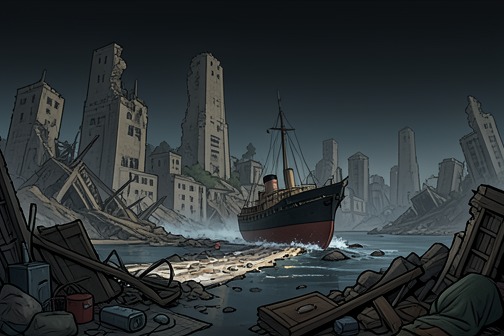
[Destruction of Tor Ilek](entity:event-recall-event-tor-ilek-fed6ee9e84db) is both a disaster in the far east and one of the defining sacrifices in [Jonathan Heights](entity:character-recall-character-jonathan-heights-d9ccad9c719b)’s passage toward sunlight. The city’s destruction removes an ancient, architecturally strange center from the world, narrows the surviving material record to scattered remnants, and leaves Jonathan carrying its loss as one of the costs of abandoning every refuge except his final goal.
## Place in the Eastern Expedition
[Tor Ilek](entity:location-recall-location-tor-ilek-da8c883970ba) belongs to the chain of remote places reached during the Endeavor’s eastward expedition. Jonathan’s journey begins within the lightless world governed by the [Illuminated King](entity:character-recall-character-illuminated-king-657c25addf69), where he insists that sunlight is real despite the accepted belief that it is a myth. The expedition therefore has a practical infrastructure as well as a visionary objective: Jonathan arranges supplies, moves cargo toward [Danby’s Point](entity:location-recall-location-danby-s-point-89a41017e4ad), and relies on his experience of mines, ruined cities, oases, caravan migrations, raw terrestrite, and other resources that can keep the airship moving through regions beyond ordinary human civilization.
The route passes through increasingly unstable borders between human authority and alien lands. At Danby’s Point, human construction meets the twisted architecture and nonhuman populations of the eastern frontier, while the Inquisition is simultaneously strongest and weakest because trade makes contact unavoidable. Jonathan’s maps and [Tiuni](entity:character-recall-character-tiuni-517876ba3162)’s intelligence further reveal that the [Verdant Expanse](entity:location-recall-location-verdant-expanse-01f0675c6588) shifts like a tide, that forces and beasts move across it, and that ancient ruins stand amid the changing landscape. Tor Ilek is part of this wider geography of inaccessible knowledge: a city known to the Exploration Society, but never fully absorbed into the secure world of maps, customs, and illuminated human administration.
## Destruction and Sacrifice
The supplied narrative does not provide a separate continuous scene describing how Tor Ilek is destroyed. Its significance is instead disclosed retrospectively, after the expedition has passed through the eastern catastrophes and Jonathan reaches the final ordeal in [Bright Defile](entity:location-recall-location-bright-defile-18d73f1df73b). There, the destruction of Tor Ilek appears as a burning city whose light helps him cross the gulf between his former life and sunlight. It is not an incidental travel hazard in this reckoning; it is one of the irreversible losses that make his progress possible.
Jonathan’s ordeal presents his life, possessions, relationships, and discoveries as material that must be surrendered. His empty estate burns first, followed by his connections to [Johann](entity:character-recall-character-johann-eeb5c5400427) and [Agnes](entity:character-recall-character-agnes-a7e5e75ca8a8). The death of Tiuni and the destruction of Tor Ilek then join the other losses that illuminate his path. The ruined city is therefore placed beside the books Jonathan threw from the deck of the Endeavor, the burial and burning of a god, the sacrifice of [Angkor Leng](entity:location-recall-location-angkor-leng-dfd69cfaf06c), his loss of [Eleanor McAvey](entity:character-recall-character-eleanor-mcavey-56495d17d879)’s friendship, his banishment from [Ukaresh](entity:location-recall-location-ukaresh-085787e2ce38), and his rejection of the Players and their Game. Each sacrifice becomes a point of light across the otherwise impassable gap; Tor Ilek’s destruction is part of the cumulative price of becoming someone capable of entering sunlight.
The event also reverses the expedition’s ordinary logic of acquisition. Jonathan repeatedly organizes the Endeavor around cargo, refueling, barter, and survival. He has supplies shipped to Danby’s Point, inspects portable equipment, carries or distributes valuable materials, advises the crew to barter with raw metal stock, and treats even the eastern cities as places where useful goods can be obtained. Tor Ilek interrupts that logic. Its destruction turns a living or inhabitable city into a source of fragments, and the city’s value becomes inseparable from its disappearance.
## Aftermath in [Beacon](entity:location-recall-location-beacon-05545c91a64e)
When the Endeavor finally returns, the ship is battered and tattered, but the public first notices its wealth. The gold brought back from the expedition attracts substantially more attention than the lone inquisitor or the three women who disembark. This contrast places Tor Ilek within the same economy of extraction that governs the expedition’s practical preparations: metal, fuel, equipment, and other materials are sorted according to their usefulness, while human observers convert distant catastrophe into wealth, reputation, and opportunity.
The destruction of Tor Ilek creates a secondary market in memory. Collectors of curios and artifacts compete for the last trinkets from the doomed city. Because Tor Ilek was known to the Exploration Society and its architecture had already become a subject for people interested in forbidden knowledge, the city’s destruction makes even innocuous surviving remnants valuable. Its ruins acquire an aura precisely because the place itself can no longer be visited or possessed as it was; the fragment becomes a substitute for the vanished whole.
This aftermath also distributes the expedition’s gains unevenly but widely. Nearly every airman of the Endeavor becomes wealthy, and some leave the life of exploration. Others use their proceeds to purchase another airship, while thieves who target the returning crew discover that veteran airmen are difficult victims. Against this background, Tor Ilek’s relics are not merely souvenirs. They are commodities moving through a network of explorers, collectors, traders, customs officials, and would-be criminals, each assigning a different price to the remnants of a destroyed city.
## Historical and Narrative Significance
Tor Ilek’s destruction is significant because the text makes absence productive. The city’s architectural strangeness had already marked it as an object of fascination for the Exploration Society and for seekers of forbidden knowledge; after its destruction, its remaining objects become more desirable because they are detached from their original setting. The city survives as a broken archive, assembled from fragments whose meanings can no longer be secured by the place that produced them.
For Jonathan, however, Tor Ilek is not reducible to a relic market. In the Bright Defile trial, the city appears as an illuminated loss within the private geography of his conscience. Its burning does not provide a triumphant reward or restore what was destroyed. Instead, it demonstrates the severity of his chosen path: to enter the land of sunlight, he must relinquish the world that formed him, including places he discovered and helped make intelligible. The event consequently joins the book’s largest contrast between civilization’s desire to map, trade, and possess the unknown and the unknown’s capacity to erase the very objects that those systems seek to preserve.
After the Endeavor’s return, people in Beacon name the turbulent period the [Winter of Blood](entity:expression-recall-expression-winter-of-blood-d40bffbf7ef6) or, with some mockery, the Winter of the Shadow. The destruction of Tor Ilek contributes to that atmosphere indirectly, through the circulation of its artifacts and the fear and excitement surrounding the expedition’s return. Yet the proposed refitting of the Endeavor for another voyage soon becomes ordinary news. Tor Ilek’s destruction thus remains both monumental and normalized: a city has vanished, its fragments have entered commerce, and the machinery of exploration prepares to move east again.
Event 41
Sacrifice of Angkor Leng
[Sacrifice of Angkor Leng](entity:event-recall-event-angkor-leng-cd25a7fdec2e) is the expedition’s most consequential act of deliberate destruction: [Jonathan Heights](entity:character-recall-character-jonathan-heights-d9ccad9c719b) disables the machinery preserving the city, escapes aboard the Endeavor, and leaves [Angkor Leng](entity:location-recall-location-angkor-leng-dfd69cfaf06c) to the awakening force beneath it. The event turns a disputed delay in the journey into an irreversible catastrophe, while the city’s destruction later becomes part of the spiritual cost Jonathan must accept before entering [Bright Defile](entity:location-recall-location-bright-defile-18d73f1df73b).
## Causes and Background
Angkor Leng appears to Jonathan and his companions as an impossible enclave of civilization in the wilderness. After the Endeavor’s repairs bring the ship near a glowing vein of [Luminiferous terrestrite](entity:object-recall-object-luminiferous-terrestri-097a4a16a904), its spotlights reveal not an untouched mineral site but new machinery, walls, mooring towers, streets, and a bright settlement far beyond the ordinary limits of human lands. The city therefore represents both refuge and danger: a concentrated outpost of infrastructure in a region where such civilization should not exist.
The city is also connected to a deeper threat. [Antomine](entity:character-recall-character-antomine-c73da0eb5297) warns that a nest of [Umbraught](entity:character-recall-character-umbraught-3ce6ba54e2df) may be present and argues that it must be purged before the creatures learn of zint and carry knowledge of it westward. Jonathan refuses to divert the expedition toward a military cleansing operation. He insists that the Endeavor is not a navy and lacks the time and resources to survey a city as large as Angkor Leng, especially when the expedition’s stated purpose remains the search for sunlight. Their disagreement places two competing definitions of responsibility against each other: Antomine treats the defense of civilization as an obligation to future generations, while Jonathan treats the expedition’s singular objective as a reason to reject every additional burden.
The danger is not limited to the Umbraught. Jonathan has already learned to distrust apparently benevolent settlements and recognizes the possibility that the city itself is a trap. As elsewhere in the expedition, the promise of safety is inseparable from the machinery and knowledge that make it possible. Angkor Leng’s protective system is not merely a shield around a city; it is an artifice holding back something capable of transforming the surrounding reality.
## What Happens
Jonathan remains behind while the Endeavor is prepared to leave. After the control room is cleared and the ship rises inside the hangar, he checks a particular line in his notebooks and places it inside the inner pocket of his suit. He then enters a precise sequence of commands into the gold mechanism, repeating it three times. The commands once caused an earthquake; here they set massive machinery below the city in motion. The mechanism squeals, the machinery groans, the ground shakes, and finally something gives way with a violent metallic crash.
The destruction is timed as an escape rather than an assault conducted from safety. Jonathan runs for the descent line with his cane under one arm while the airmen haul him upward and the Endeavor climbs hastily into the air. The fever heat of Angkor Leng intensifies as the artifice sustaining its doom fails. Something massive stirs beneath the city, and a hallucinatory wave passes through the escaping party. Jonathan cannot comprehend the event through ordinary sight or hearing, yet its effects are impressed directly upon reality, giving him an intrinsic awareness of what has been released.
The sacrifice therefore has two simultaneous forms. Jonathan sacrifices Angkor Leng as a place of shelter and civilization, and Angkor Leng’s destruction sacrifices the barrier that had kept the buried presence contained. The city is not simply abandoned; its protective order is actively broken, allowing the fevered god-dream beneath it to awaken. The event’s horror lies in the gap between Jonathan’s practical command and the scale of the consequence: a sequence of remembered instructions produces a catastrophe that exceeds ordinary human understanding.
## Consequences and Aftermath
The immediate consequence is the loss of Angkor Leng as a viable refuge and the release of the force beneath it. Jonathan and the Endeavor escape, but the departure does not restore the previous order. The city’s protective mechanism has failed, and the expedition carries away knowledge of what its walls and machinery had contained. The earlier argument with Antomine is consequently transformed: the question is no longer whether the expedition should spend time purging a possible Umbraught nest, but what destruction Jonathan’s refusal to engage has helped bring about.
Angkor Leng joins the expedition’s accumulating record of ruined human and nonhuman settlements. [Danner’s Grasp](entity:location-recall-location-danner-s-grasp-1a3bfa423977) is left smoldering after the storm and bombardment, while other eastern cities appear later as places whose histories have been altered or erased. Against that background, Angkor Leng’s fate is distinctive because Jonathan initiates the decisive failure himself. He is not merely a witness to an ancient catastrophe or a survivor of an attack; he is the person who enters the commands that makes the city’s collapse possible.
The event also changes the meaning of Jonathan’s possessions and memories. During the later trial of sunlight, the city appears among the places illuminated within the landscape of his self. Its sacrifice becomes a golden radiance inside the dream of a god, one of the lights that helps provide a path across the final gulf. The image does not redeem the destruction or make its victims incidental. Instead, it renders the cost inseparable from Jonathan’s achievement: the way to sunlight is lit by places, relationships, objects, and lives that he has abandoned or destroyed.
## Role in Jonathan’s Passage to [Sunlight](entity:state-recall-state-sunlight-28d75af2a2d6)
When Jonathan reaches the final barrier in Bright Defile, he must shed every remaining attachment in order to cross. His empty estate burns first, followed by his connections to [Johann](entity:character-recall-character-johann-eeb5c5400427) and [Agnes](entity:character-recall-character-agnes-a7e5e75ca8a8). The death of [Tiuni](entity:character-recall-character-tiuni-517876ba3162), the destruction of [Tor Ilek](entity:location-recall-location-tor-ilek-da8c883970ba), the burning of a dead god’s corpse, the loss of his friendship with [Eleanor McAvey](entity:character-recall-character-eleanor-mcavey-56495d17d879), his banishment from [Ukaresh](entity:location-recall-location-ukaresh-085787e2ce38), and his rejection of the Players and their Game all become separate contributions to the passage. Angkor Leng occupies a precise place in this sequence: its sacrifice appears as a golden city within a god’s dream, offering an ephemeral radiance across the gulf.
This retrospectively makes Sacrifice of Angkor Leng both a plot catastrophe and a spiritual accounting. Jonathan’s journey begins with the claim that he has seen sunlight and must find it again, while others regard sunlight as a myth. His pursuit carries him through trade boundaries, alien settlements, ruined towns, funerary rites, and impossible thresholds. At the end, the city he destroyed is not forgotten by the narrative’s deepest reckoning. It returns as part of the truth Jonathan must confront and pay for.
The final crossing confirms the cost without turning it into a conventional victory. Jonathan lays his cane, described as a thin sword-blade, across the last stretch and gives it up as his final sacrifice. Only then does he cross into Bright Defile, where the green country, mountains, rivers, blue sky, and sun stand beyond the shrouded lands. Angkor Leng has helped illuminate that route, but Jonathan arrives carrying no restoration of the city and no recovery of what was lost. Its sacrifice remains the irreversible condition of his passage, a luminous fragment within an otherwise destructive road to truth.
Event 42
Return of the Endeavor
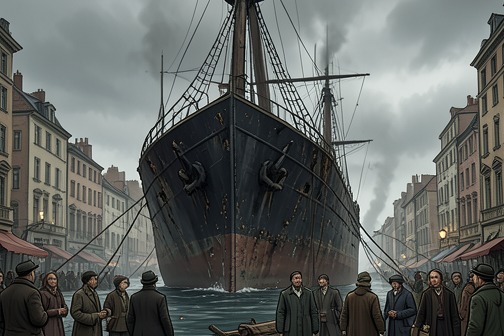
[Return of the Endeavor](entity:event-recall-event-endeavor-43f4eb092fa3) is the homecoming event that converts a disastrous far-eastern expedition into a public windfall and a private disturbance. The Endeavor reaches [Beacon](entity:location-recall-location-beacon-05545c91a64e) battered and tattered, carrying immense wealth in gold, but its return also leaves behind a vanished inquisitor, missing underworld rulers, unexplained deaths, and a city whose ordinary gossip cannot quite contain what has happened. The event therefore functions as both a material success and an obscured supernatural rupture: civilization receives the expedition’s wealth while failing, or choosing not, to recognize the violence embedded in its arrival.
## Return to Beacon
The immediate setting is Beacon and the lands of the [Illuminated King](entity:character-recall-character-illuminated-king-657c25addf69) at the turning of the season. The population has just witnessed an apparition, but the east has already trained them to absorb extraordinary events without sustained alarm. Immense [Glacilium](entity:creature-recall-creature-glacilium-fb0796ff3e3c) have previously brought unseasonable cold before departing, so even an apparition can be nearly forgotten when the Endeavor finally limps into port. The ship’s damaged condition identifies the return as costly rather than triumphant; it survives, but only in a state requiring substantial repair.
The returning party attracts less attention than the cargo. A lone Inquisition member and an odd trio of women disembark as socially unremarkable passengers, while the quantity of raw gold moving through customs makes many of the airmen minor celebrities. The contrast is decisive: the expedition’s human and political consequences remain obscure, whereas its extractable wealth is immediately legible to officials, opportunists, and the public. The return thus restores the expedition to the economic circuits of Beacon before it restores it to any official account of what occurred in the east.
## Wealth, Labor, and Material Aftermath
The gold’s public impact depends on a long chain of preparation and labor. Before departure, [Jonathan Heights](entity:character-recall-character-jonathan-heights-d9ccad9c719b) arranged for supplies to be shipped by train to [Danby’s Point](entity:location-recall-location-danby-s-point-89a41017e4ad), more than a hundred miles from Beacon, so that the Endeavor could travel there quickly without being fully loaded. At the eastern terminus, the expedition assembled a portable luminiferous terrestrite distillation apparatus, a lifting-gas separator, water siphons and filters, portable searchlights, crew-served zint guns, food, water, spare parts, clothing, bedding, and other necessities. The homecoming wealth therefore emerges from an expedition organized as a logistical enterprise, not from a single miraculous discovery detached from transport, equipment, and human effort.
The same expedition repeatedly treats value as something gathered, exchanged, carried, and converted. Jonathan advises the crew that raw metal stock is the best barter in the [Verdant Expanse](entity:location-recall-location-verdant-expanse-01f0675c6588), bringing rolled steel rods himself. He later orders a golden apparatus trimmed and divided among the men, agreeing to carry the main trunk if necessary because the find will improve the crew’s attitude. [Eleanor McAvey](entity:character-recall-character-eleanor-mcavey-56495d17d879) attacks the mass with a metal chisel, while other airmen use crowbars, pliers, and engineers’ hammers; the golden structure is dissected into portable pieces, with flashes of silver appearing among the fragments. By the time the Endeavor returns, the gold is no longer merely an eastern marvel. It has become wages, customs traffic, repair capital, retirement money, and a source of predatory interest.
The ship itself is repaired with the proceeds. [Captain Montgomery](entity:character-recall-character-captain-montgomery-85ba416f8403) spends a breathtaking sum, though only a fraction of the total, on the Endeavor’s restoration. Workers find the ship’s spine and envelope strangely familiar to the touch, while the ship’s cats watch them with uncanny intelligence, but these signs are dismissed as part of the oddness associated with explorers and voyages into the dark. The repair process consequently places the inexplicable inside an ordinary industrial frame: laborers handle the damaged vessel, money pays for reconstruction, and official knowledge neutralizes what it cannot comfortably explain.
## Disappearance and Bloodshed
The most conspicuous political consequence concerns the young inquisitor who returns with the expedition. He disappears into Beacon’s tower, and thereafter those who regularly see the Illuminated King remark that the ruler’s light appears brighter and his strength greater. Public speculation divides between the possibility that the inquisitor has been imprisoned or hospitalized somewhere deep within the tower and the darker suggestion that the Illuminated King has consumed him to strengthen his own monstrous life. The latter rumor is suppressed as slander by the Inquisition, but the absence itself remains undeniable.
The return also coincides with a quieter assault on the Reflected Council, the shadowy figures who rule Beacon’s underworld. Certain Council members vanish in the weeks and months after the Endeavor’s arrival. The only remains discovered are copious quantities of blood and a small discarded husk resembling an exotic fruit. No culprit is established, despite investigations by driven and bloodthirsty professionals. Those investigators themselves frequently disappear, leaving the criminal world temporarily less violent because some of its most feared enforcers have been removed.
The pattern creates a double concealment. The disappearance of the inquisitor is absorbed into rumors about the tower and the Illuminated King, while the destruction of the Reflected Council is treated as an unsolved criminal matter. Neither consequence is publicly connected to the Endeavor in a definitive manner. Yet their timing makes the homecoming a threshold between the expedition’s eastern encounters and a new, unacknowledged violence inside Beacon itself.
## The [Winter of Blood](entity:expression-recall-expression-winter-of-blood-d40bffbf7ef6)
The combined incidents lead some observers to name the period after the Endeavor’s return the Winter of Blood. Others call it the Winter of the Shadow, a label greeted with some mockery. Both names register the same contradiction: Beacon experiences more excitement than usual, but not enough visible disruption to justify an official crisis. The city’s political order, criminal networks, customs offices, and public routines continue, allowing extraordinary deaths to become rumor rather than history.
The winter’s violence is also distributed unevenly. The underworld loses influential enforcers; investigators vanish; wealthy airmen become targets for thieves and brigands; and the victorious crew acquires the means to resist those attacks. Nearly every airman of the Endeavor becomes rich, and many retire from the profession with greater or lesser success. A brawny airman and a wiry one jointly use their proceeds to purchase an airship, turning the expedition’s gains into renewed access to exploration and transport rather than simple consumption.
Predation follows wealth, but it does not reliably succeed. Veteran airmen prove difficult targets, and several would-be thieves disappear, leaving behind only occasional scorched shadows. These retaliatory absences are scarcely mourned and rarely become public knowledge. The Winter of Blood therefore describes not one announced massacre but an accumulation of violent corrections beneath the surface of prosperity: wealth creates targets, the targets resist, and the city registers the results as gossip.
## Significance and Continuation
Return of the Endeavor reverses the expected meaning of an expedition’s homecoming. The crew does bring back an elixir of sorts—gold enough to repair the ship, enrich the airmen, and alter the fortunes of Beacon—but the knowledge and power associated with the east do not return in a form the city can safely integrate. The apparition is forgotten, [Antomine](entity:character-recall-character-antomine-c73da0eb5297)’s fate is obscured, the Reflected Council is quietly reduced, and the material treasure becomes the dominant public story.
The event also exposes the limits of Beacon’s categories of civilization. At Danby’s Point, human construction meets the architecture and peoples of the dark beneath the pressure of trade, with the Inquisition simultaneously strongest and weakest at the boundary. The expedition carries that unstable frontier home: its cargo enters customs, its ship enters repair, and its violence enters rumor. The city’s apparent continuity is maintained by treating each disturbance as isolated, even though the timing of the disturbances binds them to the return.
The aftermath does not end the expeditionary cycle. By the time news spreads that Captain Montgomery is outfitting the Endeavor again, the next voyage attracts no more attention than any other minor undertaking. [Eleanor](entity:character-recall-character-eleanor-f86629a4f595) remarks that this is a less auspicious departure, while [Montgomery](entity:character-recall-character-montgomery-3d1e676073f0) replies that, considering what happened last time, he is content with that. [Sarah](entity:character-recall-character-sarah-7c634cfe73af) and [Marie](entity:character-recall-character-marie-38740b047e25) stand behind Eleanor with [Dreyfus](entity:character-recall-character-dreyfus-97bd3b9ac865) and [Penelope](entity:character-recall-character-penelope-82d0d91517fc) draped over their shoulders; they no longer present themselves as maids, yet remain within Eleanor’s orbit. Most of the bridge crew are new but experienced, and Montgomery’s reason for going out again is left uncertain, perhaps mere insatiable wanderlust. The Endeavor’s return thus becomes not a conclusion but a temporary concealment, after which the machinery of departure begins again.
Event 43
Beacon的巨人幻影
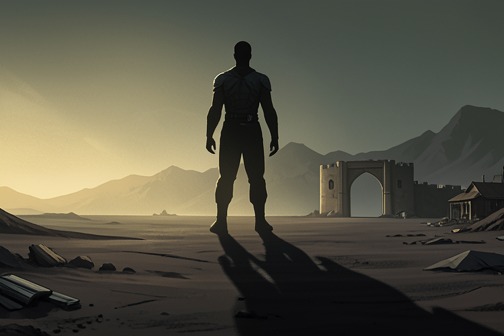
The [Beacon](entity:location-recall-location-beacon-05545c91a64e) Giant Apparition is the strange public aftermath of [Jonathan Heights](entity:character-recall-character-jonathan-heights-d9ccad9c719b)’s entry into [Bright Defile](entity:location-recall-location-bright-defile-18d73f1df73b), when his passage into [Sunlight](entity:state-recall-state-sunlight-28d75af2a2d6) produces a flash and casts his immense silhouette from the far east to Beacon. The apparition gives visible, almost cosmic form to Jonathan’s completed separation from the world of darkness and makes his private achievement briefly legible to the civilization that had dismissed Sunlight as a myth.
## Circumstances and Threshold
The event follows Jonathan’s approach to Bright Defile through a journey defined by unstable borders. At [Danby’s Point](entity:location-recall-location-danby-s-point-89a41017e4ad), the illuminated human settlement stands beside alien territories, with a great zint-lit gate separating human construction from darker forces even as each side visibly reshapes the other. Farther east, the Endeavor encounters an impossible outpost of human infrastructure around a terrestrite vein, then moves through destinations whose laws and physical conditions resist ordinary travel. [Terminus](entity:location-recall-location-terminus-9fe35f8062b8) presents a temptation Jonathan judges malign; [Ukaresh](entity:location-recall-location-ukaresh-085787e2ce38) recognizes few laws beyond power; and the [Dead Battle](entity:location-recall-location-dead-battle-30b0e0946d83) gradually reveals itself as more than a spectacle when its perspective shifts and immense human-shaped figures emerge from the scene. These places establish the eastern expedition as a passage through thresholds where geography, knowledge, and identity are repeatedly altered.
Jonathan’s goal remains the recovery of Sunlight. He has claimed to have seen it before, although the human world treats that claim as a laughable myth, and he joins the expedition with a single-minded refusal to be diverted. His determination also separates him from the institutions traveling with him. The authority of the [Illuminated King](entity:character-recall-character-illuminated-king-657c25addf69) and the Reflected Council frames the expedition, while [Antomine](entity:character-recall-character-antomine-c73da0eb5297) insists that civilization requires confronting threats rather than ignoring them; Jonathan rejects the demand to cleanse [Angkor Leng](entity:location-recall-location-angkor-leng-dfd69cfaf06c) because the Endeavor lacks the time and resources and because the journey to Sunlight takes precedence. The eventual apparition therefore carries both spiritual and political stakes: it marks Jonathan’s success, but it also confronts the civilization whose agents tried to regulate the path toward it.
## The Apparition
At the end of the passage through Bright Defile, Jonathan reaches a final barrier that is simultaneously a gulf in the land and a barrier of understanding. In a country defined by revelation, the darkness before him has no hidden meaning; the only remaining obstacle is what he must surrender in order to cross. His empty estate, his ties to his chauffeur and housekeeper, the death of [Tiuni](entity:character-recall-character-tiuni-517876ba3162), the destruction of [Tor Ilek](entity:location-recall-location-tor-ilek-da8c883970ba), the books he cast from the Endeavor, the resting of a god, the sacrifice of Angkor Leng, his lost friendship with [Eleanor McAvey](entity:character-recall-character-eleanor-mcavey-56495d17d879), his banishment from Ukaresh, and his rejection of the Players and the Game all become steps in the crossing. Finally, he gives up his cane, the last object associated with the self he has carried through the expedition.
Once Jonathan crosses, Bright Defile opens into a green country beneath white clouds and a vast blue sky. Every leaf, stone, blade of grass, and drop of river water contains the secrets of time and space, while the Sun is described as older than worlds and older than time. The lands Jonathan has traversed shrink behind him into a dim mote between sunbeams. He feels the Sun’s warmth and the freedom of truth, and smiles; the response is not a speech or a claim of authority but a moment of arrival after the successive losses required by the final barrier.
Then, in the lands westward from Bright Defile, there is a flash of light and the silhouette of a great man. Jonathan’s shadow stretches from the furthest east to Beacon, where the Illuminated King stands in his tower. For an instant Jonathan appears as a titan capable of bestriding the world, before the image disappears. The apparition is thus both an extension of his physical passage and an alteration of scale: the explorer who left human civilization as a controversial individual becomes, for one moment, a figure large enough to span the world’s known horizon.
## Witnesses and Immediate Aftermath
The people of Beacon and the lands governed by the Illuminated King respond with considerable excitement when the apparition appears at the turning of the season. Their reaction matters because the event is not confined to Jonathan’s private experience. The eastern journey, normally mediated through maps, reports, trade, and official institutions, suddenly announces itself through a phenomenon visible across the western human lands. The shadow makes the far east impossible to treat as merely distant territory or a collection of rumors.
Yet the apparition does not remain the dominant public story. The inhabitants of Beacon are accustomed to strange visitations from the east, including the immense [Glacilium](entity:creature-recall-creature-glacilium-fb0796ff3e3c) that previously brought unseasonable cold before departing. Familiarity with eastern impossibilities allows the excitement to fade, and the visitor is nearly forgotten by the time the Endeavor limps into port. The damaged airship provides the material counterimage to Jonathan’s moment of transcendence: the shadow is immense and fleeting, while the returning vessel is battered, tattered, and physically burdened by the expedition it has survived.
The ship’s arrival produces another reversal of attention. The gold carried by the Endeavor generates far more interest than the lone inquisitor or the three women who disembark. [Captain Montgomery](entity:character-recall-character-captain-montgomery-85ba416f8403) spends part of the great windfall on repairing the ship, whose spine and envelope seem strangely familiar to the laborers and whose cats watch them with uncanny intelligence. The public therefore translates the expedition into wealth and eccentricity rather than understanding the apparition as evidence of Jonathan’s transformation. The official presence of an Inquisition member makes the public assume that nothing too untoward could have happened, even as the ship itself retains signs that the journey changed it.
## Meaning and Narrative Function
The apparition converts the novel’s recurring opposition between darkness and light into an image of contested visibility. Beacon’s civilization defines itself through illumination, and the Illuminated King’s authority depends on the belief that human order contains the darkness. Jonathan’s shadow reverses that arrangement. It originates beyond the eastern frontier, crosses the entire interval between the far east and Beacon, and briefly falls over the domain of the ruler associated with light. The image does not simply proclaim Jonathan as a new sovereign; it exposes the limits of a civilization that has treated Sunlight as impossible while depending on controlled forms of illumination.
The event also completes a movement from exploration to revelation. At Danby’s Point, human presence is described as an ongoing struggle against alien architecture and nonhuman inhabitants, with trade forcing contact even as the Inquisition attempts to restrain it. Jonathan’s maps, negotiations, and exchanges with Tiuni participate in that border system, while the expedition’s need to replenish supplies reveals the practical fragility beneath the language of civilization. By the time he reaches Bright Defile, however, knowledge is no longer merely information gathered, traded, or protected by institutions. It becomes an environment in which every part of the world writes its secrets openly. His shadow over Beacon is the outward sign that this form of knowledge has escaped the structures that sought to contain it.
The apparition is deliberately temporary. It appears, becomes an object of excitement, and vanishes; the returning expedition is then reduced to cargo, repairs, and strange but dismissible habits. That contrast preserves the event’s ambiguity. The narrative confirms that Jonathan has entered a realm of Sunlight and that his presence can affect the western world, but it does not give Beacon a stable doctrine for interpreting what has happened. The giant is neither incorporated into the official order nor allowed to remain as a permanent miracle. It is a fleeting image of a truth that the human world can witness without yet possessing the means to understand it.